
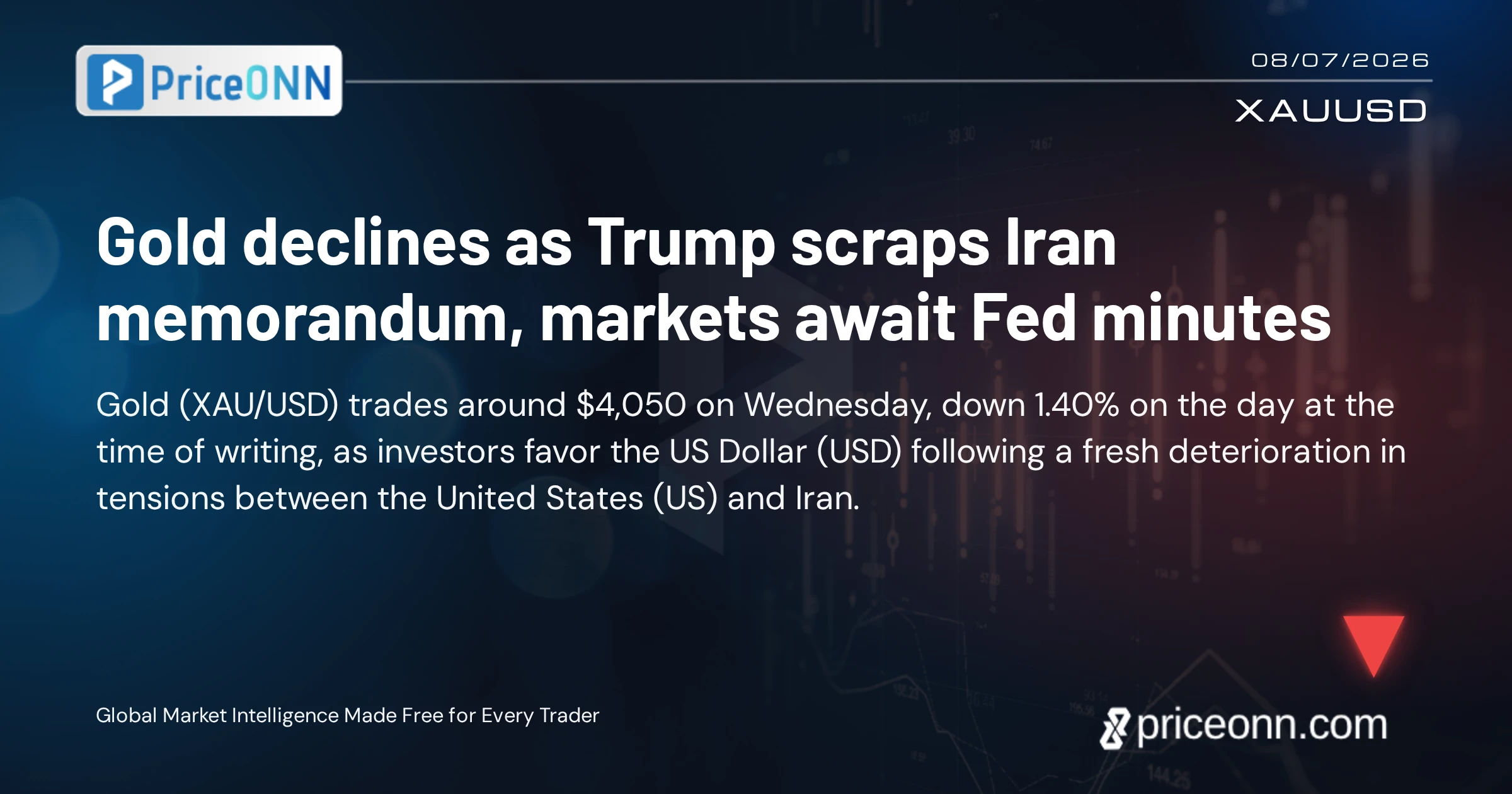
Gold declines as Trump scraps Iran memorandum, markets await Fed minutes
 PriceONN Editorial Desk
Multi-source verification
PriceONN Editorial Desk
Multi-source verification
Global Tensions Drive Flight to Greenback
Wednesday saw a notable downturn in the price of gold, with the precious metal falling approximately 1.40% to hover around the $4,050 mark. This decline is largely attributed to a renewed bout of geopolitical uncertainty stemming from the United States and Iran. As tensions between the two nations escalated, investors demonstrated a clear preference for perceived safety, channeling capital into the US Dollar. This strategic reallocation underscores gold's dual nature: a traditional safe haven that can be overshadowed by immediate currency strength during periods of acute geopolitical stress.
The precious metal's historical role as a store of value and a medium of exchange has cemented its place in global finance. Beyond its aesthetic appeal and use in adornments, gold is widely recognized as a premier safe-haven asset, offering a degree of security during volatile economic and political climates. It also functions as a hedge against inflation and currency devaluation, its value independent of any single government or issuer. This inherent stability makes it an attractive diversification tool for central banks.
Central banks, indeed, are the largest custodians of gold. In their ongoing efforts to fortify their respective currencies, particularly during turbulent phases, these institutions frequently diversify their reserves by acquiring gold. Such actions are intended to bolster confidence in the underlying economy and the currency's strength. Substantial gold holdings can serve as a critical indicator of a nation's financial solvency and stability, providing a tangible asset backing their financial system.
Recent data from the World Gold Council reveals a massive surge in central bank acquisitions. In 2022, these institutions added a staggering 1,136 tonnes of gold to their reserves, a quantity valued at approximately $70 billion. This represents the highest annual purchase volume recorded since data collection began. Emerging economies, notably China, India, and Turkey, are at the forefront of this accelerated accumulation, rapidly expanding their gold reserves.
Gold's price dynamics are intricately linked with major reserve and safe-haven assets like the US Dollar and US Treasuries. A general pattern observed is an inverse correlation; when the dollar weakens, gold often strengthens, facilitating asset diversification for investors and central banks navigating uncertain times. Conversely, gold typically shows a negative correlation with riskier assets. A buoyant stock market often leads to a softening in gold prices, whereas significant downturns in riskier markets tend to boost the appeal of the yellow metal.
The Bigger Picture
The interplay of geopolitical events, central bank policies, and currency movements creates a complex environment for gold traders. The recent escalation in US-Iran relations serves as a stark reminder of how quickly safe-haven flows can pivot. While gold is often the go-to asset during global instability, the immediate strength of the US Dollar, driven by heightened risk aversion, can temporarily suppress its gains. Investors are closely watching the Federal Reserve's minutes, which could provide further clues on the future path of interest rates, a critical factor for a yield-less asset like gold.
The current situation presents several key considerations for market participants. Firstly, the heightened geopolitical risk premium associated with US-Iran tensions is likely to keep a floor under gold prices, even with dollar strength. Secondly, the anticipation surrounding the Federal Reserve's meeting minutes introduces an element of caution. Any indication of a more hawkish stance could weigh on gold, while dovish undertones might offer support. Traders will be monitoring key technical levels around the $4,050 mark, with a decisive break below potentially opening the door for further declines, while sustained holding could signal resilience.
This development also has ripple effects across related markets. The strength of the US Dollar Index (DXY) is a direct counterpoint to gold's performance. Furthermore, a cautious mood in global markets could negatively impact equity indices like the S&P 500, while government bond yields might see volatility depending on the Fed's outlook. The Canadian Dollar (CAD) could also be indirectly affected through shifts in global risk sentiment and commodity prices, although its correlation is less direct than that of the USD.
Track markets in real-time
Empower your investment decisions with AI-powered analysis, technical indicators and real-time price data.
Join Our Telegram Channel
Get breaking market news, AI analysis and trading signals delivered instantly to your Telegram.
Join Channel PriceONN News
TL;DR: Gold and Silver tumbled as markets returned to the oil-rates relationship that governed Q2, with Brent above $100 and 10-year Treasury yields above 4.7% restoring pressure on the metals - leaving their next move hostage to Trump’s binary decision on Iran. Why This Matters Gold and Silver tumbled as markets returned to trading precious […] The post Gold and Silver Tumble as Oil Link Returns; Trump’s Looming Decision on Iran Adds Binary Risk appeared first on ActionForex.
PriceONN News
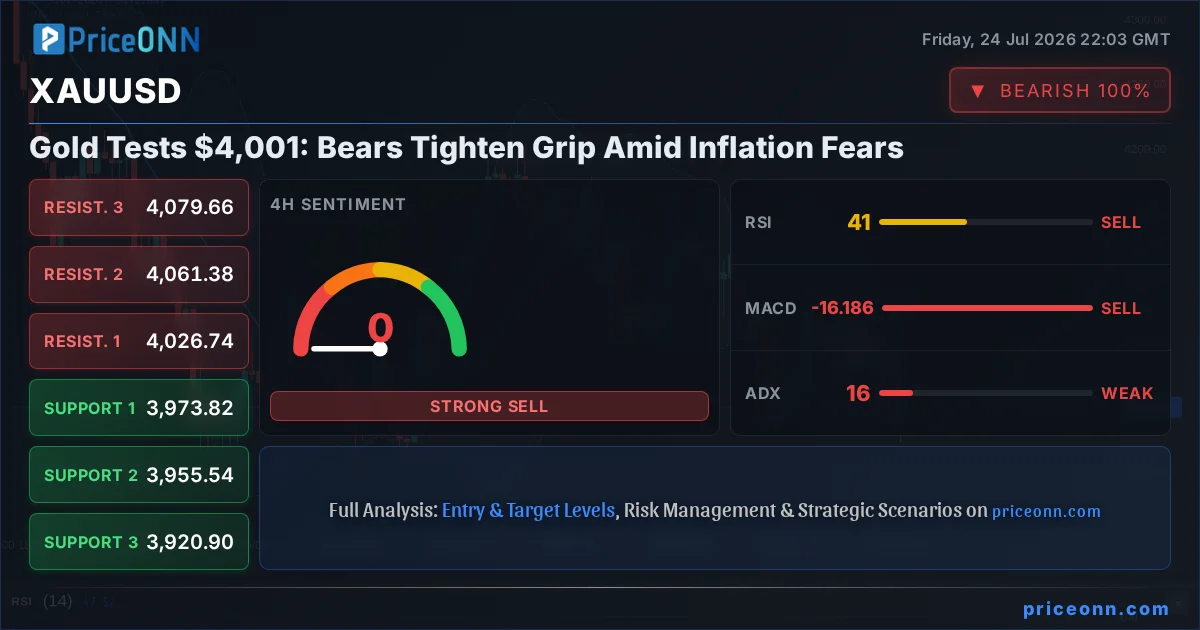
The short‑term Elliott Wave outlook in Gold (XAUUSD) indicates that the rally to $4204 marked the completion of wave ((B)), after which the metal turned lower in wave ((C)). The internal subdivision of wave ((C)) is unfolding as a five‑wave structure. Within this sequence, wave (1) ended at $3983.2. The subsequent rally in wave (2) […] The post Elliott Wave Outlook: Gold (Xauusd) Rally Rejected, Downside Potential Remains appeared first on ActionForex.
PriceONN News
EUR/USD rose to 1.1429 on Thursday, with the US dollar continuing its moderate decline from the previous session. The market is assessing rising inflation risks driven by elevated energy prices against a backdrop of weakening economic data, while seeking further signals on Federal Reserve policy. At next week’s meeting, the regulator is expected to keep […] The post EUR/USD Recovers as Dollar Weakens appeared first on ActionForex.
PriceONN News
Key insights from the week that was. The June Labour Force Survey offered both noise and signal. Employment surprised materially to the upside, rising 76.3k in the month. However, the gain was matched by a sizeable lift in labour supply, the participation rate bouncing 0.3ppts to 67.0%, a 13-month high. The ABS noted in the […] The post Cliff Notes: Markets on Edge appeared first on ActionForex.
PriceONN News
EURUSD is rising on expectations of ‘hawkish’ rhetoric from the ECB. The rally in Brent crude and Treasury yields is not helping the US dollar. The US dollar has retreated, despite rising oil prices and the resulting increase in US Treasury yields. Houthi attacks on tankers in the Red Sea have heightened geopolitical risks and […] The post Euro Focuses on the ECB appeared first on ActionForex.
PriceONN News
TL;DR: Brent oil has surged from to above $97 on Red Sea attacks and Strait of Hormuz escalation, bringing the psychological $100 level into view. While broader markets (stocks, bonds, currencies) have treated the move as a geopolitical risk premium, a decisive break above $100 could signal investors are pricing genuine supply disruption-a narrative shift that […] The post Red Sea Attacks Push Brent Oil Toward $100. Will Markets Finally React? appeared first on ActionForex.
PriceONN News
We expect the Federal Reserve to remain on hold in the July meeting, in line with consensus. Markets price in 20-25% probability for a hike. Without new projections or forward guidance from Warsh, the focus will be on the vote split. We think the most likely outcome is 2-4 votes in favour of a hike. […] The post US – Fed Preview: A Divided Hold appeared first on ActionForex.
PriceONN News
Another month of recovery is in the cards for Canada’s economy next Friday where we expect to see a 0.2% increase in GDP data for May (more details below), but the outlook is once again clouded by the latest bout of U.S. tariff threats that suggest the path ahead could be bumpier. Just how bumpy […] The post Six Takeaways for Canada from Latest U.S. Tariff Threats; GDP Likely Rose Again in May appeared first on ActionForex.
PriceONN News
US business activity accelerated at the start of the third quarter, with S&P Global’s Flash Composite PMI Output Index rising from 51.9 to 53.6 in July, its highest level in eight months. The improvement was driven by the services sector, where the Business Activity Index climbed from 51.2 to 53.6, also an eight-month high. Manufacturing, […] The post US PMI Hits Eight-Month High,Yet Rising Costs and Supply Delays Raise Caution appeared first on ActionForex.
PriceONN News
The Brent crude rally is a bigger ‘bearish’ factor for EURUSD than the ECB. The Fed may spring a surprise as early as July. The US dollar paid no heed to the ECB’s hawkish rhetoric and continued its advance against major global currencies, including the euro. The European Central Bank left its deposit rate at […] The post Dollar: Oil Leaves the Fed with No Choice appeared first on ActionForex.
PriceONN News
USD/JPY soared to 163.81 on Friday, marking a new 40-year high. Repeated warnings of possible currency intervention have so far failed to halt the yen’s decline amid a broad strengthening of the US dollar. The market paid little attention to the Japanese Finance Minister’s statement that authorities are ready to take decisive action. Reports that […] The post USD/JPY Breaks Records: Nothing Slows the Yen’s Decline appeared first on ActionForex.
PriceONN News
UK retail sales volumes jumped 1.0% mom in June, far exceeding expectations for a -0.3% mom decline, following an unrevised 1.2% mom increase in May. The stronger-than-expected performance points to resilient consumer demand despite elevated borrowing costs and persistent cost-of-living pressures. Retailers credited sales promotions and warm weather for boosting spending, particularly at online and […] The post UK Retail Sales Surge 1.0% mom as Online Spending Leads Broad-Based June Rebound...