
Gold Holds Tentative Support at $4,500 Amid Liquidation Exhaustion

Gold has found a tentative foothold near the $4,500 level, marking a pause in its brutal and disorderly decline witnessed yesterday. Market data suggests this sharp downturn was primarily triggered by a significant liquidity crunch, where trading mechanics, rather than fundamental economic drivers, dictated price movements.
Market Context
This week's pronouncements from major central banks, including the Federal Reserve, European Central Bank, Bank of England, and even the Bank of Japan, have indeed adopted a hawkish tone, initially placing pressure on the precious metal. However, the sheer speed and magnitude of the subsequent price collapse point towards a market dislocation, a scenario where forced selling overwhelmed underlying value. The decisive breach below the psychologically significant $5,000 level proved to be a critical tipping point. This break unleashed a torrent of margin calls across highly leveraged positions, initiating a cascade of forced selling that rapidly drove prices lower. This pattern is a classic indicator of liquidity stress, where the mechanics of trading can override fundamental considerations.
Adding to the pressure, substantial outflows were observed from major gold-backed exchange-traded funds. Significant redemptions from prominent funds underscore the aggressive unwinding of institutional positions. Intriguingly, this sharp selloff occurred despite a softening U.S. Dollar, further reinforcing the narrative that liquidity constraints, rather than currency headwinds, were the primary driver of the dramatic price action.
Analysis & Drivers
The primary catalyst for gold's recent sharp decline appears to be a liquidity squeeze, exacerbated by hawkish central bank rhetoric. When gold decisively broke below the $5,000 psychological barrier, it triggered a wave of margin calls for leveraged traders. This forced liquidation created a snowball effect, pushing prices down rapidly and leading to further selling as more positions were automatically closed out. This deleveraging process is often swift and brutal, temporarily detaching prices from their fundamental underpinnings.
The significant outflows from gold ETFs, such as GLD, provide concrete evidence of institutional capitulation. Investors were seen aggressively unwinding their positions, suggesting a flight to safety or a need to meet margin requirements elsewhere. The fact that this occurred while the U.S. Dollar weakened is a key indicator. Typically, a weaker dollar supports gold prices. Its failure to do so in this instance strongly suggests that the selling pressure was driven by internal market mechanics – specifically, a lack of available liquidity to absorb the selling – rather than external currency market forces.
Trader Implications
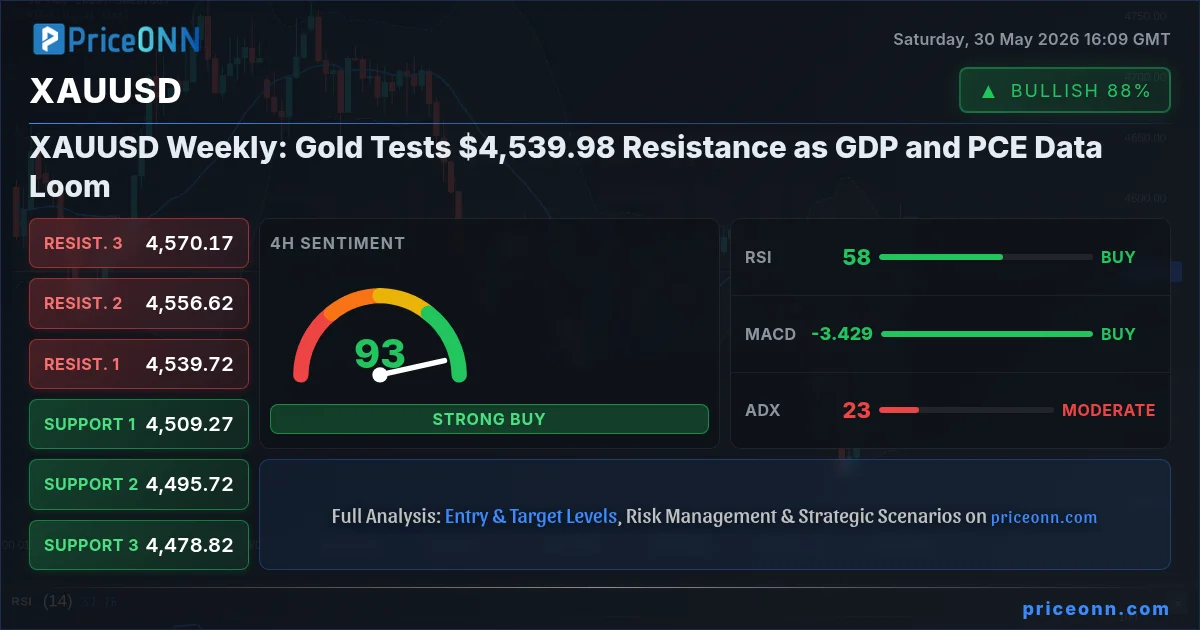
With the most intense phase of forced selling likely behind us, traders should monitor the $4,500 level closely. This area is now establishing itself as a critical support zone. A sustained hold above this level could signal that the market has absorbed the bulk of the liquidation and may begin to stabilize. Conversely, a decisive break below $4,500 could re-open the door to further downside, with analysts noting $4,000 as a potential target if selling pressure reignites.
Key factors to watch include:
- ETF Flows: Continued outflows from gold ETFs would signal ongoing institutional deleveraging, while inflows could indicate a return of confidence.
- Liquidity Conditions: Market participants should keep an eye on broader market liquidity indicators. A general easing of liquidity would be a positive sign for risk assets like gold.
- Central Bank Communication: While hawkish rhetoric was a catalyst, any signs of central banks easing their tightening stance or acknowledging financial stability risks could provide a reprieve for gold.
For traders, the immediate implication is to watch for confirmation of support at $4,500. A bounce from this level could offer a short-term trading opportunity, targeting resistance levels around $4,700-$4,800. However, caution is advised, as the underlying liquidity issues may not be fully resolved. A breakdown below $4,500 would necessitate a reassessment, with potential for a move towards the $4,000 mark.
Outlook
The immediate outlook for gold hinges on its ability to consolidate above the $4,500 support. If this level holds, the market may see a period of stabilization as participants digest the recent volatility and reassess economic conditions. However, the underlying liquidity concerns and the lingering effects of hawkish central bank signals mean that upside potential may remain capped in the short term. The path towards the $4,000 target remains a possibility if the liquidity crunch re-emerges or if further negative catalysts appear. Upcoming economic data releases and central bank speeches will be crucial in shaping market sentiment.
Frequently Asked Questions
What caused the recent sharp decline in gold prices?
Gold experienced a severe selloff primarily due to a liquidity crunch, which triggered forced selling among highly leveraged positions after prices broke below $5,000. Significant outflows from gold ETFs also contributed to the pressure.
Is the $4,500 level a reliable support for gold?
The $4,500 level is currently acting as a tentative support zone following the liquidation exhaustion. A sustained hold above this price point would indicate stabilization, but a break below could lead to further declines towards the $4,000 target.
What is the short-term outlook for gold prices?
The short-term outlook is dependent on gold holding the $4,500 support. If it holds, a period of consolidation or a modest bounce is possible. However, persistent liquidity issues or renewed hawkish central bank sentiment could pressure prices lower, with $4,000 remaining a potential downside target.
Track markets in real-time
Empower your investment decisions with AI-powered analysis, technical indicators and real-time price data.
Join Our Telegram Channel
Get breaking market news, AI analysis and trading signals delivered instantly to your Telegram.
Join Channel PriceONN News
Canada's labor market is showing signs of stabilization, with analysts predicting a dip in the unemployment rate to 6.8% in May, driven by an expected 25,000 new jobs. This follows a period of sluggish GDP growth and rising joblessness earlier in the year.
PriceONN News
USDJPY has returned to the area of previous interventions. The ECB is moving towards a rate hike in June. The US dollar retreated on Friday amid new record highs for stock indices and rumours of amendments to the US-Iran agreement. However, tit-for-tat exchanges between the adversaries pushed the dollar index back into the support zone […] The post Yen Braces for a New Storm appeared first on ActionForex.
PriceONN News
The US Dollar experienced a notable decline last week as markets priced in a potential diplomatic resolution to the US-Iran conflict, leading to a drop in oil prices and Treasury yields. This shift in sentiment suggests a move away from stagflation fears towards a more stable economic outlook.
PriceONN News
Markets are pricing in a potential de-escalation in the US-Iran conflict, leading to a significant drop in crude oil prices and a weakening US Dollar as diplomatic efforts appear to be gaining traction.
PriceONN News
Canada's economy showed signs of a slowdown in early 2026, but upcoming May jobs data is expected to reveal a modest uplift. Analysts anticipate the unemployment rate to fall to 6.8%.
PriceONN News
USD/CAD faces pressure as Canada's economy shows signs of stalling, with Q1 GDP contracting 0.1% and domestic demand weakening. This comes as trade negotiations and geopolitical shifts add layers of uncertainty.
PriceONN News
Canada's economy showed signs of life in early 2026, with analysts expecting a moderate job growth of around 25,000 positions and a potential dip in the unemployment rate to 6.8% for May.
PriceONN News
AUD/USD’s late break of 0.7183 resistance suggests that pullback from 0.7277 has already completed at 0.7076, after defending 55 D EMA. Initial bias is back on the upside this week for retesting 0.7277 high first. Firm break there will resume larger up trend. For now, risk will stay on the upside as long as 0.7076 […] The post AUD/USD Weekly Report appeared first on ActionForex.
PriceONN News
USD/CAD is showing signs of potential upward movement as Canada's economy grapples with a significant slowdown, marked by weak domestic demand and stalled investment, while trade negotiations loom large.
PriceONN News
USD/JPY is testing the critical 160 level as stalled US-Iran negotiations and hawkish Federal Reserve rhetoric fuel inflation concerns and a potential for further rate hikes. Traders are closely watching upcoming US Non-Farm Payrolls and Eurozone CPI data for direction.
PriceONN News
Canada's economy showed signs of weakness in early 2026, but upcoming May jobs data is expected to reveal a moderate uplift. Analysts anticipate job growth of around 25,000 positions and a potential dip in the unemployment rate to 6.8%.
PriceONN News
The USD/JPY pair is flirting with the 160 level as stalled US-Iran negotiations and hawkish Federal Reserve rhetoric fuel inflation concerns. Traders are closely watching upcoming US Non-Farm Payrolls and Eurozone CPI data.