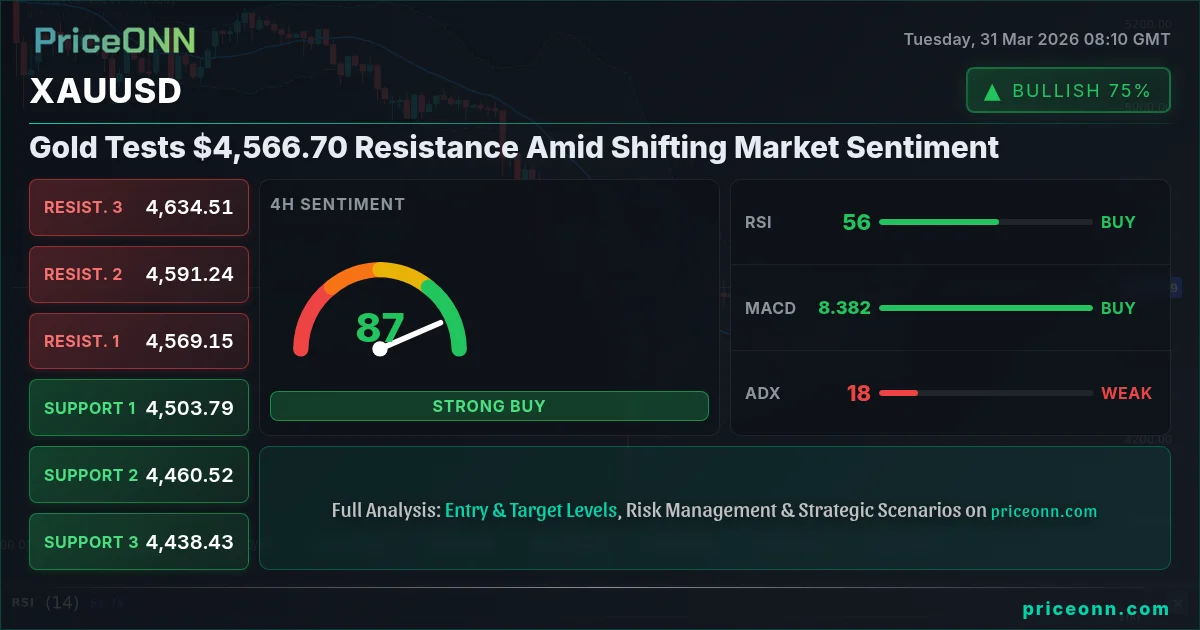
Gold hovers below $4,600 as traders weigh Mideast de-escalation hopes and interest rate outlook
Global Tensions Subside, Gold Faces Headwinds
The precious metal, often a barometer of geopolitical unease, finds itself treading water below the $4,600 mark this Tuesday. Hopes for a cooling of tensions in the Middle East are subtly diminishing its appeal as a premier safe-haven asset. This shift comes as traders begin to recalibrate their portfolios, factoring in a less volatile global outlook.
For centuries, gold has served humanity not just as adornment but as a bedrock of financial stability, functioning as both a store of value and a medium of exchange. Today, its historical significance as a hedge against inflation and currency devaluation remains paramount. Unlike fiat currencies, gold's intrinsic value is not tethered to any single government or issuing authority, making it a resilient choice in uncertain economic climates. This inherent stability is why central banks, the largest custodians of gold, actively incorporate it into their reserve strategies.
In 2022, a remarkable 1,136 tonnes of gold, valued at approximately $70 billion, flowed into central bank reserves, marking the most substantial annual accumulation on record. Institutions in burgeoning economies, notably China, India, and Turkey, are leading this charge, aggressively expanding their gold holdings. This diversification strategy aims to bolster the perceived strength of their economies and currencies, especially during periods of global financial turbulence. Substantial gold reserves can indeed act as a powerful signal of a nation's financial solvency and trustworthiness.
Market Interplay and Gold's Dynamics
Gold's price movements are intrinsically linked to a complex web of market forces. A well-documented inverse relationship exists between gold and key safe-haven assets like the US Dollar and US Treasuries. When the greenback weakens, gold typically strengthens, offering investors and central banks a vital avenue for diversifying their asset baskets during times of duress.
Furthermore, gold often exhibits a counter-trend correlation with riskier assets such as equities. A robust stock market rally can pressure gold prices downward, while significant sell-offs in the stock market tend to provide a tailwind for the yellow metal. The interplay of these factors creates a dynamic environment for gold traders.
The cost of money, represented by interest rates, also plays a critical role. As an asset that generates no yield, gold tends to perform better in an environment of lower interest rates. Conversely, rising interest rates increase the opportunity cost of holding gold, often leading to downward pressure on its price. However, the behavior of the US Dollar remains a dominant influence, given that gold is primarily priced in USD (XAU/USD). A strong dollar typically caps gold's upward potential, while a weaker dollar can unlock significant gains.
Reading Between the Lines
The current market narrative suggests a tug-of-war between geopolitical de-escalation hopes and the ongoing uncertainty surrounding the trajectory of major central bank monetary policies, particularly the US Federal Reserve. While the immediate threat of wider conflict in the Middle East may be receding, offering some relief to risk assets, the persistent inflation data and the Fed's stance on interest rates continue to cast a long shadow over the gold market.
Traders are closely watching key economic indicators, including inflation prints and employment figures, for clues about the Fed's next move. Any indication of a more hawkish stance could weigh on gold, while signs of a potential pivot or a pause in rate hikes would likely be supportive. The $4,600 level is proving to be a significant psychological and technical barrier. A sustained break below this point could signal further downside, while a firm hold above it might suggest underlying strength despite current headwinds.
The broader market sentiment also remains a crucial factor. A general increase in risk appetite could lead investors to shift capital away from safe havens like gold and into growth-oriented assets. Conversely, any renewed signs of economic fragility or unexpected geopolitical flare-ups could quickly reignite demand for gold, pushing its price back towards recent highs. The interplay between these macro-economic forces and geopolitical developments will dictate gold's path in the near term.
Market Ripple Effects
The current price action in gold has implications for several related markets. The US Dollar Index (DXY), which typically moves inversely to gold, will be a key indicator to monitor. A strengthening DXY could exert further downward pressure on XAU/USD. Conversely, any weakness in the dollar could provide a floor for gold prices. Equity markets, particularly those sensitive to interest rate expectations, may also react. A scenario where gold prices fall due to a stronger dollar and higher rates could signal a risk-on environment, potentially benefiting sectors like technology. However, if gold declines on receding geopolitical risk alone, it might not necessarily translate to a broad equity rally. Investors may also look at other precious metals like silver, which often exhibits higher volatility than gold and could present its own set of opportunities or risks depending on the prevailing market conditions. The performance of emerging market currencies, often influenced by central bank gold buying, could also see subtle shifts as global reserve trends evolve.
Track markets in real-time
Empower your investment decisions with AI-powered analysis, technical indicators and real-time price data.
Join Our Telegram Channel
Get breaking market news, AI analysis and trading signals delivered instantly to your Telegram.
Join Channel