Gold Price Forecast: XAU/USD declines sharply to near $4,400 as Middle East fears revive
Gold's Historical Anchor Faces Shifting Sands
For millennia, gold has served as a bedrock of financial stability, functioning as a universally recognized store of value and a reliable medium of exchange. Beyond its luster and adornment in jewelry, the precious metal is now predominantly viewed through the lens of a safe-haven asset. This designation implies that gold is often perceived as a prudent investment choice during periods of heightened market uncertainty and economic turbulence. Its appeal is further amplified by its role as a hedge against the erosion of purchasing power due to inflation and the devaluation of fiat currencies. Unlike government-backed tender, gold's value is not intrinsically tied to the policies or solvency of any single issuer or nation.
Central banks, historically the largest custodians of gold, frequently integrate the yellow metal into their reserve strategies. Their objective is often to bolster the perceived strength of their domestic economies and currencies, especially when navigating volatile global financial conditions. Substantial gold holdings can act as a powerful signal of a country's financial resilience and creditworthiness, fostering international confidence.
The scale of central bank accumulation is striking. In 2022 alone, these institutions collectively acquired an unprecedented 1,136 tonnes of gold, a move valued at roughly $70 billion, according to data compiled by the World Gold Council. This marked the highest annual purchase volume since record-keeping commenced. Emerging economies, notably China, India, and Turkey, have been particularly aggressive in expanding their gold reserves, signaling a strategic shift in global reserve management.
Interplay with Global Financial Instruments
Gold exhibits a distinct inverse correlation with key global financial instruments, most notably the US Dollar and US Treasuries. Both the dollar and treasury bonds are themselves considered major reserve assets and safe havens. When the value of the US Dollar weakens, gold prices often show upward momentum. This dynamic allows both individual investors and central banks a valuable avenue for diversifying their portfolios during uncertain times.
Furthermore, gold's trajectory frequently moves in opposition to riskier asset classes. A robust rally in equity markets, for instance, typically exerts downward pressure on gold prices. Conversely, significant sell-offs in riskier market segments often lead to increased demand for the precious metal, underscoring its role as a counter-cyclical asset. The price of gold is influenced by a complex web of factors.
Events such as geopolitical instability or widespread fears of a severe economic downturn can trigger rapid escalations in gold prices, directly leveraging its status as a secure asset. As an asset that does not generate yield, gold typically performs better in an environment of declining interest rates. Conversely, a rise in the cost of borrowing money, reflected in higher interest rates, generally weighs on the performance of the yellow metal.
However, the most dominant driver for gold's price fluctuations often remains the behavior of the US Dollar, given that gold is predominantly priced in dollar terms (XAU/USD). A strengthening dollar tends to exert a constraining influence on gold prices, while a weakening dollar typically provides an upward impetus for the precious metal.
Market Ripple Effects
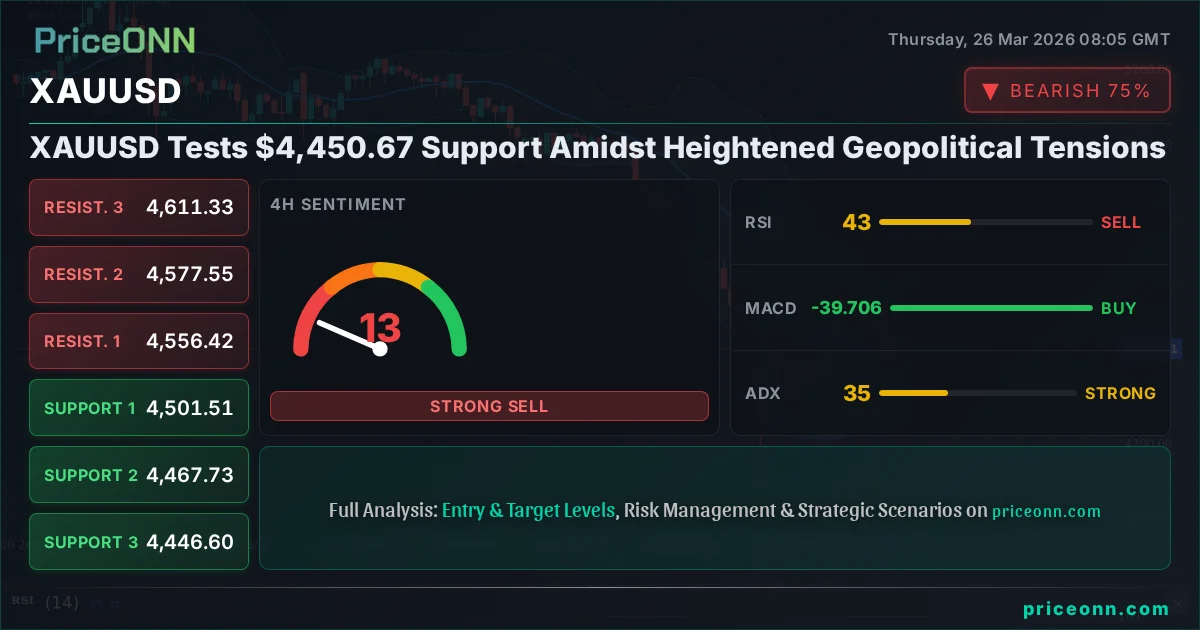
The recent sharp decline in gold prices, falling below the significant $4,400 mark, signals a potential shift in market sentiment away from immediate safe-haven demand. This move suggests that geopolitical anxieties, which had previously propelled gold higher, may be easing, at least temporarily. For traders and investors, this presents a critical juncture to reassess portfolio allocations.
The impact of this gold price movement extends beyond the precious metal itself. A weaker gold price can often be correlated with a stronger US Dollar Index (DXY), as the two assets typically move inversely. Investors might also see a rotation out of safe-haven assets like gold and into riskier assets, potentially benefiting equity markets, particularly sectors sensitive to economic growth. Additionally, a dip in gold could influence currencies of major gold-producing nations, such as the Australian Dollar (AUD) and the Canadian Dollar (CAD), which often see their fortunes tied to commodity prices.
Traders should closely monitor key support and resistance levels for XAU/USD. A sustained break below $4,400 could signal further downside, potentially targeting levels around $4,350 or even lower if broader market sentiment shifts decisively towards risk-on. Conversely, any resurgence in geopolitical fears or a significant weakening of the US Dollar could quickly reignite demand for gold, offering opportunities for short-term bounces. The current environment calls for cautious positioning, with an emphasis on risk management and vigilance regarding macroeconomic data releases and geopolitical developments.
Track markets in real-time
Empower your investment decisions with AI-powered analysis, technical indicators and real-time price data.
Join Our Telegram Channel
Get breaking market news, AI analysis and trading signals delivered instantly to your Telegram.
Join Channel