
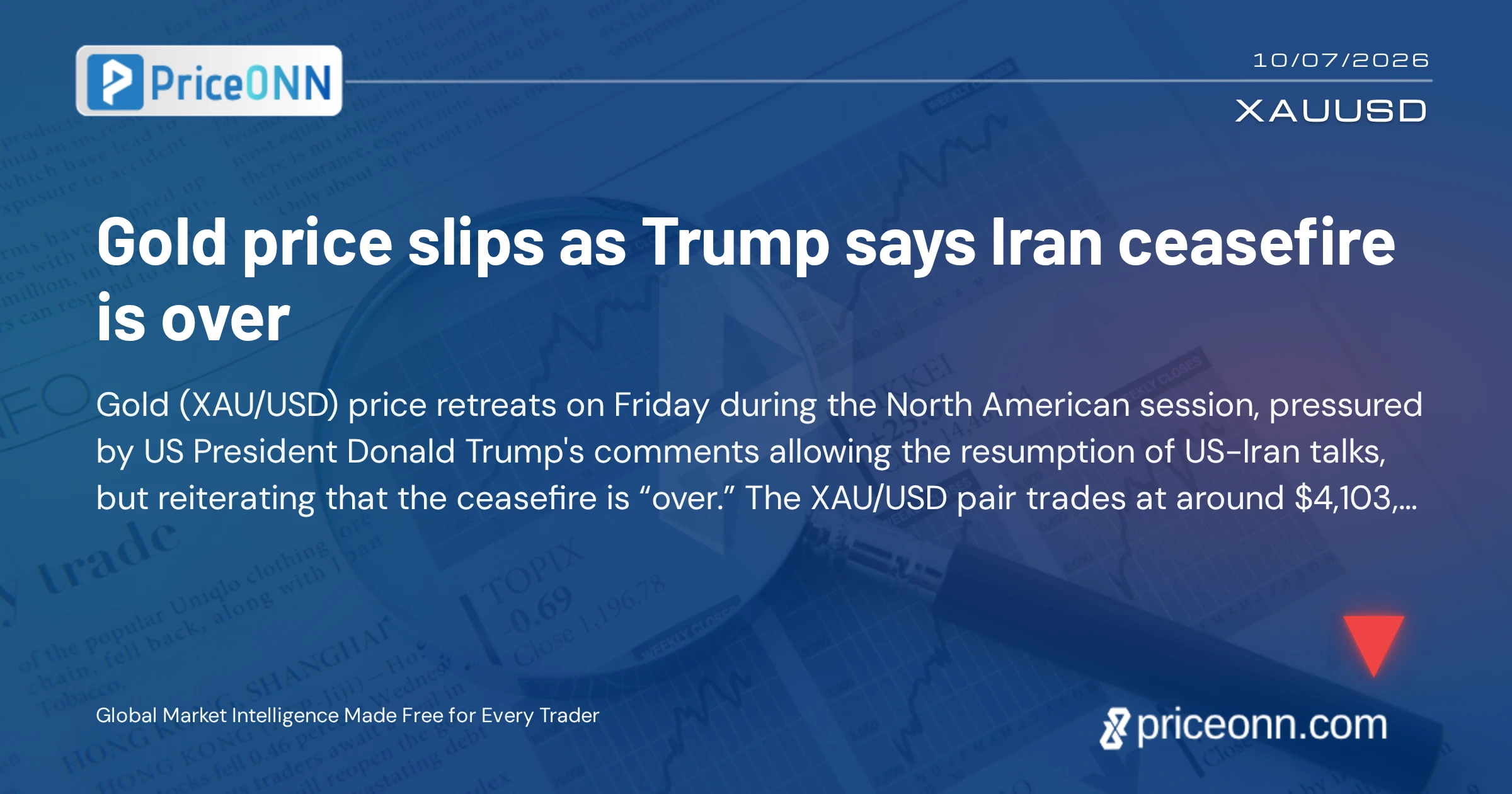
Gold price slips as Trump says Iran ceasefire is over
 PriceONN Editorial Desk
Multi-source verification
PriceONN Editorial Desk
Multi-source verification
Geopolitical Crosswinds Shake Gold's Safe Haven Status
The allure of gold as a historical store of value and a hedge against economic uncertainty has long captivated markets. Beyond its aesthetic appeal and use in adornment, the precious metal functions as a quintessential safe-haven asset, often attracting capital during periods of heightened global anxiety. Its appeal extends to inflation hedging and protection against currency devaluation, as gold's intrinsic worth is not tethered to any single government or issuer. This fundamental characteristic makes it a vital component of global financial stability.
Central banks, in particular, have demonstrated a significant appetite for gold. In a strategic move to bolster their own currencies and project economic resilience, these institutions frequently diversify their foreign exchange reserves by acquiring gold. The World Gold Council reported a staggering addition of 1,136 tonnes of gold, valued at approximately $70 billion, to central bank reserves in 2022. This represents the largest annual increase on record, with nations like China, India, and Turkey leading the charge in expanding their gold holdings. Such substantial reserves serve as a powerful signal of a nation's financial solvency and stability.
The intricate relationship between gold, the US Dollar, and US Treasury bonds is well documented. Typically, gold exhibits an inverse correlation with both the dollar and Treasuries, assets that also serve as major global reserves and safe havens. As the US Dollar weakens, gold prices often see an upward trend, allowing investors and central banks to rebalance their portfolios amidst market volatility. Conversely, a strengthening dollar tends to exert downward pressure on gold prices.
Furthermore, gold's performance often moves counter to riskier assets. A robust stock market rally can dampen demand for gold, while significant downturns in equity markets typically drive investors toward the perceived safety of the precious metal. The price of gold is susceptible to a myriad of influences. Geopolitical flare-ups or the genuine fear of a severe economic downturn can trigger rapid price escalations, a direct consequence of its safe-haven designation. As an asset that does not generate yield, gold typically benefits from lower interest rate environments. Conversely, a rise in the cost of borrowing money often weighs on the yellow metal. However, the behavior of the US Dollar remains a paramount driver, given that gold is priced in dollars (XAU/USD). A strong dollar generally caps gold's ascent, while a weaker dollar provides fertile ground for price appreciation.
Market Ripple Effects
The recent shift in the geopolitical landscape, sparked by President Trump's remarks concerning Iran, has introduced a layer of uncertainty that directly impacts gold's trading dynamics. While the comments signaled a potential for renewed dialogue, they simultaneously declared an existing ceasefire as null and void. This ambiguous stance creates a palpable tension, pushing gold prices lower in the immediate aftermath as some of the immediate safe-haven demand appears to recede. The XAU/USD pair was observed trading around the $1,803 mark, reflecting a decline of approximately 0.48%, indicating that market participants are digesting the news by reducing exposure to the precious metal for the moment.
This development is not isolated. The US Dollar Index (DXY) might see some upward momentum if the geopolitical uncertainty is perceived to be increasing, which would typically pressure gold. Conversely, if the situation de-escalates unexpectedly, the dollar could weaken, providing a potential tailwind for gold. Additionally, Treasury yields could react to shifts in risk sentiment; a move towards risk aversion might see yields dip, which usually supports gold, but the immediate reaction to Trump's comments seemed to favor a reduction in safe-haven demand across the board. Equity markets could also experience volatility, with potential sell-offs in riskier sectors if geopolitical fears intensify, although the direct impact on gold in this scenario is complex, as reduced risk appetite can also lead to gold buying.
Trader Takeaways
The latest commentary from President Trump regarding Iran has injected a fresh wave of volatility into the gold market. While the pronouncement of a ceasefire's end might typically bolster safe-haven demand, the simultaneous indication of renewed talks complicates the immediate price action. This creates a scenario where traders must carefully distinguish between short-term reactions and the broader underlying trends.
The key takeaway is that geopolitical rhetoric continues to wield significant influence over gold prices. Despite the current dip, the inherent safe-haven status of gold means that any sustained escalation in tensions or a breakdown in diplomatic efforts could swiftly reverse the current trend. Traders should monitor the $1,800 level closely; a decisive break below this psychological threshold could signal further downside potential. Conversely, any indication of de-escalation or a return to more stable diplomatic channels could reignite demand for the precious metal. The interplay between the US Dollar's strength, Treasury yields, and evolving geopolitical developments will be critical in shaping gold's trajectory in the coming days.
Track markets in real-time
Empower your investment decisions with AI-powered analysis, technical indicators and real-time price data.
Join Our Telegram Channel
Get breaking market news, AI analysis and trading signals delivered instantly to your Telegram.
Join Channel PriceONN News
Gold (XAU/USD) edges higher on Tuesday as buying interest around the $4,000 psychological level supports prices, while traders assess developments in the Middle East and their potential economic fallout. At the time of writing, XAU/USD trades around $4,058, up 1.27% on the day.
PriceONN News
Gold price (XAU/USD) is up 1.5% to near $4,067 during the European trading session on Tuesday. The precious metal outperforms as the rally in oil prices has stalled, with investors turning confident that negotiations between the United States (US) and Iran towards peace have resumed.
PriceONN News
Gold (XAU/USD) regains positive traction following the previous day's two-way price moves, though it struggles to capitalize on the move and trades below the $4,050 level during the Asian session on Tuesday.
PriceONN News
Gold (XAU/USD) trades in a volatile range on Monday as markets react to conflicting headlines from the Middle East. At the time of writing, XAU/USD trades around $4,010, little changed on the day after climbing to an intra-day high of $4,040.
PriceONN News
The Gold price turns negative on Wednesday, even though the last two US inflation reports showed that prices are dropping, though developments in the Middle East sent energy prices higher. At the time of writing, the XAU/USD traded at $4,034, down some 0.53%.
PriceONN News
(RTTNews) - Gold prices fell toward $4,000 an ounce on Wednesday as investors weighed geopolitical tensions and reacted to mixed economic data from China.
PriceONN News
(RTTNews) - Gold was little changed on Monday, reversing early losses as the dollar eased and risk currencies rebounded on signs of renewed diplomatic efforts between the United States and Iran.
PriceONN News
Esmaeil Baghaei Hamaneh, a spokesperson for the Ministry of Foreign Affairs of Iran, said during the European trading session on Monday that Tehran pursues war and diplomacy based on its national interests when asked whether the door to talks with the United States (US) was now closed, Reuters repor
PriceONN News
Gold (XAU/USD) reverses a modest Asian session dip to the $3,983-$3,982 area and is now looking to build on Friday's bounce from the monthly low. The intraday uptick is sponsored by a softer US Dollar (USD), which tends to benefit the commodity.
PriceONN News
Producer inflation in the United States, as measured by the change in the Producer Price Index (PPI), declined to 5.5% on a yearly basis in June from 6% in May, the US Bureau of Labor Statistics (BLS) reported on Wednesday. This reading came in below the market expectation of 6.2%.
PriceONN News
(RTTNews) - Partially reversing yesterday's surge, gold prices have edged lower on Friday as the status of U.S.-Iran peace talks remains unclear after the recent skirmish while expectations of a high-interest-rate regime in the near-term in the U.S. continue to rise.
PriceONN News
(RTTNews) - Oil prices were slightly lower on Tuesday, halting a recent rally as reports of mediation efforts between the United States and Iran helped ease worries over supply disruptions in the Middle East.