
Gold Stabilizes Near $4,500 After Liquidity Squeeze Erases Gains


Gold prices are exhibiting a pause near the $4,500 level, marking a tentative stabilization after a sharp and disorderly decline yesterday. This dramatic selloff appears to have been exacerbated by a significant liquidity crunch, indicating that market plumbing issues, rather than fundamental economic drivers, were the principal catalysts for the price action.
Earlier this week, hawkish pronouncements from major central banks, including the Federal Reserve, the European Central Bank, the Bank of England, and even the Bank of Japan, had initially exerted downward pressure on the precious metal. However, the sheer velocity and magnitude of the subsequent price drop point towards a market dislocation, a scenario where trading mechanics overwhelm underlying value.
Market Context: The Cascade of Liquidation
The critical tipping point for gold appeared to be a decisive break below the psychologically significant $5,000 mark. This breach triggered a wave of margin calls across highly leveraged positions. As forced selling intensified, prices plummeted, creating a damaging cascade effect where further liquidations were triggered by the initial price decline. This pattern is characteristic of liquidity stress, where the process of trading itself becomes the overwhelming factor, overshadowing fundamental considerations.
Adding to the selling pressure, substantial outflows were observed from major gold-backed exchange-traded funds. Significant redemptions from prominent funds underscored an aggressive unwinding of institutional positions. Intriguingly, this steep selloff occurred concurrently with a softening U.S. Dollar. This divergence further reinforces the narrative that liquidity constraints, rather than foreign exchange headwinds, were the primary driver behind the dramatic price action in gold.
Analysis & Drivers: Beyond Central Bank Rhetoric
While central bank tightening cycles and hawkish rhetoric provide a backdrop for potential weakness in gold, the recent price action suggests these factors alone do not fully explain the extreme volatility. Market data indicates that the breakdown was less about a fundamental shift in gold's long-term value proposition and more about the short-term mechanics of market liquidity. When market makers and liquidity providers withdraw or face funding issues, the ease with which trades can be executed diminishes rapidly.
This liquidity squeeze can amplify price movements in both directions. In this instance, it led to a rapid unwinding of long positions as traders were forced to liquidate to meet margin requirements or simply to exit a market where liquidity was drying up. The simultaneous decline in the U.S. Dollar is a key indicator here; typically, a weaker dollar supports gold prices. Its failure to do so during the sharp decline suggests that the selling pressure was so intense it overwhelmed currency dynamics.
Trader Implications: Navigating the Aftermath
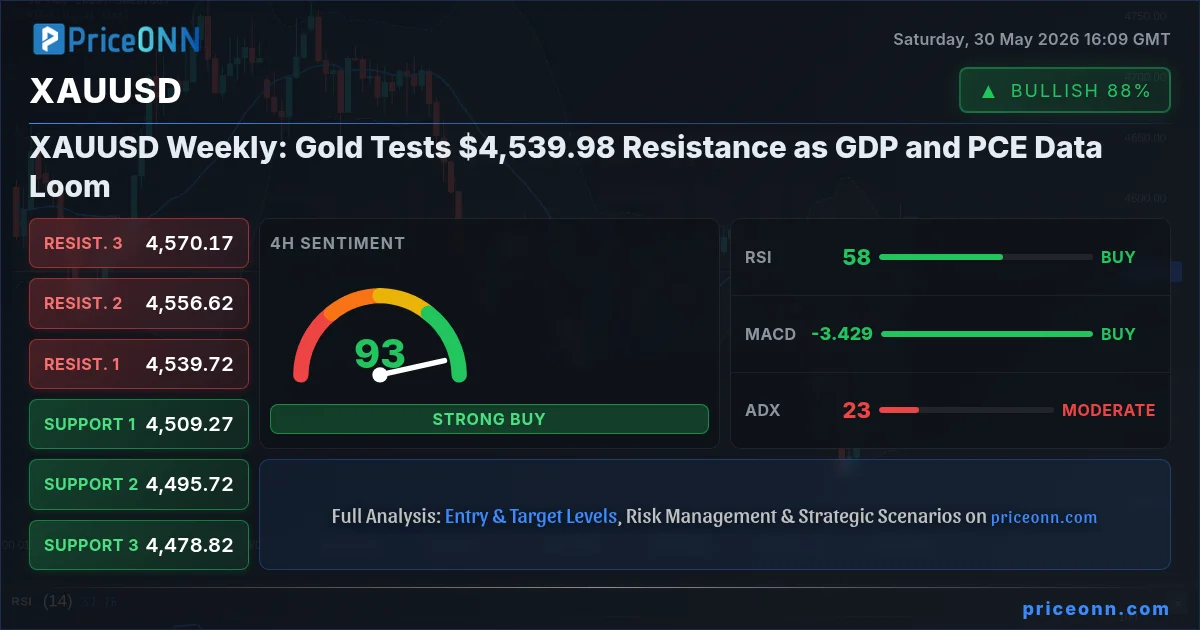
With the most intense phase of forced selling likely behind us, gold is beginning to establish support in the vicinity of $4,500. Analysts note that this stabilization suggests the extreme selling pressure may have abated, potentially paving the way for a period of consolidation. Traders should closely monitor the $4,500-$4,600 range as a potential support zone. A sustained hold above this level could indicate a temporary bottoming process.
Conversely, a decisive break below $4,400 could signal that further downside is imminent, potentially targeting the lower psychological level of $4,000. Key factors to watch include the flow of funds into and out of gold ETFs, as well as broader market liquidity conditions. Any signs of renewed liquidity stress could reignite volatility. Investors and traders should exercise caution, as the market re-evaluates the extent of the liquidity issues and their potential lingering effects on asset prices.
The immediate focus for traders will be on whether the $4,500 support level can hold firm. A failure to do so could lead to a retest of the recent lows, while a successful defense might lead to a gradual recovery as liquidity conditions normalize. The market's ability to absorb selling pressure without significant price depreciation will be a key indicator of underlying strength.
Outlook
Looking ahead, gold's trajectory will likely depend on the resolution of current liquidity concerns and the ongoing narrative surrounding central bank policy. While the immediate crisis may be subsiding, the underlying vulnerabilities exposed by the liquidity crunch could influence market sentiment for some time. A sustained recovery would likely require a clear signal that market liquidity is normalizing and that central banks are not poised for further aggressive tightening that could exacerbate such conditions. Until then, expect choppiness as the market digests the recent events and reassesses risk.
Frequently Asked Questions
What caused the recent sharp decline in gold prices?
The primary driver appears to have been a severe liquidity crunch, leading to forced selling and margin calls, particularly after gold broke below $5,000. This market dislocation overshadowed fundamental economic factors and hawkish central bank signals.
Where is gold finding support after the selloff?
Gold is currently showing tentative stabilization and finding support in the vicinity of the $4,500 level. A sustained hold above this price point is being watched as a potential indicator of a bottoming process.
What should traders watch for in the near term?
Traders should monitor the $4,500-$4,600 support zone. A break below $4,400 could signal further declines towards $4,000. Key indicators include gold ETF flows and broader market liquidity conditions.
Track markets in real-time
Empower your investment decisions with AI-powered analysis, technical indicators and real-time price data.
Join Our Telegram Channel
Get breaking market news, AI analysis and trading signals delivered instantly to your Telegram.
Join Channel PriceONN News
Canada's labor market is showing signs of stabilization, with analysts predicting a dip in the unemployment rate to 6.8% in May, driven by an expected 25,000 new jobs. This follows a period of sluggish GDP growth and rising joblessness earlier in the year.
PriceONN News
USDJPY has returned to the area of previous interventions. The ECB is moving towards a rate hike in June. The US dollar retreated on Friday amid new record highs for stock indices and rumours of amendments to the US-Iran agreement. However, tit-for-tat exchanges between the adversaries pushed the dollar index back into the support zone […] The post Yen Braces for a New Storm appeared first on ActionForex.
PriceONN News
The US Dollar experienced a notable decline last week as markets priced in a potential diplomatic resolution to the US-Iran conflict, leading to a drop in oil prices and Treasury yields. This shift in sentiment suggests a move away from stagflation fears towards a more stable economic outlook.
PriceONN News
Markets are pricing in a potential de-escalation in the US-Iran conflict, leading to a significant drop in crude oil prices and a weakening US Dollar as diplomatic efforts appear to be gaining traction.
PriceONN News
Canada's economy showed signs of a slowdown in early 2026, but upcoming May jobs data is expected to reveal a modest uplift. Analysts anticipate the unemployment rate to fall to 6.8%.
PriceONN News
USD/CAD faces pressure as Canada's economy shows signs of stalling, with Q1 GDP contracting 0.1% and domestic demand weakening. This comes as trade negotiations and geopolitical shifts add layers of uncertainty.
PriceONN News
Canada's economy showed signs of life in early 2026, with analysts expecting a moderate job growth of around 25,000 positions and a potential dip in the unemployment rate to 6.8% for May.
PriceONN News
AUD/USD’s late break of 0.7183 resistance suggests that pullback from 0.7277 has already completed at 0.7076, after defending 55 D EMA. Initial bias is back on the upside this week for retesting 0.7277 high first. Firm break there will resume larger up trend. For now, risk will stay on the upside as long as 0.7076 […] The post AUD/USD Weekly Report appeared first on ActionForex.
PriceONN News
USD/CAD is showing signs of potential upward movement as Canada's economy grapples with a significant slowdown, marked by weak domestic demand and stalled investment, while trade negotiations loom large.
PriceONN News
USD/JPY is testing the critical 160 level as stalled US-Iran negotiations and hawkish Federal Reserve rhetoric fuel inflation concerns and a potential for further rate hikes. Traders are closely watching upcoming US Non-Farm Payrolls and Eurozone CPI data for direction.
PriceONN News
Canada's economy showed signs of weakness in early 2026, but upcoming May jobs data is expected to reveal a moderate uplift. Analysts anticipate job growth of around 25,000 positions and a potential dip in the unemployment rate to 6.8%.
PriceONN News
The USD/JPY pair is flirting with the 160 level as stalled US-Iran negotiations and hawkish Federal Reserve rhetoric fuel inflation concerns. Traders are closely watching upcoming US Non-Farm Payrolls and Eurozone CPI data.