
Gold Under Pressure: Third Consecutive Session of Declines
 PriceONN Editorial Desk
Multi-source verification
PriceONN Editorial Desk
Multi-source verification

Inflation Fears Grip Gold Market
The yellow metal experienced another downturn on Thursday, slipping to $4,387 USD per troy ounce. This marks the third consecutive trading day where gold has failed to find upward momentum, signaling persistent selling pressure.
Investor caution is palpable, driven by the ongoing, yet seemingly stalled, negotiations between the United States and Iran. These diplomatic discussions, fraught with disagreement, are fanning the flames of inflation concerns and bolstering the outlook for sustained elevated interest rates.
At the heart of the impasse lie critical points of contention. Tehran remains steadfast in its position regarding passage through the Strait of Hormuz and the continuation of its nuclear initiatives. Conversely, Washington, under President Donald Trump's administration, has publicly declared an unwillingness to accept an unfavorable agreement or to lift sanctions without significant concessions from Iran, including financial relief and an end to hostilities.
Even a hypothetical breakthrough in these talks is unlikely to immediately alleviate market anxieties regarding energy prices. The prevailing expectation is that costs for oil and gas will remain elevated. This persistence in energy prices is anticipated to keep inflationary pressures high, compelling global central banks to maintain restrictive monetary policies for an extended period. The prospect of imminent rate cuts appears increasingly remote.
Since the escalation of tensions, gold's value has already seen a substantial erosion, dropping by over 15%. This decline is attributable to a confluence of factors: a strengthening US dollar, climbing bond yields, and widespread anticipation of tighter monetary conditions across the global economic landscape.
Chart Signals Deeper Declines
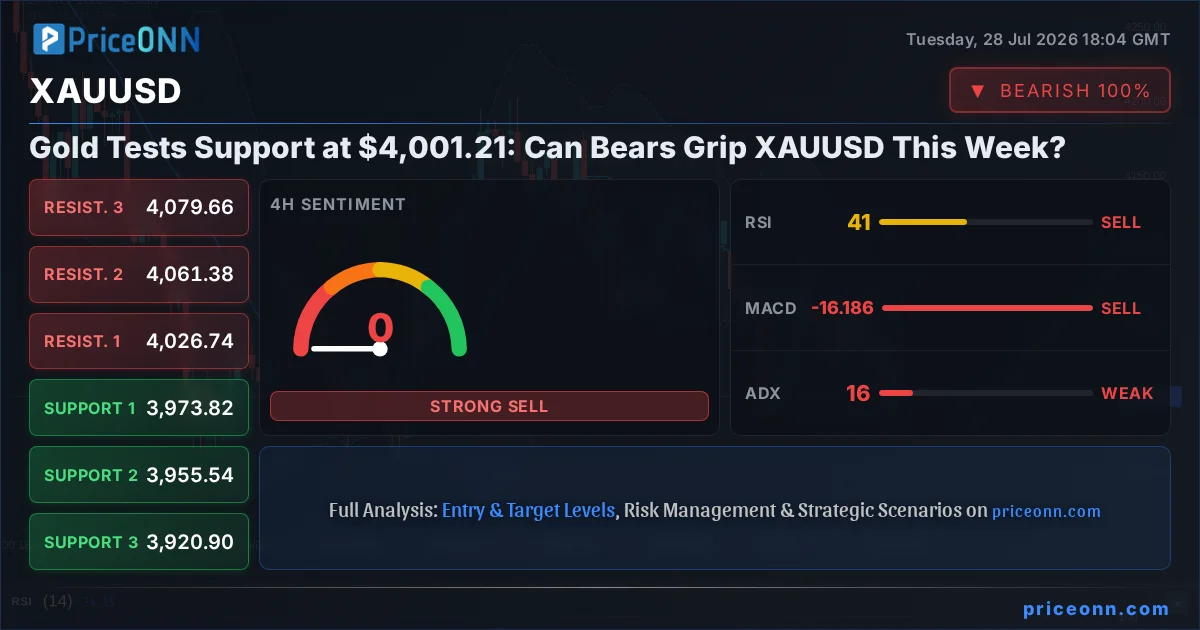
Technical indicators are painting a decidedly bearish picture for XAU/USD. On the four-hour chart, the price action is currently confined within a consolidation pattern near the $4,470 USD mark. A downward trajectory towards $4,359 USD appears probable.
While a temporary corrective bounce to retest the $4,470 USD level from below might occur, the broader trend suggests further downside potential. Analysts are watching for a subsequent move towards $4,238 USD, with the possibility of an extension towards $4,170 USD.
The Moving Average Convergence Divergence (MACD) indicator reinforces this bearish sentiment. Its signal line is positioned below the centerline and is trending decisively downward, underscoring the current negative momentum.
Examining the one-hour chart reveals a breach below the $4,470 USD threshold, with prices continuing their descent toward the $4,390 USD level. Similar to the longer timeframe, a short-term rebound to revisit $4,470 USD is conceivable before a further slide toward $4,250 USD. A subsequent, albeit potentially brief, recovery towards $4,390 USD could follow.
The Stochastic oscillator also lends support to this outlook. Its signal line is languishing below the 20 level and pointing downwards, indicating oversold conditions that could precede a minor upward correction but do not negate the dominant bearish trend.
Reading Between the Lines
Gold's persistent weakness is not merely a function of technical patterns. The underlying drivers are deeply rooted in geopolitical instability and the stubborn persistence of inflation. The US dollar's strength, coupled with rising yields on government debt, makes non-yielding assets like gold less attractive to investors seeking returns.
Furthermore, the narrative from central banks globally is one of caution. With inflation proving more resilient than initially hoped, the door for aggressive interest rate cuts is firmly shut. This environment of higher-for-longer interest rates directly counters the appeal of gold, which often performs well when rates are falling and the dollar is weakening.
The unresolved nature of the US-Iran discussions is a critical wildcard. Any perceived escalation or continued deadlock fuels uncertainty, which typically benefits gold as a safe-haven asset. However, in the current environment, this safe-haven demand is being overshadowed by the twin pressures of high rates and inflation expectations directly linked to energy prices. This creates a complex trading dynamic where traditional safe-haven impulses are being suppressed.
Traders are closely monitoring energy markets for any signs of a de-escalation or, conversely, further supply disruption. A significant move in crude oil prices could either ease inflation concerns, potentially offering gold a reprieve, or exacerbate them, leading to renewed selling pressure on the metal as central banks double down on their hawkish stances.
Track markets in real-time
Empower your investment decisions with AI-powered analysis, technical indicators and real-time price data.
Join Our Telegram Channel
Get breaking market news, AI analysis and trading signals delivered instantly to your Telegram.
Join Channel PriceONN News
Gold fell to 4,047 USD per ounce on Tuesday, erasing gains from the previous session. Pressure on the metal is mounting amid fears that the Federal Reserve may raise rates as early as this week. Markets currently estimate the probability of such a move on Wednesday at over 33% – an unusually high level of […] The post Gold Declines, Focus on Fed and Falling Oil Prices appeared first on ActionForex.
PriceONN News
The de-escalation of the conflict in the Middle East has sent Brent prices tumbling. The oil market could return to a surplus as early as the end of 2026. The US dollar and oil have lost their correlation. Brent recorded its worst daily fall in three months after reports of a ceasefire in the Middle […] The post Oil: A Surplus on the Horizon appeared first on ActionForex.
PriceONN News
The US stock market is not factoring in the existing risks. Investors are increasingly focusing on the cash flows of S&P 500 companies. US stock indices have closed in the red the last two weeks, something that hasn’t happened since March. The stock market has weathered both the armed conflict in the Middle East and […] The post It’s Time to Weigh Up the Risks for the S&P 500 appeared first on ActionForex.
PriceONN News
The ceasefire in the Middle East has disrupted the greenback’s plans. Strong PMI data and falling oil prices are helping the euro. The US dollar faced a downward gap at the start of the week as the Middle East de-escalation of the conflict came as an unwelcome surprise to speculators who had built up net […] The post De-Escalation Undermines the Greenback appeared first on ActionForex.
PriceONN News
(RTTNews) - Gold prices traded higher on Monday as oil prices tumbled amid eased Middle East tensions, helping ease inflation and interest-rate concerns ahead of crucial Fed, BoE and BoJ central bank meetings due this week.
PriceONN News
The dollar heads into a pivotal week trading near 101.80, just off a 15-month high, with the Fed’s July 29 meeting standing as the clear focal point. Markets currently price roughly a 65% chance of a hold, though renewed Middle East escalation has kept a hike back on the table for later this year. Energy […] The post US Dollar Index: a Defining Week for the King of the Markets appeared first on ActionForex.
PriceONN News
EUR/USD enters the final week of July at 1.1369. Friday’s modest decline in energy prices reduced expectations that the Federal Reserve could raise rates as early as its upcoming meeting, scheduled for Tuesday and Wednesday. At the same time, the main currency pair remains very close to the monthly low recorded in late June. Markets […] The post EUR/USD Ahead of a Key Week: Holding Near Lows appeared first on ActionForex.
PriceONN News
European Central Bank Governing Council member Peter Kazimir from Slovak reinforced the hawkish bias on Monday, arguing that policymakers will likely need to raise interest rates at least once more and warning that a worsening energy shock could ultimately require even more tightening than markets currently anticipate. His remarks come just days after the ECB […] The post ECB’s Kazimir Sees At Least One More Rate Hike, Warns Oil Shock Could Require More appeared first on ActionForex.
PriceONN News
On 21 July, Stats NZ reported an acceleration in inflation: the Consumer Price Index rose 1.5% in the second quarter, while the annual inflation rate climbed to 4.1%, its highest level in more than two years and slightly above analysts’ consensus forecast of 4.0%. The increase was driven primarily by higher fuel prices amid tensions […] The post NZD/USD: Inflation Surge Meets Strong US Dollar Pressure appeared first on ActionForex.
PriceONN News
US business activity accelerated at the start of the third quarter, with S&P Global’s Flash Composite PMI Output Index rising from 51.9 to 53.6 in July, its highest level in eight months. The improvement was driven by the services sector, where the Business Activity Index climbed from 51.2 to 53.6, also an eight-month high. Manufacturing, […] The post US PMI Hits Eight-Month High,Yet Rising Costs and Supply Delays Raise Caution appeared first on ActionForex.
PriceONN News
Market Overview The crypto market trended lower at the end of Monday, mirroring the US equity market, as it fell from a peak of $2.23T to $2.16T before returning to recent local lows of $2.18T by Tuesday morning. This marks yet another test of the 50-day moving average (MA) as support, which sellers have been […] The post Bitcoin Has Failed to Break Away from Its Long-Term Trend appeared first on ActionForex.
PriceONN News
I am already riding two EURUSD sell entries. Another possible sell opportunity could be forming for traders that are not in yet. EURUSD Possible Bearish Scenario Watch for price to tap 4 Hour FVG (Purple) first. Watch for a bearish shift and bearish reversal signs in the FVG zone. Wait for all above to play […] The post Riding EURUSD Sellside appeared first on ActionForex.