
How Venezuela’s Oil Industry Killed Lake Maracaibo
 PriceONN Editorial Desk
Multi-source verification
PriceONN Editorial Desk
Multi-source verification
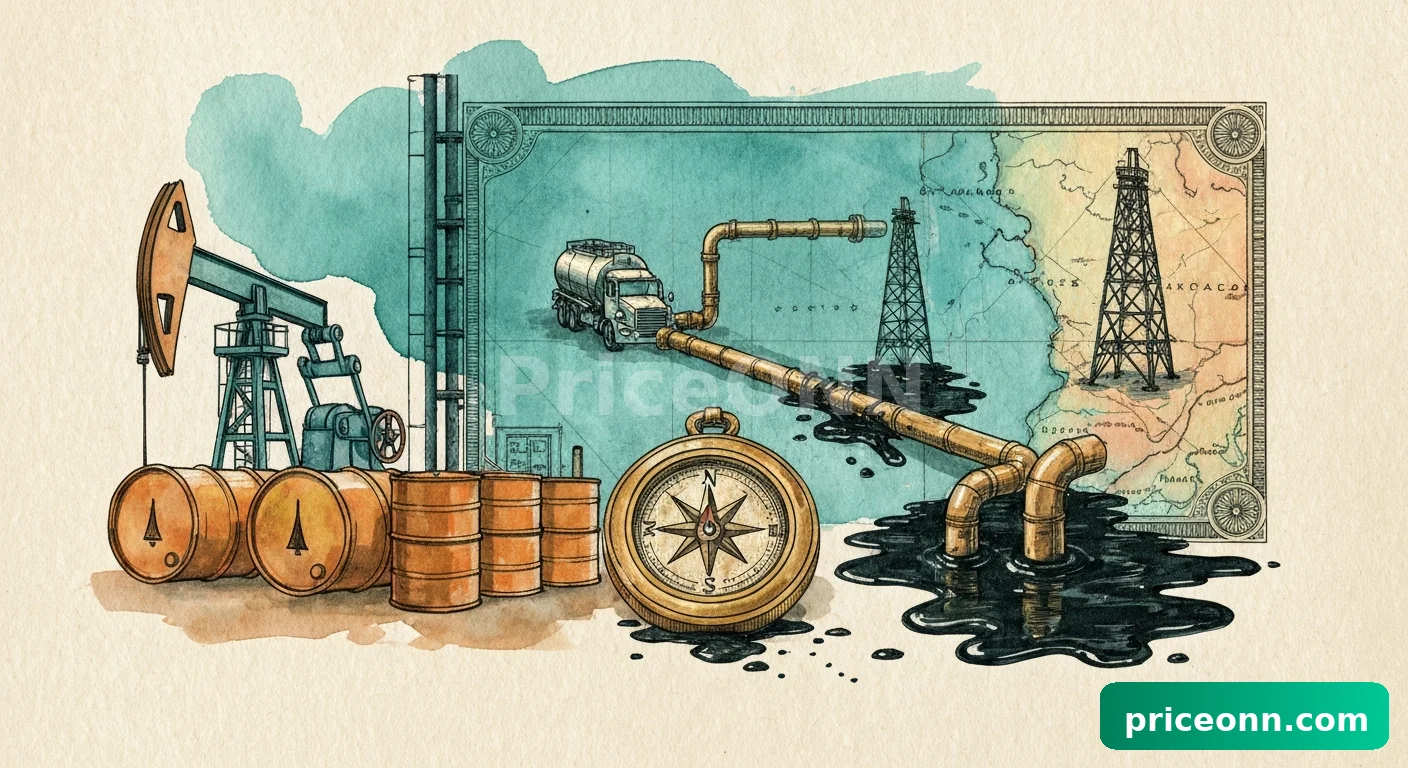
Venezuela’s Lake Maracaibo, South America’s largest and oldest waterbody, is at risk. The lake is situated in the heart of the Maracaibo Basin, one of the continent’s richest oil-producing regions. After the Zumaque 1 wildcat well found black gold on Lake Maracaibo’s eastern shore, Venezuela’s oil industry rapidly expanded, covering the ancient waterbody with persistently leaking pipelines, storage tanks, and derricks. This triggered a devastating environmental disaster, which could worsen after the United States intervened in Venezuela with the White House ruthlessly seeking to exploit the country’s copious oil reserves.
It was the May 1922 Barroso 2 discovery, also on Lake Maracaibo’s eastern shore, which confirmed the presence of vast quantities of petroleum after suffering a blowout with oil geysering 130 feet (40 meters) into the sky. The blowout was so forceful it took Shell’s oilfield workers nearly two weeks to install a valve and bring the well under control. This marked a turning point for Venezuela’s oil industry by proving that the Maracaibo Basin possessed the considerable volumes of crude oil needed to attract foreign investment.
By the late 1920s, Standard Oil, Shell, and Gulf Petroleum were investing tens of millions of dollars to develop what turned out to be Venezuela’s tremendous oil potential, with Lake Maracaibo becoming ground zero for a flourishing boom. Production after 24 years hit the one million barrel per day mark in 1946 and doubled to two million barrels daily during 1955. By 1960, when Venezuela became a founding member of the OPEC oil cartel, the country was pumping over 2.8 million barrels per day, with most of that petroleum lifted in and around Lake Maracaibo.

The tremendous income generated by rapidly rising oil exports funded a groundbreaking public works program that lifted Venezuela out of poverty, creating a thriving capitalist democracy. Indeed, by the mid-1960s, Caracas, Venezuela’s capital, had emerged as a vibrant cosmopolitan city described as the jewel of South America. In 1962, a global engineering landmark, the General Rafael Urdaneta Bridge, which crosses Lake Maracaibo, was inaugurated by then-President Romulo Betancourt. On completion, the structure, which connects the city of Maracaibo to the rest of Venezuela, was the world’s longest pre-stressed concrete bridge.
Related: Six Stocks That Could Soar in an Era of Regional Instability
This piece of infrastructure proved crucial to the development of Venezuela’s oil industry, facilitating the expansion of petroleum-producing operations in and around Lake Maracaibo. Soaring oil wealth prompted Caracas to double down on drilling and oil production, with production expanding at a steady clip to hit an annual all-time high of 3.75 million barrels per day during 1970. This intensive industry activity, which was mostly unregulated, caused tremendous environmental damage to Lake Maracaibo, long considered ground zero for Venezuela’s oil industry.
By the 1970s, after more than 50 years of oil industry operations, the ancient water body was heavily polluted. This created the foundation for the ongoing ecological degradation that now endangers Lake Maracaibo and the waterbody’s very existence. The dangers facing the lake rapidly intensified over the years, with President Hugo Chavez’s 1999 Bolivarian revolution marking a turning point that pushed Lake Maracaibo to destruction. You see, Chavez adopted a drill at all costs mentality as he rapidly expanded economically crucial oil production, regardless of the environmental fallout, to grow fiscal revenues and boost government spending.
In January 2003, NASA satellite images show an ailing Lake Maracaibo covered in multiple oil slicks. By then, pipelines, storage tanks, and wellheads were leaking an estimated 1,000 barrels per day into Lake Maracaibo. The extensive ecological damage only accelerated as Venezuela’s economy declined and ever stricter U.S. sanctions bit deeper. You see, by 2013, when President Nicolas Maduro assumed office after Chavez’s death, Venezuela’s oil industry was in a deep decline. Even significantly higher prices, with Brent peaking at over $106 per barrel during August 2013, did little to slow the deterioration of the hydrocarbon sector.
After U.S. President Donald Trump ratcheted up sanctions in early 2019, as part of his campaign to topple the Maduro regime, the disintegration of Venezuela’s oil industry accelerated. You see, those measures cut Caracas off from global energy and capital markets, making it impossible for the national oil company PDVSA to raise the capital required to conduct routine infrastructure maintenance and refits. This created a vicious cycle where rapidly corroding infrastructure accelerated production declines, placing ever greater financial pressure on PDVSA and Caracas.
Related: No Magnets, No Drones: How China Controls the Future of Warfare
After seven decades of oil industry operations, Lake Maracaibo and its surroundings contain tens of thousands of facilities associated with an economically crucial sector. It is estimated that there are at least 15,000 wells drilled into the bottom of the lake, with many now inactive and abandoned. It is feared that scores of those abandoned wells were never properly capped, leaving them constantly seeping oil into the lake. There is at least 15,500 miles or 25,000 kilometers of pipelines running beneath and around Lake Maracaibo. Many of those structures, including pumping stations, are heavily corroded and leaking, with quite a few now deserted and no longer in use.
As facilities rapidly decayed and resources for crucial maintenance became scarcer, the frequency and size of oil spills grew. Although PDVSA discontinued reporting such incidents in 2016, Caracas-based think tank the Observatory of Political Ecology of Venezuela documented 86 oil spills that occurred during 2022, a substantial increase over the 73 spills identified for 2021. It was Zulia state, home to Lake Maracaibo, where 31 spills occurred, one of which was reported during June 2022, stretching more than 9 miles or 15 kilometers across the waterbody.
NASA photos from October 2021 show the lake covered in oil slicks and toxic algal blooms. These are asphyxiating Lake Maracaibo, killing what little marine life remains. For decades, local farmers and fishermen regularly reported weekly spills in and around Lake Maracaibo. Fishermen claim the waterbody and its shores are constantly covered in a sheen of oil due to the constant leaks from the more than 10,000 corroded petroleum facilities scattered across the lake and its shores. They also regularly complain of catches where the fish are covered in an oily sludge. This is devastating Lake Maracaibo and nearby communities, especially impacting those people whose livelihoods are dependent on the lake.
Related: Little-Known US Company Lands Important Pentagon Contract in Rare Earth Race
Nearly all facilities in Venezuela’s oil heartland, even those still in operation, are severely corroded and leak oil every time they operate. As a result, whenever PDVSA ratchets up production, as occurred after President Biden eased sanctions in October 2023, the volume of accidents and spills spirals higher. Residents living near the operational sites dotted around Lake Maracaibo claim the frequency of infrastructure breaking down and the number of oil spills spikes whenever PDVSA ramps up operational activities.
There are fears that, as foreign capital surges into Venezuela’s petroleum sector after President Trump’s call for energy companies to invest in the country, the volume of spills and other environmentally damaging emissions will soar. By some accounts, it will take at least $100 billion, possibly as much as $200 billion, invested over a decade to rebuild Venezuela’s badly corroded energy infrastructure. This is a deterrent for foreign energy companies who will likely, at least for the immediate future, focus their spending on immediately profitable oil-producing activities rather than spending considerable capital on longer-term projects.
For these reasons, oil companies will forgo refitting and rebuilding Venezuela’s dilapidated petroleum infrastructure. Instead, drillers will focus on ramping up profitable oil-producing operations with the potential to generate a rapid return on their capital. This, along with boosting Venezuela’s petroleum output, will lead to further spills and environmental degradation in and around Lake Maracaibo. This could very well destroy any hope of remedying existing ecological issues and cleaning up the water body. It is estimated it will cost more than $3 billion to undertake a minimal clean-up of Lake Maracaibo, with fears that the ecological damage is now irreversible.
Track markets in real-time
Empower your investment decisions with AI-powered analysis, technical indicators and real-time price data.
Join Our Telegram Channel
Get breaking market news, AI analysis and trading signals delivered instantly to your Telegram.
Join Channel PriceONN News
BP will sell 5% in the $35-billion Browse LNG project in Australia, which Australian energy giant Woodside is looking to progress, the UK-based supermajor told Reuters on Monday. BP is selling the 5% stake, out of its total of its 44% interest, to South Korea's GS Energy. “The dilution reflects BP’s disciplined approach to portfolio management by bringing in a committed partner,” BP said in a statement emailed to Reuters. The Browse LNG project in Australia, proposed by Woodside Energy, entails...
PriceONN News
The Iran war suddenly turned what had started as a year of oversupply in global oil and LNG markets into the worst oil and gas supply disruption in history. Three months after the U.S.-Israeli strikes on Iran began on February 28, the world has already lost 1 billion barrels of crude oil supply, oil and gas prices have found a new, much higher floor, and whipsaw with violent volatility nearly every day, trade routes have shifted, and tanker rates have spiked. Actual supply shortages are...
PriceONN News
Nuclear fuel is becoming a geopolitical battleground as the world increasingly turns to nuclear energy to contend with skyrocketing energy demand projections. The combination of an oil-based energy crisis emanating out of the Strait of Hormuz, the enormous and ballooning energy needs of artificial intelligence, and the urgent imperative of decarbonization is garnering a renewed interest in nuclear energy as a carbon-free, efficient, and round-the-clock power source. Moreover, nuclear energy can...
PriceONN News
Over the last two decades, solar panels have fallen in price while efficiency has increased. Greater uptake and high levels of investment in research and development have led to vast improvements in solar power technology. As panel prices fall and governments worldwide look to diversify their energy mix and cut emissions, several developers are now launching mega-projects to meet the growing demand. Most major solar projects developed in recent years provide hundreds of megawatts of clean...
PriceONN News
China has been cited as an example of a country that has managed to insulate itself relatively well against oil crises. With over a billion barrels in estimated inventories before the war in the Middle East started, China was the poster child of forward planning in energy security. But this could change, and if it does, it would make an already severe crisis even worse. Kpler sounded the alarm about that prospect earlier this month, reporting that Chinese refiners have reduced their purchases...
PriceONN News
The Iran war has handed the United States a rare opportunity: a new dawn of energy dominance in an increasingly fractured world. With coordinated US-Israeli strikes disrupting the Strait of Hormuz from late February, roughly 20% of global LNG supply has been stripped from the market since early March. Prices have surged across Asia and Europe. And into that vacuum, American gas has flowed. The numbers speak for themselves. US LNG exports to Asia jumped sharply in April, with nearly a quarter of...
PriceONN News
Cuba has been experiencing a worsening energy crisis for several years, which previously led it to rely heavily on Venezuela for its fuel. Following the United States’ intervention in Venezuela in February, the energy crisis has grown even worse, as Cubans face regular blackouts and the economy suffers. Cuba requires about 100,000 barrels a day to power its grid and meet the regular transportation demands. It fulfils just 40 percent of this demand domestically. In January, the Trump...
PriceONN News
Crude oil prices experienced a significant drop, with WTI futures falling over 1.8% to $87.25, as optimism grew for a U.S.-Iran deal potentially reopening the Strait of Hormuz.
PriceONN News
Crude oil prices experienced a significant downturn as market sentiment shifted towards optimism about a potential US-Iran Memorandum of Understanding that could reopen the Strait of Hormuz. WTI futures fell nearly 2% on the news.
PriceONN News
(RTTNews) - Crude oil prices have tumbled on Friday as expectations of the U.S. and Iran signing a Memorandum of Understanding run high. The MoU would allow for immediate reopening of the Strait of Hormuz and pave the way for the resumption of oil and energy trade.
PriceONN News
Crude oil futures experienced a dramatic intraday reversal on Thursday, soaring overnight on geopolitical fears only to pull back significantly as reports of a potential diplomatic understanding between the U.S. and Iran emerged.
PriceONN News
Crude oil futures experienced a dramatic intraday reversal, soaring to $92.52 before pulling back significantly on Thursday. The volatile session was driven by shifting geopolitical narratives and U.S. inventory data.