
Japan’s Kihara says government aims to secure market trust by stably lowering debt-to-GDP ratio
 PriceONN Editorial Desk
Multi-source verification
PriceONN Editorial Desk
Multi-source verification

Fiscal Prudence Takes Center Stage
In a significant policy announcement, Japan's government has articulated its intention to proactively manage its public finances. Chief Cabinet Secretary Minoru Kihara stated that a core objective for the administration is to restore and solidify market confidence. The primary mechanism for achieving this, according to Kihara, will be a concerted and stable effort to bring down the nation's government debt as a percentage of its Gross Domestic Product (GDP).
This declaration arrives during a period of considerable global economic flux, where investor sentiment can pivot rapidly based on fiscal stability signals from major economies. Japan, holding one of the largest debt piles globally relative to its economic output, faces the critical task of reassuring international and domestic stakeholders about its long-term financial health. The government's commitment to a 'stable' reduction implies a measured approach, avoiding drastic austerity measures that could stifle economic growth.
The Yen's Complex Equation
The Japanese Yen (JPY), a currency frequently found in the portfolios of global traders, operates under a confluence of influences. While the overall health of the Japanese economy provides a foundational backdrop, its trajectory is significantly shaped by the monetary policy directives of the Bank of Japan (BoJ). Crucially, the spread between Japanese and US bond yields, alongside broader shifts in trader risk appetite, also plays a pivotal role.
The BoJ, tasked with a mandate that includes currency management, possesses the authority to directly intervene in foreign exchange markets. Historically, such interventions have occurred, often aimed at weakening the Yen. However, these actions are typically undertaken with caution, mindful of potential political sensitivities with key international trading partners. Between 2013 and 2024, the BoJ's prolonged commitment to an ultra-accommodative monetary stance contributed to a depreciation of the Yen. This was largely a consequence of widening policy divergence when compared to the tightening cycles of other major central banks, particularly the U.S. Federal Reserve.
Shifting Monetary Tides
The dynamic between the BoJ and its global counterparts has been a defining feature of recent currency markets. For nearly a decade, the BoJ's adherence to exceptionally low interest rates created a significant gap with other central banks. This policy divergence directly fueled a widening spread in yields on benchmark 10-year government bonds between the United States and Japan. Consequently, this environment strongly favored the US Dollar (USD), exerting downward pressure on the Japanese Yen.
However, a notable pivot began in 2024. The BoJ's gradual move away from its ultra-loose policy, coinciding with interest rate reductions initiated by other leading central banks, is now contributing to a narrowing of these critical yield differentials. This shift in monetary policy is providing some much-needed upward support for the Yen.
Safe Haven Appeal Under Scrutiny
Traditionally, the Japanese Yen has been categorized as a safe-haven asset. This designation implies that during periods of heightened market anxiety or global uncertainty, investors tend to seek refuge in JPY, perceiving it as a stable and reliable store of value. Consequently, turbulent economic climates have historically seen the Yen strengthen against currencies perceived as riskier investment choices.
The government's current focus on fiscal consolidation through debt reduction could bolster this safe-haven status, provided the strategy is perceived as credible and sustainable. A stable fiscal outlook often reinforces currency stability, a key tenet of attracting safe-haven flows. The market will be watching closely to see if this renewed emphasis on fiscal responsibility can translate into sustained Yen strength, especially as global risks persist.
Market Ripple Effects
This Japanese government initiative to prioritize debt reduction and bolster market trust carries significant implications. It suggests a potential recalibration of monetary and fiscal policy coordination, moving towards greater fiscal prudence. While the BoJ has begun normalizing its policy, a clearer fiscal path could further support the Yen, especially if it leads to improved sovereign credit perception.
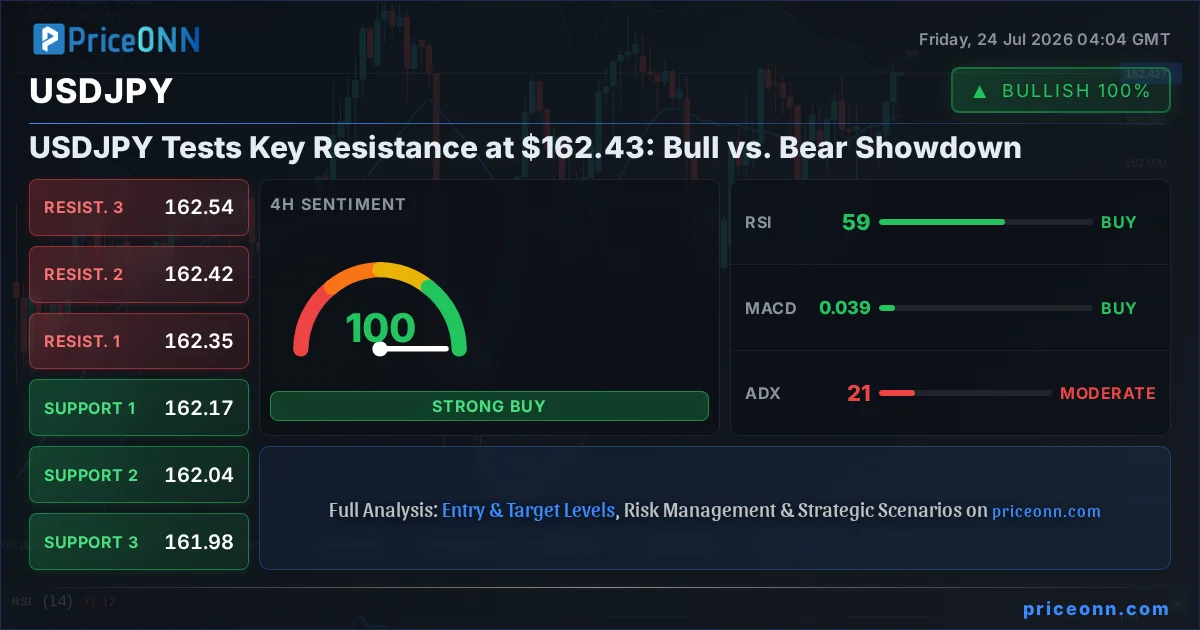
Traders will likely be monitoring the USD/JPY cross rate closely. A sustained reduction in Japan's debt-to-GDP ratio, coupled with a narrowing interest rate differential as the BoJ continues its policy normalization, could exert downward pressure on the pair, favoring the Yen. Beyond currency markets, Japanese government bonds (JGBs) may see increased investor interest if the fiscal reforms are seen as credible, potentially pushing yields slightly higher but offering greater stability. Global bond markets could also react, as shifts in the attractiveness of JGBs can influence broader fixed-income flows. Furthermore, the broader theme of fiscal responsibility in major economies is a critical watchpoint for overall market risk sentiment, impacting global equities and other risk assets.
Track markets in real-time
Empower your investment decisions with AI-powered analysis, technical indicators and real-time price data.
Join Our Telegram Channel
Get breaking market news, AI analysis and trading signals delivered instantly to your Telegram.
Join Channel PriceONN News
(RTTNews) - Gold prices have tumbled on Thursday as the Middle East crisis deepens after Iran-backed Houthi militants of Yemen attacked two Saudi Arabian vessels in the Red Sea, raising concerns of intense oil supply disruption for an extended period. The possibility of an intere
PriceONN News
(RTTNews) - Gold prices fell from a two-week high on Thursday as escalating West Asia tensions rekindled inflation fears and clouded the outlook for interest rates.
PriceONN News
(RTTNews) - Gold prices traded higher on Wednesday, extending gains for a fourth consecutive session and hitting a two-week high as investors reacted to escalating Middle East tensions and looked ahead to next week's Federal Reserve meeting.
PriceONN News
(RTTNews) - Oil prices traded sharply higher on Wednesday to hit a seven-week high as risks to global supply spread beyond the Middle East to the Black Sea.
PriceONN News
Dow Jones futures lose 0.30% to trade around 52,290 during European trading hours on Wednesday. Meanwhile, S&P 500 futures and Nasdaq 100 futures decline 0.38% and 0.85%, trading near 7,520 and 29,070, respectively.
PriceONN News
Gold’s rally this week may prove to be one of the more important developments across financial markets-not simply because prices have reclaimed the $4,100 level, but because the move appears to contradict the macro forces that have governed precious metals for much of the second quarter. Silver has joined the advance, climbing back toward $60, […] The post Gold Defies Higher Oil and Yields. Is the Market Entering a New Regime? appeared first on ActionForex.
PriceONN News
Gold (XAU/USD) rallies to an over two-week high, around the $4,140-$4,141 area, during the Asian session on Wednesday amid hopes that US-Iran diplomacy could ease energy prices and temper hawkish US Federal Reserve (Fed) expectations.
PriceONN News
Silver price (XAG/USD) gains ground for the fourth successive day, trading around $59.70 per troy ounce during the Asian hours on Wednesday. Silver prices are surging despite rising rate-hike expectations, as powerful market forces outweigh the drag of higher interest rates.
PriceONN News
US President Donald Trump approved a landmark agreement with Saudi Arabia that could potentially provide the kingdom with uranium enrichment capability for its civilian nuclear program, the Wall Street Journal reported on Wednesday.
PriceONN News
Yemen’s Houthis said that they have closed the Bab el-Mandeb Strait to Saudi-linked shipping in retaliation for the kingdom’s blockade on Yemen and a recent attack on the international airport in Yemen’s rebel-held capital, Sanaa, the Guardian reported on Wednesday.
PriceONN News
Gold (XAU/USD) edges higher on Tuesday as buying interest around the $4,000 psychological level supports prices, while traders assess developments in the Middle East and their potential economic fallout. At the time of writing, XAU/USD trades around $4,058, up 1.27% on the day.
PriceONN News
Gold price (XAU/USD) is up 1.5% to near $4,067 during the European trading session on Tuesday. The precious metal outperforms as the rally in oil prices has stalled, with investors turning confident that negotiations between the United States (US) and Iran towards peace have resumed.