
Is the Japanese Yen Poised for a Rebound Amidst Rising Geopolitical Risk?


The Japanese Yen (JPY) is navigating a complex market environment, exhibiting defensive characteristics as geopolitical tensions in the Middle East intensify. While the Yen has recently underperformed against the US Dollar, the ongoing conflict is bolstering demand for safe-haven assets, potentially offering a floor for the currency.
Market Context
In early Asian trading on Monday, the Japanese Yen experienced pressure against the US Dollar, a trend that persisted despite the Middle East conflict entering its fourth week with no clear signs of de-escalation. Simultaneously, the Australian Dollar also weakened, with the AUD/USD pair finding sellers near the 0.7000 level. This broader risk-off sentiment, driven by escalating global tensions, has propelled the US Dollar higher as a traditional safe-haven asset, putting pressure on currencies like the AUD.
Analysis & Drivers
The Japanese Yen's value is influenced by a confluence of factors, including the performance of the Japanese economy, the Bank of Japan's (BoJ) monetary policy, and the yield differential between Japanese and US bonds. Historically, the BoJ's ultra-loose monetary policy, maintained for over a decade until 2024, led to a depreciating Yen due to policy divergence with other major central banks like the US Federal Reserve. This divergence widened the spread between 10-year US and Japanese bonds, favoring the US Dollar.
However, the BoJ's gradual pivot away from this ultra-loose stance in 2024, coinciding with interest rate cuts by other central banks, has begun to narrow this yield differential. This shift has provided some underlying support for the Yen. Furthermore, the Yen is widely regarded as a safe-haven investment. In periods of market stress and heightened geopolitical uncertainty, such as the current situation in the Middle East, investors typically flock to perceived safe assets like the JPY, seeking stability and reliability. This dynamic suggests that the Yen could strengthen as global risk aversion increases.
The Australian Dollar, on the other hand, is sensitive to global commodity prices, particularly iron ore, and the economic health of its primary trading partner, China. The current risk-off environment, driven by Middle East hostilities, dampens demand for riskier assets and commodities, negatively impacting the AUD. The Reserve Bank of Australia's (RBA) monetary policy decisions also play a crucial role in its valuation.
Trader Implications
For traders, the escalating Middle East conflict presents a dual-edged sword. While it fuels demand for safe-haven currencies like the JPY, it simultaneously weighs on risk-sensitive assets and commodity-linked currencies such as the AUD. Key levels to watch for USD/JPY include potential resistance around 151.80, a level tested previously. Support could emerge near 150.50 if safe-haven flows accelerate significantly. For AUD/USD, the 0.7000 mark remains a critical psychological level. A sustained break below this could open the door to further downside towards 0.6950.
Traders should monitor central bank communications, particularly from the BoJ and the US Federal Reserve, for any shifts in monetary policy expectations, as this will continue to influence yield differentials. Geopolitical developments will be paramount; any further escalation or de-escalation in the Middle East will likely trigger sharp price movements in currency markets. The interplay between risk sentiment and central bank policy will dictate the near-term direction for major currency pairs.
Outlook
The outlook for the Japanese Yen appears cautiously optimistic in the short term, contingent on sustained geopolitical uncertainty and potential shifts in global monetary policy. If Middle East tensions continue to simmer or escalate, the safe-haven appeal of the JPY is likely to remain elevated, potentially leading to a retest of lower USD/JPY levels. Conversely, a rapid resolution to the conflict could see risk appetite return, potentially weakening the Yen as yield differentials become the primary driver once more. Upcoming economic data releases from Japan and the US will provide further clues on the underlying economic strength and influence central bank policy expectations.
Frequently Asked Questions
Will the Japanese Yen strengthen due to the Middle East conflict?
Yes, the Japanese Yen is considered a safe-haven currency. As geopolitical tensions in the Middle East escalate, market data indicates increased demand for the JPY, which typically strengthens its value against riskier currencies. Analysts note this effect could push USD/JPY lower, potentially testing support levels around 150.50.
What are the key levels to watch for AUD/USD?
The Australian Dollar is currently under pressure due to risk aversion. The 0.7000 level is a critical psychological and support area for AUD/USD. A decisive break below this level could trigger further declines, with traders watching for a potential move towards 0.6950 in the near term.
How does the Bank of Japan's policy affect the Yen's outlook?
The Bank of Japan's gradual abandonment of its ultra-loose monetary policy is providing underlying support for the Yen by narrowing yield differentials with countries like the US. Analysts suggest that any further hawkish signals from the BoJ, or continued dovishness from other central banks, could strengthen the Yen, but geopolitical factors are currently the dominant driver.
Track markets in real-time
Empower your investment decisions with AI-powered analysis, technical indicators and real-time price data.
Join Our Telegram Channel
Get breaking market news, AI analysis and trading signals delivered instantly to your Telegram.
Join Channel PriceONN News
The US Dollar experienced a notable decline last week as markets priced in a potential diplomatic resolution to the US-Iran conflict, leading to a drop in oil prices and Treasury yields. This shift in sentiment suggests a move away from stagflation fears towards a more stable economic outlook.
PriceONN News
Canada's economy showed signs of a slowdown in early 2026, but upcoming May jobs data is expected to reveal a modest uplift. Analysts anticipate the unemployment rate to fall to 6.8%.
PriceONN News
Canada's economy showed signs of life in early 2026, with analysts expecting a moderate job growth of around 25,000 positions and a potential dip in the unemployment rate to 6.8% for May.
PriceONN News
AUD/USD’s late break of 0.7183 resistance suggests that pullback from 0.7277 has already completed at 0.7076, after defending 55 D EMA. Initial bias is back on the upside this week for retesting 0.7277 high first. Firm break there will resume larger up trend. For now, risk will stay on the upside as long as 0.7076 […] The post AUD/USD Weekly Report appeared first on ActionForex.
PriceONN News
The New Zealand Dollar surged on Friday, with investors interpreting Reserve Bank of New Zealand (RBNZ) comments as a sign that interest rate hikes could resume sooner and be larger than previously anticipated. This hawkish pivot has created significant trading opportunities.
PriceONN News
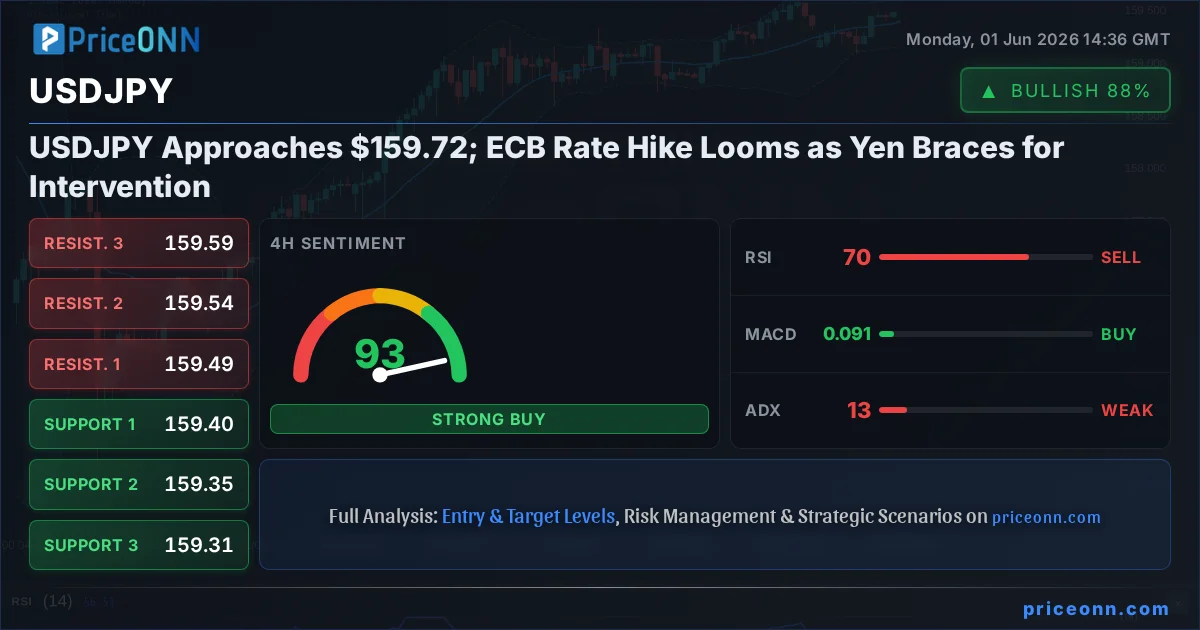
USDJPY has returned to the area of previous interventions. The ECB is moving towards a rate hike in June. The US dollar retreated on Friday amid new record highs for stock indices and rumours of amendments to the US-Iran agreement. However, tit-for-tat exchanges between the adversaries pushed the dollar index back into the support zone […] The post Yen Braces for a New Storm appeared first on ActionForex.
PriceONN News
Canada's labor market is showing signs of stabilization, with analysts predicting a dip in the unemployment rate to 6.8% in May, driven by an expected 25,000 new jobs. This follows a period of sluggish GDP growth and rising joblessness earlier in the year.
PriceONN News
Markets are pricing in a potential de-escalation in the US-Iran conflict, leading to a significant drop in crude oil prices and a weakening US Dollar as diplomatic efforts appear to be gaining traction.
PriceONN News
USD/CAD faces pressure as Canada's economy shows signs of stalling, with Q1 GDP contracting 0.1% and domestic demand weakening. This comes as trade negotiations and geopolitical shifts add layers of uncertainty.
PriceONN News
USD/CAD is showing signs of potential upward movement as Canada's economy grapples with a significant slowdown, marked by weak domestic demand and stalled investment, while trade negotiations loom large.
PriceONN News
USD/JPY is testing the critical 160 level as stalled US-Iran negotiations and hawkish Federal Reserve rhetoric fuel inflation concerns and a potential for further rate hikes. Traders are closely watching upcoming US Non-Farm Payrolls and Eurozone CPI data for direction.
PriceONN News
Canada's economy showed signs of weakness in early 2026, but upcoming May jobs data is expected to reveal a moderate uplift. Analysts anticipate job growth of around 25,000 positions and a potential dip in the unemployment rate to 6.8%.