
Is the Japanese Yen Poised for a Rebound as Inflation Dips and BoJ Policy Shifts?


The Japanese Yen faced renewed pressure, with USD/JPY hovering near 158.55 during early Asian trading. This softening comes on the heels of a February inflation report that indicated a cooling price environment, reaching a four-year low. This development injects fresh uncertainty into the currency's trajectory, prompting a re-evaluation of its safe-haven appeal and the Bank of Japan's (BoJ) policy stance.
Market Context
The recent depreciation of the Japanese Yen against the US Dollar underscores a complex interplay of economic indicators and central bank actions. The softer inflation data for February, which has now fallen to its lowest point in four years, directly challenges the narrative of persistent price pressures that might necessitate aggressive monetary tightening. Historically, the Yen's value has been closely tied to the BoJ's monetary policy, the yield differential between Japanese and US bonds, and global risk sentiment. The BoJ's prolonged period of ultra-loose monetary policy, which spanned from 2013 to 2024, contributed significantly to Yen depreciation due to a widening policy divergence with other major central banks, most notably the US Federal Reserve. This divergence fueled a growing gap in 10-year bond yields, favoring the US Dollar.
Analysis & Drivers
The cooling inflation figures are a critical driver for the Yen's current weakness. A lower inflation rate diminishes the urgency for the Bank of Japan to deviate from its accommodative stance, or at least signals that any policy normalization might be more gradual than previously anticipated. This is particularly significant as other central banks, such as the Federal Reserve, have been signaling potential shifts or even rate cuts. The narrowing yield differential between US and Japanese bonds, which had previously supported USD/JPY, could now be less of a tailwind for the dollar if the BoJ maintains its ultra-loose policy while others begin to ease. Furthermore, the Yen's traditional role as a safe-haven asset comes into play during periods of market stress. However, recent market dynamics have sometimes seen the Yen underperform even when global risk aversion rises, suggesting that domestic factors and the perceived stability of the Japanese economy are increasingly influencing its safe-haven status.
Trader Implications
For traders, the current environment presents a mixed bag of opportunities and risks. The immediate focus will be on the Bank of Japan's forward guidance and any commentary regarding the inflation data. Any hint of a less hawkish stance could see USD/JPY continue its ascent, potentially targeting levels above 160.00. Conversely, any indication that the BoJ remains committed to gradual policy normalization, despite the soft inflation, could provide some support for the Yen. Key technical levels to watch include the recent highs around 158.55 as resistance, and potential support emerging around 157.00. Traders should also monitor global risk sentiment, as a significant increase in market volatility could still trigger a safe-haven bid for the Yen, counteracting the impact of domestic inflation data. The widening gap between Japanese and US interest rates remains a primary driver for the pair, and any shifts in expectations for Fed policy will also be crucial.
Outlook
The path forward for the Japanese Yen remains contingent on the evolving monetary policy landscape. While the recent inflation data might suggest a less urgent need for the BoJ to tighten policy, the gradual unwinding of its ultra-loose measures is still a medium-term consideration. Traders will be closely watching upcoming BoJ meetings and statements for clues on the pace and timing of any policy shifts. The potential for direct intervention by Japanese authorities also remains a background risk, particularly if USD/JPY continues to push towards psychologically significant levels. For now, the immediate trend suggests continued dollar strength against the yen, but the underlying economic data and central bank policy expectations create a dynamic and potentially volatile trading environment.
Frequently Asked Questions
What is the current price for USD/JPY?
As of the latest reports, the USD/JPY pair is trading near 158.55. This level reflects the ongoing weakening of the Japanese Yen against the US Dollar.
How does February's inflation data affect the Japanese Yen?
February's inflation data showed a cooling price environment, reaching a four-year low. This suggests less pressure on the Bank of Japan to tighten monetary policy, which can weaken the Yen as interest rate differentials may not narrow as quickly.
What are the key factors to watch for USD/JPY in the coming weeks?
Traders should monitor the Bank of Japan's policy statements for any shifts in stance, US Federal Reserve commentary on interest rates, and global risk sentiment. Key levels to watch are resistance near 158.55 and support around 157.00.
Track markets in real-time
Empower your investment decisions with AI-powered analysis, technical indicators and real-time price data.
Join Our Telegram Channel
Get breaking market news, AI analysis and trading signals delivered instantly to your Telegram.
Join Channel PriceONN News
Japan’s wage story continues to move in the direction the Bank of Japan has long hoped for. Nominal wages rose 3.5% yoy in April, accelerating from 3.1% yoy and beating market expectations of 3.2% yoy. The increase marked the third straight month with wage growth above 3%, something not seen in more than three decades. […] The post Japan Wage Growth Surges to 34-Year High Streak, Consumption Still Lags appeared first on ActionForex.
PriceONN News
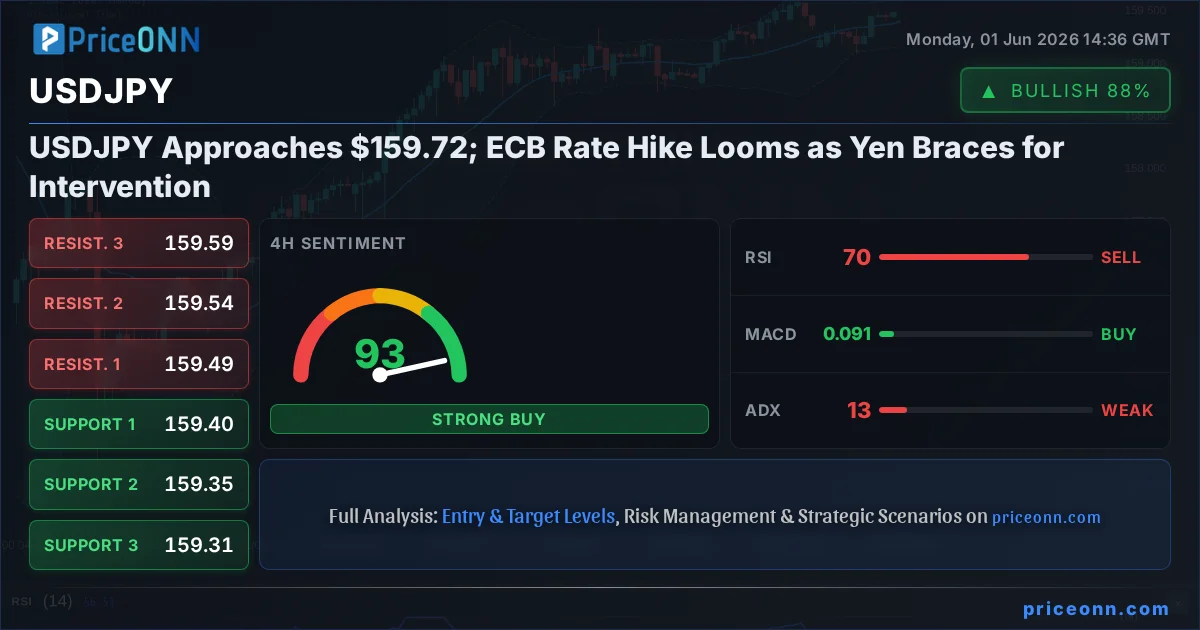
USDJPY has returned to the area of previous interventions. The ECB is moving towards a rate hike in June. The US dollar retreated on Friday amid new record highs for stock indices and rumours of amendments to the US-Iran agreement. However, tit-for-tat exchanges between the adversaries pushed the dollar index back into the support zone […] The post Yen Braces for a New Storm appeared first on ActionForex.
PriceONN News
USD/JPY is testing the critical 160 level as stalled US-Iran negotiations and hawkish Federal Reserve rhetoric fuel inflation concerns and a potential for further rate hikes. Traders are closely watching upcoming US Non-Farm Payrolls and Eurozone CPI data for direction.
PriceONN News
The USD/JPY pair is flirting with the 160 level as stalled US-Iran negotiations and hawkish Federal Reserve rhetoric fuel inflation concerns. Traders are closely watching upcoming US Non-Farm Payrolls and Eurozone CPI data.
PriceONN News
EUR/USD stalled below 1.1660 as the US Dollar defied expectations, refusing to weaken despite reports of a US-Iran ceasefire extension. Market participants remain cautious, awaiting concrete confirmation and assessing lingering inflationary pressures.
PriceONN News
The Japanese Yen is showing signs of renewed pressure, with USD/JPY approaching the psychologically significant 160 level. This comes as traders brace for key US jobs data and Eurozone inflation figures, all while lingering US-Iran tensions add a layer of uncertainty to market sentiment.
PriceONN News
EUR/USD closed at 1.1640, showing resilience amid mixed signals. Easing US-Iran tensions initially pressured the dollar, but persistent inflation concerns and political ratification hurdles are keeping the greenback surprisingly steady.
PriceONN News
The USD/JPY pair is showing signs of upside exhaustion, struggling to overcome the 159.65 resistance level and trading below a key bullish trend line. This technical setup raises concerns about a potential pullback in the near term.
PriceONN News
The EUR/USD faces headwinds as core US PCE inflation unexpectedly rose to 3.3% year-over-year, reinforcing a 'higher for longer' interest rate narrative. Meanwhile, a US-Iran ceasefire extension boosted global risk appetite, potentially drawing capital away from safe-haven currencies.
PriceONN News
Markets are pricing in a potential de-escalation in the US-Iran conflict, leading to a significant drop in crude oil prices and a weakening US Dollar as diplomatic efforts appear to be gaining traction.
PriceONN News
USD/CAD faces pressure as Canada's economy shows signs of stalling, with Q1 GDP contracting 0.1% and domestic demand weakening. This comes as trade negotiations and geopolitical shifts add layers of uncertainty.
PriceONN News
AUD/USD’s late break of 0.7183 resistance suggests that pullback from 0.7277 has already completed at 0.7076, after defending 55 D EMA. Initial bias is back on the upside this week for retesting 0.7277 high first. Firm break there will resume larger up trend. For now, risk will stay on the upside as long as 0.7076 […] The post AUD/USD Weekly Report appeared first on ActionForex.