
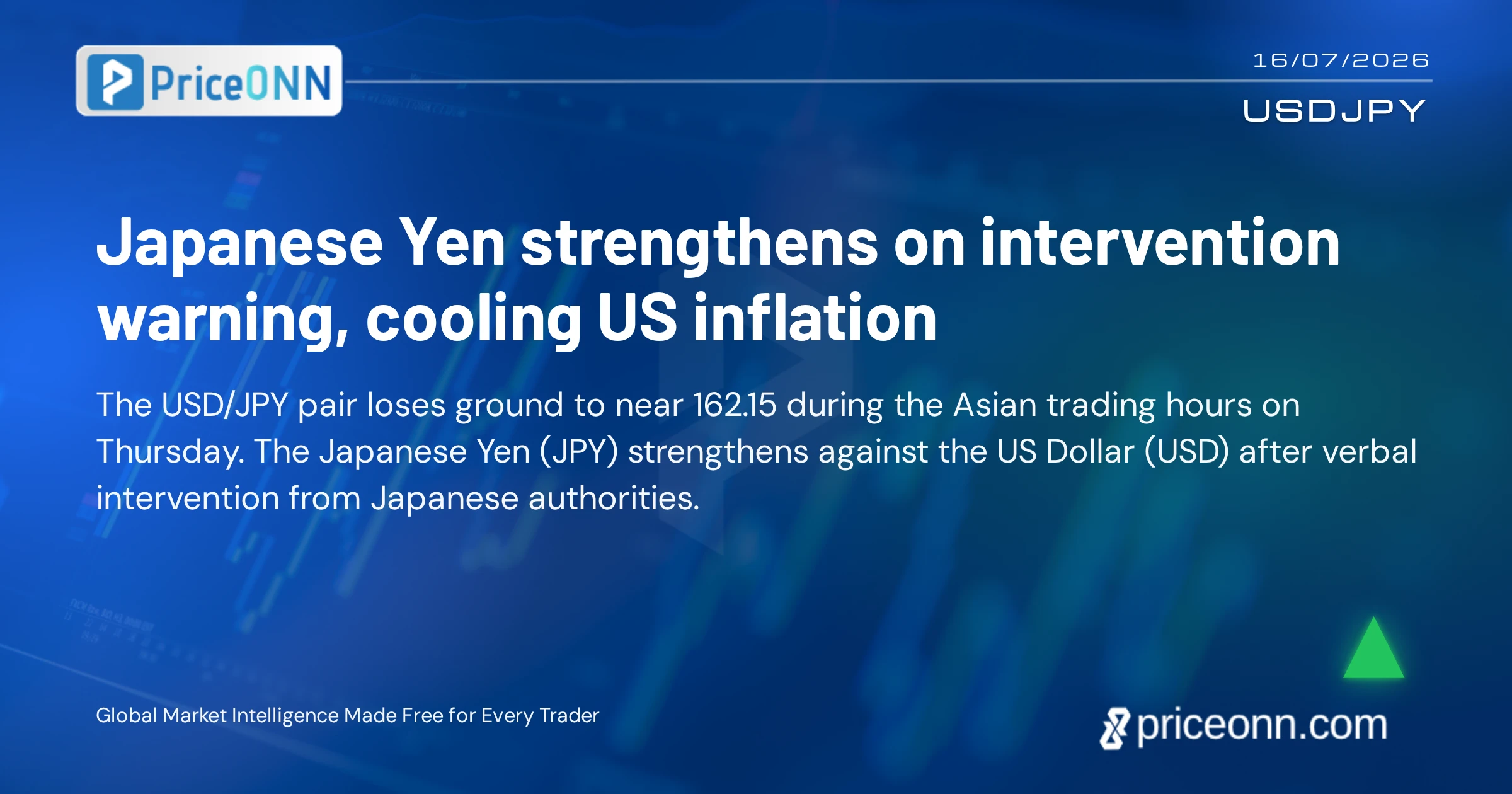
Japanese Yen strengthens on intervention warning, cooling US inflation
 PriceONN Editorial Desk
Multi-source verification
PriceONN Editorial Desk
Multi-source verification
Yen Stages Comeback on Official Warnings
The Japanese Yen (JPY) has staged a notable comeback against the US Dollar (USD), pushing the USD/JPY exchange rate down to approximately 162.15 during Thursday's Asian trading session. This shift follows direct verbal intervention from Japanese financial authorities, signaling a strong stance against the currency's recent depreciation.
Historically, the Yen's trajectory has been dictated by a confluence of factors. These include the health of the Japanese economy, the monetary policy stance of the Bank of Japan (BoJ), interest rate differentials with major economies like the United States, and broader market risk sentiment. The BoJ, in particular, holds currency stability as a key objective, although direct market intervention is a tool employed sparingly due to potential diplomatic repercussions with major trading partners.
For an extended period, stretching from 2013 through 2024, the BoJ maintained an ultra-accommodative monetary policy. This divergence in policy, especially when contrasted with the tightening cycles of other central banks, significantly pressured the Yen, leading to its depreciation across major currency pairs. However, the recent, gradual unwinding of this prolonged ultra-loose stance has begun to offer some much-needed support to the Japanese currency.
Policy Divergence Narrows, Yen's Safe-Haven Appeal Grows
The policy gap between the Bank of Japan and other global central banks, most notably the U.S. Federal Reserve, widened considerably over the past decade. This divergence directly fueled a widening spread in 10-year bond yields between the US and Japan, creating a strong tailwind for the US Dollar against the Yen. The BoJ's strategic decision in 2024 to phase out its ultra-loose policy, coinciding with interest rate reductions by other key central banks, is now actively working to narrow this yield differential.
Furthermore, the Japanese Yen often finds strength during periods of global economic uncertainty. Its status as a perceived safe-haven asset means that in times of heightened market stress, investors tend to reallocate capital towards the Yen, attracted by its reputation for stability and reliability. Conversely, currencies perceived as riskier often see outflows during such turbulent phases, further amplifying the Yen's upward momentum.
Reading Between the Lines
The recent surge in the Yen, directly prompted by official verbal warnings, highlights a critical shift in market perception and official tolerance for currency weakness. While the Bank of Japan has historically been hesitant to intervene directly, the sustained depreciation below key psychological levels has clearly crossed a threshold, prompting authorities to speak forcefully. This verbal intervention serves as a potent signal, suggesting that further downside could provoke more direct action, a prospect that traders are now keenly factoring into their positions.
The interplay between the BoJ's policy normalization and the Federal Reserve's rate decisions remains a central theme. As the yield differential narrows, the carry trade, which has heavily favored the USD/JPY pair, becomes less attractive. This could lead to a sustained unwinding of long dollar positions against the Yen. Additionally, the Yen's safe-haven appeal is likely to be tested in the coming months, especially if geopolitical tensions escalate or if global growth forecasts falter. Traders should monitor not only verbal cues but also any subtle shifts in BoJ communication regarding the pace of policy normalization and the Federal Reserve's forward guidance on interest rates.
The immediate impact is a reprieve for Japanese importers and consumers facing higher costs due to a weaker currency. For global markets, a stronger Yen can influence capital flows, potentially leading to repatriation of Japanese funds parked overseas and a reduction in demand for riskier assets. The USD/JPY pair will likely remain sensitive to any further official commentary, U.S. inflation prints, and shifts in global risk appetite.
Track markets in real-time
Empower your investment decisions with AI-powered analysis, technical indicators and real-time price data.
Join Our Telegram Channel
Get breaking market news, AI analysis and trading signals delivered instantly to your Telegram.
Join Channel PriceONN News
Whatever the inflation figures may be, the precious metal will come out on top. Japan and the US don’t want to give the yen’s fate to speculators. The US dollar continues to recover from the blow dealt by the labour market statistics. A rally in Treasury bond yields is driving the rise in the USD […] The post Gold as a Sure-Fire Bet appeared first on ActionForex.
PriceONN News
Markets Core bonds sold off yesterday with the belly of the curve slightly underperforming in the US while European curves showed more of a bear flattening. Daily changes on the US curve varied between +4.7 bps (2-yr) and +6.4 bps (7-yr). The US 30-yr yield is again within reach of the multi-annual high reached end […] The post Sunrise Market Commentary appeared first on ActionForex.
PriceONN News
The Consumer Price Index (CPI) rose by 0.1% month-on-month (m/m) in July – in line with expectations. On a twelve-month basis, CPI edged down to 3.4% (from 3.5% in June). Energy costs fell by 1.5% m/m, led by a 2.9% m/m decline in prices at the pump. Food prices rose 0.1% m/m – its softest […] The post US: Inflationary Pressures Remain Subdued in July appeared first on ActionForex.
PriceONN News
The NFIB’s Small Business Optimism Index rose 2.4 points to 99.8 in July, soundly beating expectations for a roughly flat reading of 97.5. Eight out of the ten index subcomponents improved during the month and two deteriorated. The largest improvement came from the net share of firms planning to increase employment (up 9 points to […] The post US: Small Business Optimism Spiked in July appeared first on ActionForex.
PriceONN News
A deal to reopen the Strait of Hormuz is not inevitable. Oil prices are rising amid growing risks of an escalation of the conflict in the Middle East. The US dollar continued to recover from losses caused by the jobs report, against a backdrop of rising geopolitical tensions in the Middle East with traders squaring […] The post Brent Is Following a Path of Demands Rather Than Commitments appeared first on ActionForex.
PriceONN News
Gold rose to 4,400 USD per ounce on Tuesday, reaching a two-month high. Demand for the precious metal is growing rapidly, even amid heightened inflation risks and expectations of higher interest rates driven by elevated oil prices. Chinese institutional investors continue to build positions in gold as a defensive asset amid heightened volatility in other […] The post Gold Rallies: Long-Awaited Rise and Growing Safe-Haven Demand appeared first on ActionForex.
PriceONN News
RBA on hold as expected, recognising the data has broken against its hawkish narrative. Base case clearly an extended period on hold, but RBA will hike if upside risks to inflation materialise. As widely expected, the RBA Monetary Policy Board (MPB) kept the cash rate on hold at 4.35% at its August meeting. The accompanying […] The post RBA Holds at 4.35%, Narrows Risk of Hikes appeared first on ActionForex.
PriceONN News
RBA accepted that inflation has improved, but refused to turn that improvement into a declaration that rate hikes are finished. Cash rate was left unchanged at 4.35% unanimously, yet Board described policy as only “somewhat restrictive” and explicitly kept another increase on table, saying it could still raise rates “if upside risks materialise.” That is […] The post RBA Accepts Softer Inflation but Still Leaves Scope for One More Hike appeared first on ActionForex.
PriceONN News
US inflation eased as expected in July, reinforcing case for Fed to stay on hold while it waits for clearer evidence on both prices and labor market. Headline CPI rose from -0.4% to 0.1% m/m, while annual rate slowed from 3.5% y/y to 3.4%. Core CPI increased from 0.0% to 0.2% m/m, with annual core […] The post US CPI Slows to 3.4% as Core Inflation Eases to 2.5% appeared first on ActionForex.
PriceONN News
Germany’s benchmark index just made history, breaking above 26,500 for the first time ever, extending a rally that has already delivered close to 10% over the past twelve months. The move came on fresh optimism around a potential resolution to the Iran conflict, though that optimism proved short-lived: President Trump’s latest demands, that Tehran compensate […] The post DAX 40: Record Highs, Real Fundamentals, One Channel Left to Test appeared first on ActionForex.
PriceONN News
Brent oil price rose to the highest in over one week on Tuesday, in extension of Monday’s nearly 5% advance, following the latest verbal escalation by President Trump that quickly changed the sentiment and countered efforts of Iran and Oman to find solution for reopening of strategic Hormuz strait. The latest demands from President Trump […] The post Brent Oil Price Falls After Recovery Failed to Clear Important $90 Barrier appeared first on ActionForex.
PriceONN News
Hello fellow traders. In this technical article we’re going to take a look at the Elliott Wave charts charts of Copper (HG_F) commodity published in members’ area of the website. As our members know, Copper Futures recently completed a pullback that provided a high-probability trading setup. The decline unfolded as a clear Elliott Wave Zig […] The post Copper (Hg_F) Elliott Wave: Targeting a Buy at the Blue Box appeared first on ActionForex.