
JP Morgan: Falling Oil Prices A Massive Tailwind For Global Stock Markets
 PriceONN Editorial Desk
Multi-source verification
PriceONN Editorial Desk
Multi-source verification

Equity Rally Ignited by Declining Energy Costs
The global stock market may be on the cusp of a substantial uplift, fueled by a dramatic downturn in oil prices. This shift follows news of a tentative peace agreement between the United States and Iran, a development that could usher in a wider rally across equity sectors and grant central banks the latitude to lower interest rates. Karen Ward, Chief Market Strategist for EMEA at JPMorgan Asset Management, highlighted on Monday how investors are beginning to pivot away from the threat posed by elevated energy costs. For months, rising oil prices have been perceived as a significant headwind for equities, primarily due to their inflationary impact and the potential drag on economic growth.
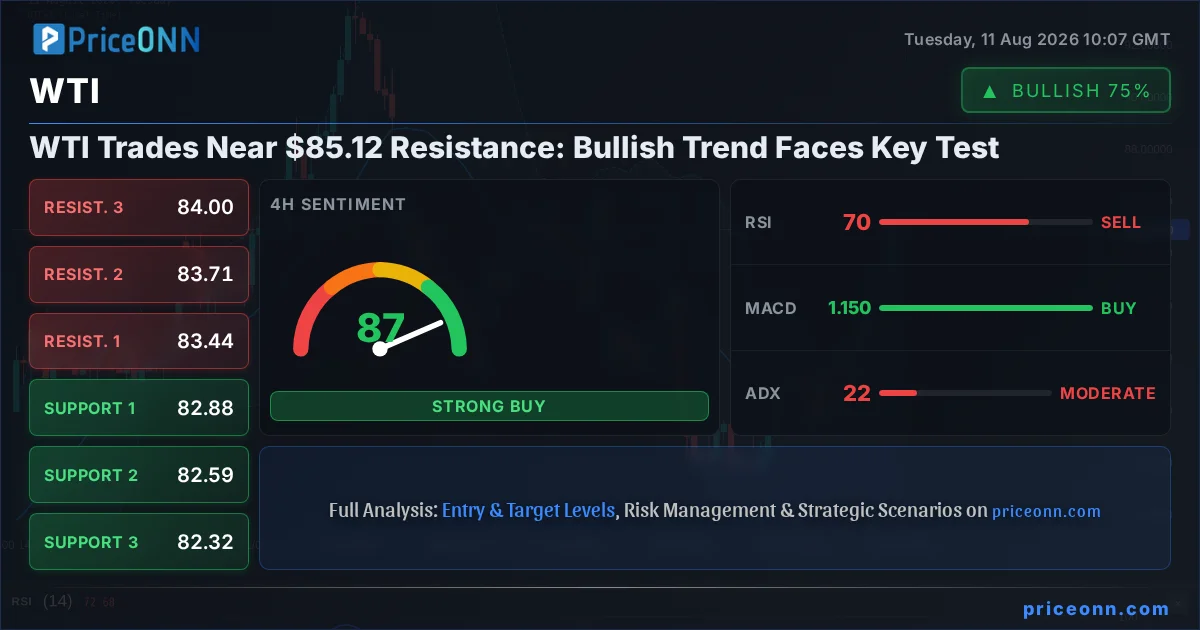
The market's reaction was swift. Oil prices experienced a sharp decline on Monday after the announcement of the U.S.-Iran deal aimed at ceasing their protracted conflict. This accord is anticipated to facilitate the reopening of trade routes, notably through the vital Strait of Hormuz. Consequently, global anxieties surrounding potential oil supply interruptions and the inflationary pressures from energy costs are expected to diminish. Brent crude, with a August delivery date, saw its value fall by 4.87% to trade at $83.08 per barrel. Simultaneously, West Texas Intermediate (WTI) crude for July delivery shed 5.4%, changing hands at $80.30 per barrel.
Ward pointed out that prior to the recent disruption caused by the Iran conflict, a discernible trend of capital moving out of a select group of dominant mega-cap technology stocks and into a more diverse range of industries was already underway. However, the surge in oil prices had abruptly reversed this momentum, reigniting inflation fears and prompting a retreat to more defensive investment postures. Now, with crude prices receding on the prospect of a stable U.S.-Iran relationship, Ward suggests that inflationary risks are abating. This creates a more favorable environment for broad-based equity market participation and enhances the flexibility of monetary policymakers.
Shifting OPEC Dynamics and Producer Strategies
Adding to the downward pressure on oil prices is a visible fragmentation within the OPEC cartel. The withdrawal of the United Arab Emirates from OPEC in May, representing approximately 15% of the cartel's production capacity, has introduced a significant element of unconstrained supply. This departure, combined with persistent disagreements over production quotas and revised forecasts for global demand growth, has demonstrably weakened the group's ability to influence market supply.
The UAE's exit fundamentally erodes OPEC's leverage, creating a structural headwind for oil prices. Furthermore, there are indications that Gulf nations are proactively seeking to accelerate the monetization of their substantial underground oil reserves. This strategy appears driven by a desire to capitalize on current market conditions before prices potentially decline further, thereby injecting additional supply into the global marketplace. The combined effect of reduced cartel cohesion and accelerated reserve monetization points towards a sustained period of lower energy costs.
Market Ripple Effects
The implications of this oil price correction extend far beyond the energy sector. A sustained drop in oil prices acts as a significant tailwind for global stock markets. For investors, this means a potential broadening of market leadership beyond the tech giants that have previously commanded investor attention. Sectors that are typically sensitive to energy costs, such as transportation, manufacturing, and consumer discretionary, could see improved profit margins and increased consumer spending power.
Furthermore, the easing of inflationary pressures creates a more conducive environment for central banks. With inflation concerns diminishing, policymakers at institutions like the Federal Reserve and the European Central Bank may find it easier to justify interest rate cuts. This prospect of lower borrowing costs can stimulate economic activity and further support equity valuations. The U.S. Dollar Index (DXY) might also face pressure as interest rate differentials narrow, potentially benefiting emerging market currencies and commodities priced in dollars. The S&P 500, which JPMorgan analysts had previously warned could face a 10%-15% correction if oil prices stayed above $90-$120 per barrel, now appears to have a clearer path to recovery and potential upside.
Track markets in real-time
Empower your investment decisions with AI-powered analysis, technical indicators and real-time price data.
Join Our Telegram Channel
Get breaking market news, AI analysis and trading signals delivered instantly to your Telegram.
Join Channel PriceONN News
Risk aversion set Monday's tone, and the Dow Jones Industrial Average wore it better than most of its peers; the index trades near 52,525, down 117 points or 0.2%, while the Nasdaq Composite sheds 1% and the S&P 500 gives back 0.4%.
PriceONN News
Commodity producing and trading giant Glencore booked a $4.4-billion net income for the first half of the year, a jump of $5 billion from a loss a year earlier, as the oil and copper price rallies and volatility boosted revenues and trading profits. Glencore on Wednesday reported $4.405 billion in net income attributable to equity holders for the first half, compared to a loss of $655 million for the same period of 2025. Adjusted core earnings, or EBITDA, jumped by 86% to $10.1 billion and...
PriceONN News
The beginning of August brought renewed optimism to the US technology sector. President Donald Trump announced the cancellation of a planned strike on Iran and expressed his intention to resume negotiations, prompting a sharp decline in oil prices. Investors interpreted the easing of geopolitical tensions as a signal that inflationary risks may also begin to […] The post NASDAQ 100 Analysis: De-Escalation Around Iran Boosts Demand for Technology Stocks appeared first on ActionForex.
PriceONN News
The Dow Jones Industrial Average climbs around 340 points, or 0.7%, on Tuesday, snapping a three-day slide that had pulled the index away from early July's record just above 53,300.
PriceONN News
The Dow Jones Industrial Average trades near the 52,000 handle on Monday, down roughly 100 points, while the S&P 500 adds 0.4% and the Nasdaq Composite climbs 0.9%, with all three coming off a losing week.
PriceONN News
Asian stocks face downward pressure on Thursday, delivering mixed results as a renewed sell-off in semiconductor shares dragged down the tech sector. The retreat stems from persistent investor skepticism over whether the artificial intelligence rally can sustain its current valuations.
PriceONN News
Dow Jones futures lose 0.26% to trade around 52,620 during European trading hours on Tuesday. Meanwhile, S&P 500 futures and Nasdaq 100 futures fall 0.03% and 0.42%, trading near 7,560 and 29,600, respectively.
PriceONN News
Most Asian equities trade in negative territory on Monday amid renewed geopolitical tension in the Middle East after reports of US-Iran airstrikes and Tehran's closure of the critical Strait of Hormuz.
PriceONN News
The Dow Jones Industrial Average spent Tuesday arriving late to a party the rest of the market had already begun to leave.
PriceONN News
Dow Jones futures gain as investors pull profits from volatile tech stocks and rotate capital into safer assets.
PriceONN News
A rotation is taking place in the US stocks. Seasonal factors and impressive earnings are supporting the S&P 500. With geopolitical concerns receding and the likelihood of a Fed rate rise diminishing, the US equity market has returned to a familiar theme: rotation. Interest in artificial intelligence has not waned, but technology shares appear overbought. […] The post S&P 500: Rotation Has Put the Brakes on the Market appeared first on ActionForex.
PriceONN News
The world’s biggest sovereign wealth fund, Norway’s $2.3-trillion Government Pension Fund Global, posted a record-high profit of $185 billion for the first half of 2026, as Asian technology stocks boosted its returns and profit on the portfolio. Norway’s Government Pension Fund Global (GPFG), which is commonly referred to as 'Norway's oil fund' because it was created with oil and gas revenues, is a shareholder in many large companies in the world, with more than half of the value of its equity...