Kiwi slides below 0.58 as GDP miss deepens sell-off

Economic Shockwaves Hit the Kiwi
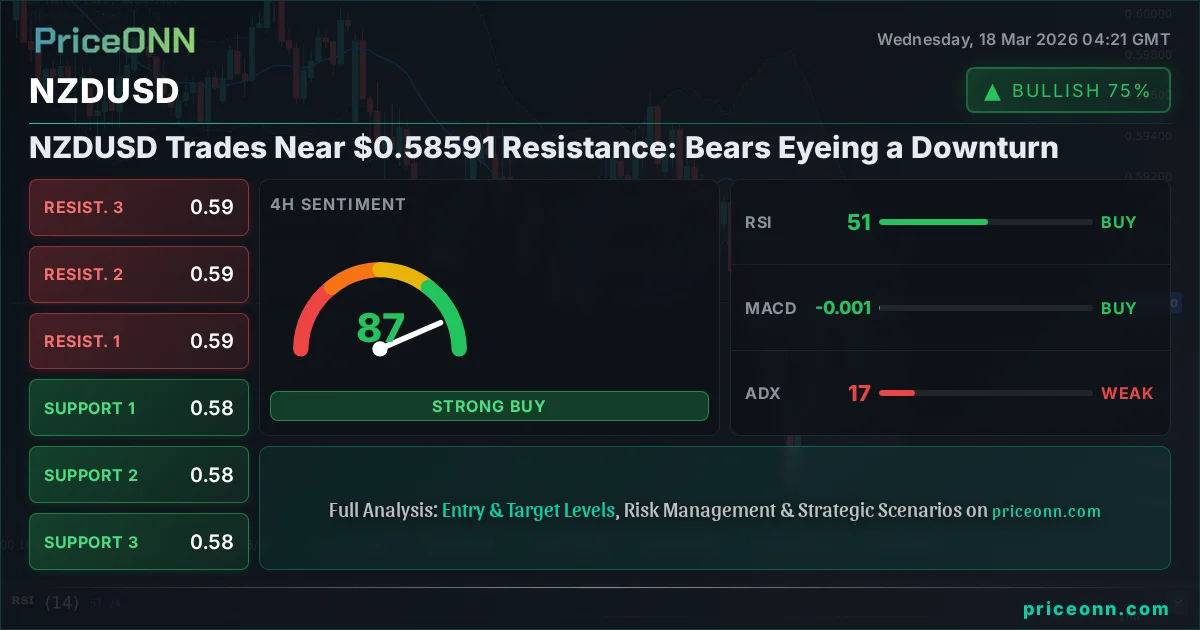
The New Zealand Dollar, often affectionately nicknamed the 'Kiwi', found itself under intense selling pressure this past Wednesday. A disappointing economic performance report triggered a sharp decline, erasing recent gains and pushing the currency to a critical juncture. The pair NZD/USD plunged by roughly 1.25% in a single session, a move that saw it flirt with the closely watched 200-day Exponential Moving Average. Ultimately, this technical level offered little solace as the downward momentum accelerated, with the pair settling near the 0.5790 mark.
This steep sell-off followed the release of New Zealand's latest Gross Domestic Product (GDP) figures. The data revealed that the nation's economic expansion fell short of expectations, painting a less optimistic picture than anticipated. Such a miss often signals underlying weaknesses in economic activity, prompting investors to reassess their exposure to the nation's currency. The implications of this economic slowdown are far-reaching, affecting everything from export revenues to the potential policy path of the Reserve Bank of New Zealand (RBNZ).
Understanding the Kiwi's Drivers
The value of the New Zealand Dollar is intrinsically linked to the health of its domestic economy and the monetary policy decisions enacted by the Reserve Bank of New Zealand. However, several external and specific factors also sway its trajectory. A primary influence is the economic vitality of China, New Zealand's largest trading partner. Weakness in the Chinese economy often translates to reduced demand for New Zealand's exports, thereby dampening the Kiwi's prospects.
Furthermore, global dairy prices play a pivotal role. Given that the dairy sector is a cornerstone of New Zealand's export earnings, fluctuations in dairy commodity prices directly impact the nation's balance of payments and, consequently, the value of its currency. Higher prices boost export income, lending strength to the NZD.
The RBNZ's mandate is to maintain inflation within a 1% to 3% range, targeting the 2% midpoint. To achieve this, the bank adjusts interest rates. When inflation pressures mount, the RBNZ typically hikes rates to cool the economy. This action can attract foreign capital seeking higher yields, thereby strengthening the NZD. Conversely, a lower interest rate environment tends to weaken the currency. The differential between New Zealand's interest rates and those set by major central banks, particularly the U.S. Federal Reserve, is a key determinant for the NZD/USD pair.
Broadly, strong economic indicators within New Zealand-such as robust growth, low unemployment, and high consumer confidence-are generally supportive of the Kiwi. Conversely, a string of weak data points can lead to depreciation. The currency also exhibits a tendency to appreciate during 'risk-on' market environments when investor appetite for growth assets increases. However, during periods of global uncertainty or market turbulence, the NZD often retreats as investors seek the safety of traditional haven assets.
Market Ripple Effects
The recent GDP miss and the subsequent sell-off in the New Zealand Dollar extend their influence beyond mere currency charts. This development warrants a close look at related markets and asset classes. The immediate impact is felt in the foreign exchange space, with the NZD/USD pair now testing key support levels. Traders will be closely monitoring whether the 0.5750 psychological level can hold, as a break below could signal further downside.
Beyond forex, the implications for commodity currencies are significant. Currencies like the Australian Dollar (AUD), which share similar economic drivers with the NZD, may also face headwinds if the market perceives a broader regional slowdown. Furthermore, the US Dollar Index (DXY) could see a modest uplift as investors rotate towards perceived safety, especially if global risk sentiment deteriorates.
For New Zealand's equity market, a weaker currency can sometimes be a double-edged sword; it might boost the competitiveness of exporters but can also signal underlying economic fragility. Investors holding New Zealand government bonds will also be watching yield movements closely, as they react to interest rate expectations and global capital flows. The narrative of slowing global growth, particularly impacting key trading partners like China, is a critical theme to watch as it directly affects the demand for raw materials and agricultural products, which are vital to New Zealand's economy.
Track markets in real-time
Empower your investment decisions with AI-powered analysis, technical indicators and real-time price data.
Join Our Telegram Channel
Get breaking market news, AI analysis and trading signals delivered instantly to your Telegram.
Join Channel