
Is the US Dollar Set for a Rebound Amidst Middle East Tensions and Fed Uncertainty?

The US Dollar Index (DXY) experienced a modest pullback, trading down to 99.58 from a recent high of 99.87, while EUR/USD edged higher to 1.1540. This movement occurred against a backdrop of simmering geopolitical tensions in the Middle East and ahead of a crucial Federal Reserve policy decision. Despite the dollar's temporary dip, the underlying factors suggest a potential for renewed strength as market participants navigate a complex economic and geopolitical landscape.
Market Context
Overnight trading saw limited significant developments from the Middle East conflict, with little progress reported on securing passage through the Strait of Hormuz. The prevailing uncertainty surrounding the conflict's duration and resolution continues to cast a shadow over global energy markets. Oil prices, specifically Brent crude, have stabilized around the $100-$105 per barrel mark, potentially becoming a short-term anchor reflecting a new normal influenced by supply concerns. In financial markets, US Treasury yields showed mixed signals, with the 2-year yield adding 0.25 bps and the 30-year yield retreating by 2.6 bps. This was mirrored by a tentative easing of market stress, evidenced by modest gains in equities, including the S&P 500 which rose 0.25%, and the Euro Stoxx 50, up 0.53%. The dollar's correction appears to be a temporary pause rather than a reversal of trend, with USD/JPY trading marginally lower at 159.
Analysis & Drivers
The primary driver influencing currency markets remains the persistent geopolitical risk emanating from the Middle East. The recent escalation involving Iran and missile strikes on Tel Aviv has heightened concerns about potential disruptions to oil supply, a factor that typically supports the US dollar as a safe-haven asset. Concurrently, market attention is sharply focused on the Federal Reserve's upcoming policy meeting. While consensus expects no change to interest rates, the accompanying projections and commentary from Fed Chair Powell will be critical. Recent data and the potential inflationary impact of higher energy prices might lead some Fed officials to adopt a more hawkish tone than anticipated. This could recalibrate market expectations regarding the timing and extent of future rate cuts, potentially bolstering the dollar if the Fed signals a more protracted stance on holding rates steady. The release of US February PPI data prior to the Fed's decision, along with final eurozone inflation figures, will offer further clues on the inflation trajectory. Additionally, the Bank of Canada's interim meeting today, where rates are also expected to remain unchanged at 2.25%, will be watched for any shifts in forward guidance, though less impactful on major currency pairs compared to the Fed.
Trader Implications
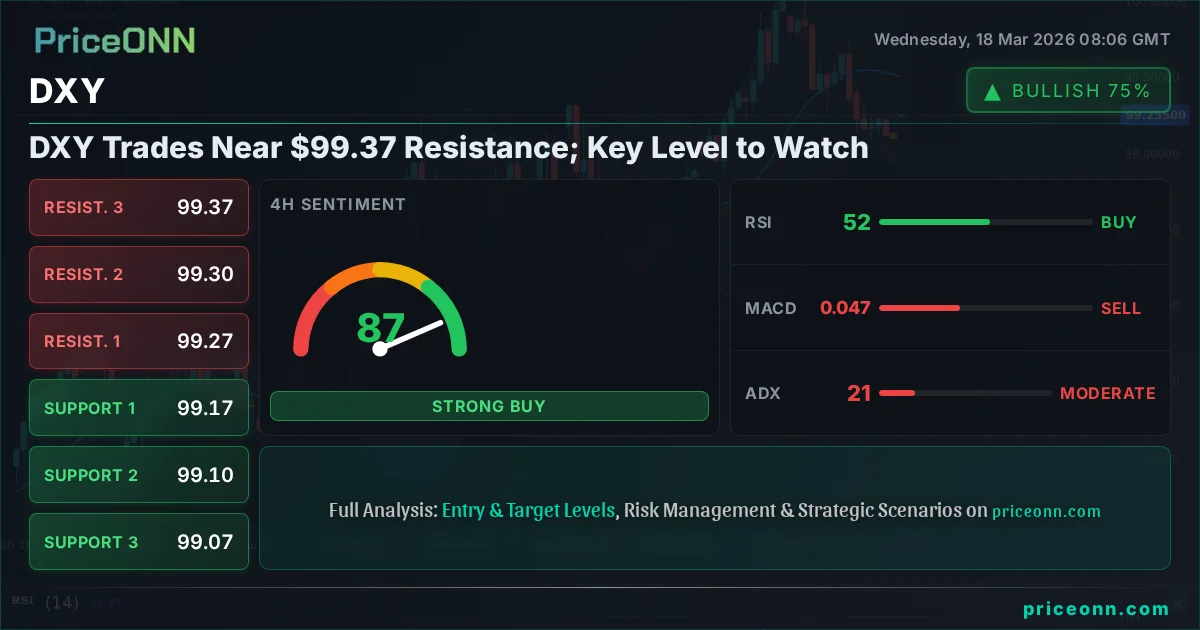
Traders should remain vigilant regarding the evolving situation in the Middle East, as any significant escalation could trigger a flight to safety, benefiting the dollar. Key price levels to watch for the US Dollar Index (DXY) include resistance at 100.00 and support around 99.30. For EUR/USD, immediate resistance lies at 1.1550, with support at 1.1500. The Fed's guidance will be paramount; a more hawkish-than-expected stance could push USD/JPY towards 160, while a dovish signal might see it retest 158. Investors should also monitor oil price movements closely, as sustained prices above $100 could reinforce inflationary concerns and influence central bank policy. The risk of a more hawkish Fed tone, coupled with ongoing geopolitical risks, presents a scenario where the dollar could find renewed upward momentum.
Outlook
The immediate outlook for the US dollar remains contingent on the Federal Reserve's policy signals and any further developments in the Middle East. If the Fed adopts a cautious or hawkish tone, reinforcing its commitment to combating inflation even amid higher energy costs, the dollar is likely to find support. Conversely, any de-escalation in geopolitical tensions or a surprisingly dovish Fed could lead to further dollar weakness. The upcoming economic data releases and central bank commentary will be crucial in shaping market sentiment and price action in the coming days.
Frequently Asked Questions
What is the current key support level for the US Dollar Index (DXY)?
The immediate support level for the US Dollar Index (DXY) is around 99.30. A break below this level could signal further weakness, while holding above it suggests resilience amidst current market conditions.
How might the Federal Reserve's stance impact the USD/JPY pair?
A more hawkish stance from the Federal Reserve, indicating a potential delay in rate cuts or a higher terminal rate, could push USD/JPY towards 160. A dovish tone might see it fall back towards 158.
What is the outlook for oil prices and its effect on currency markets?
Oil prices are showing signs of stabilizing around $100-$105 per barrel. Sustained high oil prices could exacerbate inflation concerns, potentially leading central banks to maintain tighter monetary policy, which could support their respective currencies, including the US dollar.
Track markets in real-time
Empower your investment decisions with AI-powered analysis, technical indicators and real-time price data.
Join Our Telegram Channel
Get breaking market news, AI analysis and trading signals delivered instantly to your Telegram.
Join Channel


PriceONN