
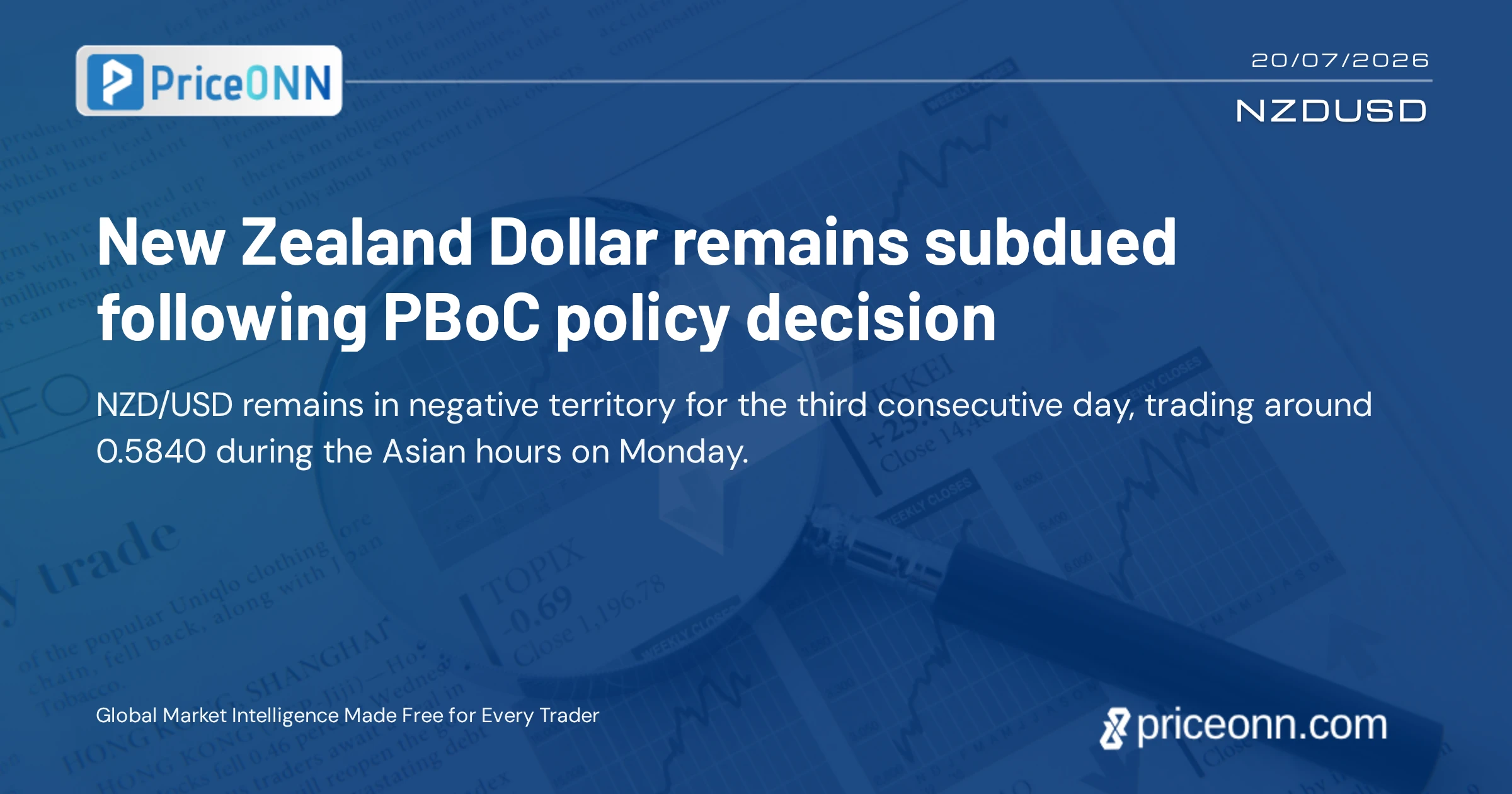
New Zealand Dollar remains subdued following PBoC policy decision
 PriceONN Editorial Desk
Multi-source verification
PriceONN Editorial Desk
Multi-source verification
Kiwi Currency's Delicate Dance with Global Forces
The New Zealand Dollar, affectionately known as the Kiwi, often finds itself at the crossroads of international economic currents. While its value is intrinsically linked to the health of New Zealand's domestic economy and the monetary policy decisions of the Reserve Bank of New Zealand (RBNZ), its trajectory is far from solely dictated by Wellington. A significant external influence stems from its largest trading partner, China. Developments within the Chinese economy cast a long shadow, impacting demand for New Zealand's exports and, consequently, the Kiwi's valuation.
The intricate relationship between the Kiwi and the Chinese economic engine is a critical factor for currency traders to monitor. When China's economic outlook dims, it can translate into reduced orders for New Zealand goods, dampening export revenues and pressuring the NZD. This dynamic highlights the interconnectedness of global trade and the vulnerability of smaller economies to shifts in major economic powers.
Key Drivers Shaping the Kiwi's Movement
Beyond the influence of its major trading partner, several other fundamental elements propel the NZD's fluctuations. The nation's vital dairy sector plays a disproportionately large role. Robust global demand for dairy products translates into higher export earnings for New Zealand, providing a substantial boost to the national economy and, by extension, its currency. The strength of this agricultural lifeline cannot be overstated in understanding Kiwi price action.
The RBNZ's mandate to maintain inflation within a 1% to 3% band, with a target centered at 2%, dictates its approach to interest rates. When inflationary pressures rise, the RBNZ typically tightens monetary policy by increasing interest rates. This move not only aims to cool domestic demand but also broadens the appeal of New Zealand assets to international investors due to higher yields. Such a scenario generally bolsters the NZD. Conversely, a reduction in interest rates, or expectations thereof, tends to exert downward pressure on the currency.
Furthermore, the 'rate differential'-the gap between New Zealand's interest rates and those set by major central banks like the US Federal Reserve-is a crucial determinant of the NZD/USD exchange rate. A widening positive differential in favor of New Zealand typically supports the pair, while a narrowing or negative differential can lead to its decline.
Macroeconomic data releases from New Zealand serve as crucial barometers of the nation's economic vitality. Strong indicators such as high economic growth, low unemployment figures, and elevated business and consumer confidence are generally supportive of the NZD. A thriving economy can attract foreign direct investment and may even prompt the RBNZ to consider rate hikes if inflation accelerates. Conversely, a string of weak economic data points often leads to Kiwi depreciation.
The Kiwi's performance also tends to mirror broader market sentiment. During periods of 'risk-on,' when investor appetite for risk assets increases and global uncertainty recedes, commodity currencies like the NZD often experience a tailwind. Investors feel more comfortable allocating capital to economies perceived as having higher growth potential. However, during times of market stress or significant economic uncertainty, the NZD typically weakens as investors retreat to perceived safe-haven assets.
Trader Takeaways
The persistent weakness in the NZD/USD pair, now trading around 0.5840, reflects a confluence of factors, including the People's Bank of China's decision to hold its benchmark lending rates steady. This stability in Chinese monetary policy, while not explicitly negative, does little to inject fresh optimism into the outlook for New Zealand's key export markets.
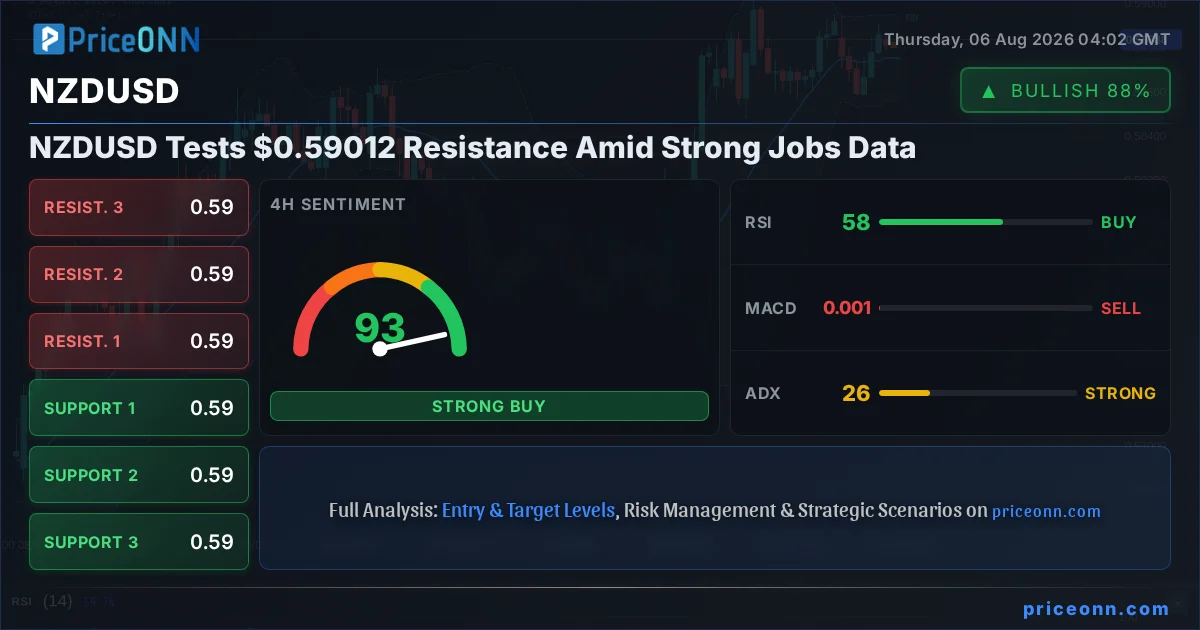
For traders, the current environment presents a complex picture. The Kiwi's sensitivity to both global risk sentiment and commodity prices means that shifts in geopolitical tensions or commodity market volatility could trigger sharp moves. Key levels to watch include the recent lows around 0.5800, a break below which could signal further downside. Conversely, any sustained move above 0.5900 would indicate a potential shift in sentiment.
The interconnectedness of the New Zealand economy with China and global commodity markets suggests that traders should closely monitor developments in crude oil and dairy prices, alongside RBNZ policy signals and upcoming New Zealand inflation data. The US Dollar Index (DXY) also remains a critical barometer, as a strengthening dollar typically weighs on NZD/USD. The Australian Dollar (AUD) often moves in tandem with the Kiwi, offering cross-asset insights.
Track markets in real-time
Empower your investment decisions with AI-powered analysis, technical indicators and real-time price data.
Join Our Telegram Channel
Get breaking market news, AI analysis and trading signals delivered instantly to your Telegram.
Join Channel PriceONN News
Whatever the inflation figures may be, the precious metal will come out on top. Japan and the US don’t want to give the yen’s fate to speculators. The US dollar continues to recover from the blow dealt by the labour market statistics. A rally in Treasury bond yields is driving the rise in the USD […] The post Gold as a Sure-Fire Bet appeared first on ActionForex.
PriceONN News
Markets Core bonds sold off yesterday with the belly of the curve slightly underperforming in the US while European curves showed more of a bear flattening. Daily changes on the US curve varied between +4.7 bps (2-yr) and +6.4 bps (7-yr). The US 30-yr yield is again within reach of the multi-annual high reached end […] The post Sunrise Market Commentary appeared first on ActionForex.
PriceONN News
RBA accepted that inflation has improved, but refused to turn that improvement into a declaration that rate hikes are finished. Cash rate was left unchanged at 4.35% unanimously, yet Board described policy as only “somewhat restrictive” and explicitly kept another increase on table, saying it could still raise rates “if upside risks materialise.” That is […] The post RBA Accepts Softer Inflation but Still Leaves Scope for One More Hike appeared first on ActionForex.
PriceONN News
The Consumer Price Index (CPI) rose by 0.1% month-on-month (m/m) in July – in line with expectations. On a twelve-month basis, CPI edged down to 3.4% (from 3.5% in June). Energy costs fell by 1.5% m/m, led by a 2.9% m/m decline in prices at the pump. Food prices rose 0.1% m/m – its softest […] The post US: Inflationary Pressures Remain Subdued in July appeared first on ActionForex.
PriceONN News
US inflation eased as expected in July, reinforcing case for Fed to stay on hold while it waits for clearer evidence on both prices and labor market. Headline CPI rose from -0.4% to 0.1% m/m, while annual rate slowed from 3.5% y/y to 3.4%. Core CPI increased from 0.0% to 0.2% m/m, with annual core […] The post US CPI Slows to 3.4% as Core Inflation Eases to 2.5% appeared first on ActionForex.
PriceONN News
Germany’s benchmark index just made history, breaking above 26,500 for the first time ever, extending a rally that has already delivered close to 10% over the past twelve months. The move came on fresh optimism around a potential resolution to the Iran conflict, though that optimism proved short-lived: President Trump’s latest demands, that Tehran compensate […] The post DAX 40: Record Highs, Real Fundamentals, One Channel Left to Test appeared first on ActionForex.
PriceONN News
Brent oil price rose to the highest in over one week on Tuesday, in extension of Monday’s nearly 5% advance, following the latest verbal escalation by President Trump that quickly changed the sentiment and countered efforts of Iran and Oman to find solution for reopening of strategic Hormuz strait. The latest demands from President Trump […] The post Brent Oil Price Falls After Recovery Failed to Clear Important $90 Barrier appeared first on ActionForex.
PriceONN News
Hello fellow traders. In this technical article we’re going to take a look at the Elliott Wave charts charts of Copper (HG_F) commodity published in members’ area of the website. As our members know, Copper Futures recently completed a pullback that provided a high-probability trading setup. The decline unfolded as a clear Elliott Wave Zig […] The post Copper (Hg_F) Elliott Wave: Targeting a Buy at the Blue Box appeared first on ActionForex.
PriceONN News
The NFIB’s Small Business Optimism Index rose 2.4 points to 99.8 in July, soundly beating expectations for a roughly flat reading of 97.5. Eight out of the ten index subcomponents improved during the month and two deteriorated. The largest improvement came from the net share of firms planning to increase employment (up 9 points to […] The post US: Small Business Optimism Spiked in July appeared first on ActionForex.
PriceONN News
Overnight, the RBA held its cash rate steady at 4.35%, as widely expected after June’s inflation data came in softer than forecast at 3.8% headline. Yet the accompanying statement struck a notably cautious tone, warning that trimmed mean inflation remains elevated and largely unchanged from the March quarter, with oil and related commodities still trading […] The post EUR/AUD: Two Central Banks on Hold, One Triangle About to Break appeared first on ActionForex.
PriceONN News
A deal to reopen the Strait of Hormuz is not inevitable. Oil prices are rising amid growing risks of an escalation of the conflict in the Middle East. The US dollar continued to recover from losses caused by the jobs report, against a backdrop of rising geopolitical tensions in the Middle East with traders squaring […] The post Brent Is Following a Path of Demands Rather Than Commitments appeared first on ActionForex.
PriceONN News
Gold rose to 4,400 USD per ounce on Tuesday, reaching a two-month high. Demand for the precious metal is growing rapidly, even amid heightened inflation risks and expectations of higher interest rates driven by elevated oil prices. Chinese institutional investors continue to build positions in gold as a defensive asset amid heightened volatility in other […] The post Gold Rallies: Long-Awaited Rise and Growing Safe-Haven Demand appeared first on ActionForex.