NZD/USD rebounds from 0.5750 as risk aversion ease

Unpacking the Kiwi's Recent Performance
The New Zealand Dollar, affectionately known as the Kiwi, experienced a halt to its three-day losing streak, finding support and trading near the 0.5780 mark during Friday's Asian session. This brief reprieve comes after a period of downward pressure, hinting at a potential stabilization in its valuation.
While often seen as a straightforward barometer of the island nation's economic health and monetary policy, the Kiwi's movements are influenced by a complex interplay of global and domestic factors. Understanding these drivers is critical for any trader looking to navigate its volatility.
Key Drivers Shaping the New Zealand Dollar
The economic fortunes of China, New Zealand's paramount trading partner, cast a long shadow over the Kiwi. Any sign of economic weakness in Beijing can translate directly into reduced demand for New Zealand's exports, thereby dampening the nation's economy and, consequently, its currency.
Similarly, the global price of dairy products plays an outsized role. As the cornerstone of New Zealand's export revenue, fluctuations in dairy prices directly impact the country's balance of payments and investor sentiment towards the NZD.
Domestically, the Reserve Bank of New Zealand (RBNZ) orchestrates monetary policy with a mandate to keep inflation within a 1% to 3% range, targeting the 2% midpoint. When inflation pressures mount, the RBNZ may lift interest rates. This action not only aims to cool the economy but also enhances the attractiveness of New Zealand's bond yields, potentially drawing in foreign capital and bolstering the Kiwi.
Conversely, a dovish monetary stance, characterized by lower interest rates, often exerts downward pressure on the currency. The critical rate differential, comparing New Zealand's interest rates against those set by major central banks like the U.S. Federal Reserve, is a constant focal point for currency traders assessing the NZD/USD pair.
Macroeconomic data releases from New Zealand serve as vital indicators of the economy's pulse. Robust economic growth, falling unemployment figures, and high business confidence paint a favorable picture for the NZD. Such strength can attract foreign investment and, if accompanied by rising inflation, might prompt the RBNZ to tighten policy.
However, a weakening economic outlook, signaled by disappointing data, typically leads to a depreciation of the New Zealand Dollar. The currency's sensitivity to global risk sentiment is also pronounced; it tends to gain traction during periods of heightened optimism and low perceived market risk, a scenario that benefits commodity-linked currencies. When uncertainty flares or market turbulence ensues, investors often shed riskier assets like the Kiwi in favor of safer havens, driving its value lower.
Market Ripple Effects
The recent stabilization in the NZD/USD pair, even if temporary, is a signal that the intense risk aversion seen earlier in the week may be subsiding. This shift in sentiment can have broader implications across financial markets.
Risk Appetite and Global Equities: A sustained improvement in risk sentiment would likely benefit global equity markets. Indices like the S&P 500 and the Composite could see further upward momentum as investors become more comfortable taking on risk. Conversely, a resurgence in fear would pressure these markets.
Commodity Prices: As a commodity currency, the New Zealand Dollar often moves in tandem with raw material prices. A lift in global risk appetite can support demand for commodities, potentially boosting prices for metals and energy, which in turn could further underpin the Kiwi.
US Dollar Index (DXY): The NZD/USD pair's performance is intrinsically linked to the strength of the US Dollar. A cooling of global risk aversion might see a slight pullback in the DXY as capital flows out of safe-haven assets. However, if US economic data remains strong, the dollar could retain underlying support, creating a complex dynamic for the NZD/USD.
Australian Dollar (AUD): Given the close economic ties and similar commodity-driven nature, the Australian Dollar (AUD) often moves in correlation with the NZD. A recovery in risk sentiment benefiting the Kiwi would likely see a similar positive impact on its trans-Tasman neighbor.
Trader Takeaways
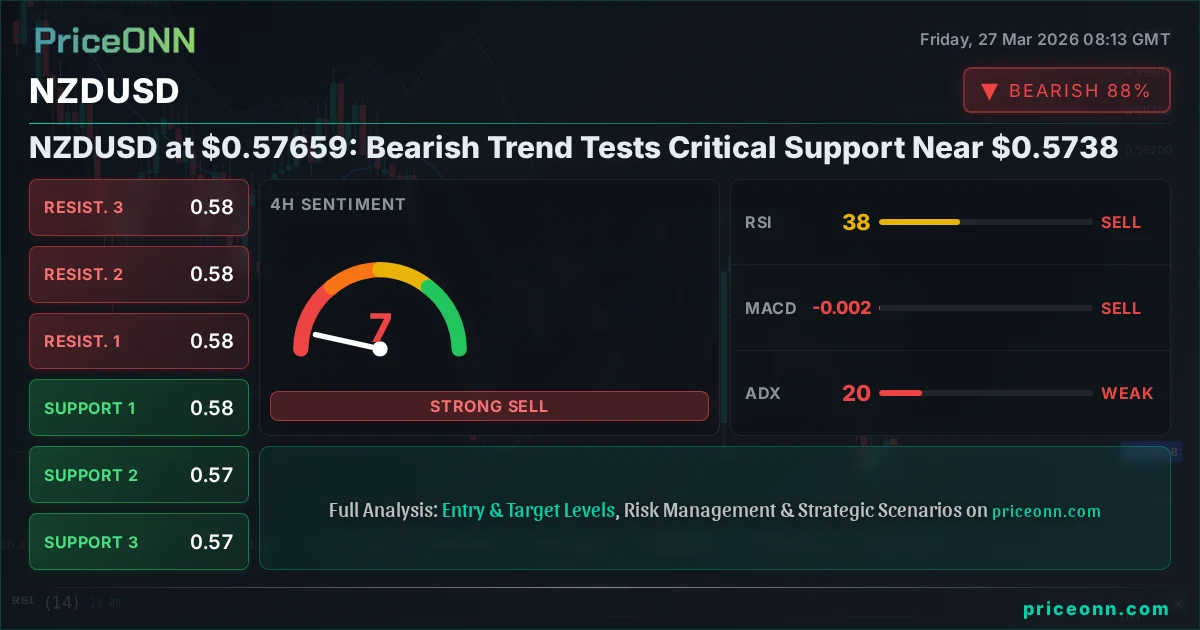
The current positioning of the NZD/USD pair near 0.5780 suggests a market pause rather than a decisive trend reversal. Traders will be keenly watching for confirmation of the easing risk aversion. Key economic data releases from both New Zealand and the United States in the coming days will be critical in shaping the next move.
Immediate upside resistance for the NZD/USD could be found around the 0.5800 to 0.5850 levels. Conversely, a failure to hold the current gains could see a retest of the 0.5750 low, with further support potentially found near 0.5700. The interplay between global risk sentiment and the specific economic data from New Zealand and the US will dictate the short-to-medium term trajectory.
Track markets in real-time
Empower your investment decisions with AI-powered analysis, technical indicators and real-time price data.
Join Our Telegram Channel
Get breaking market news, AI analysis and trading signals delivered instantly to your Telegram.
Join Channel