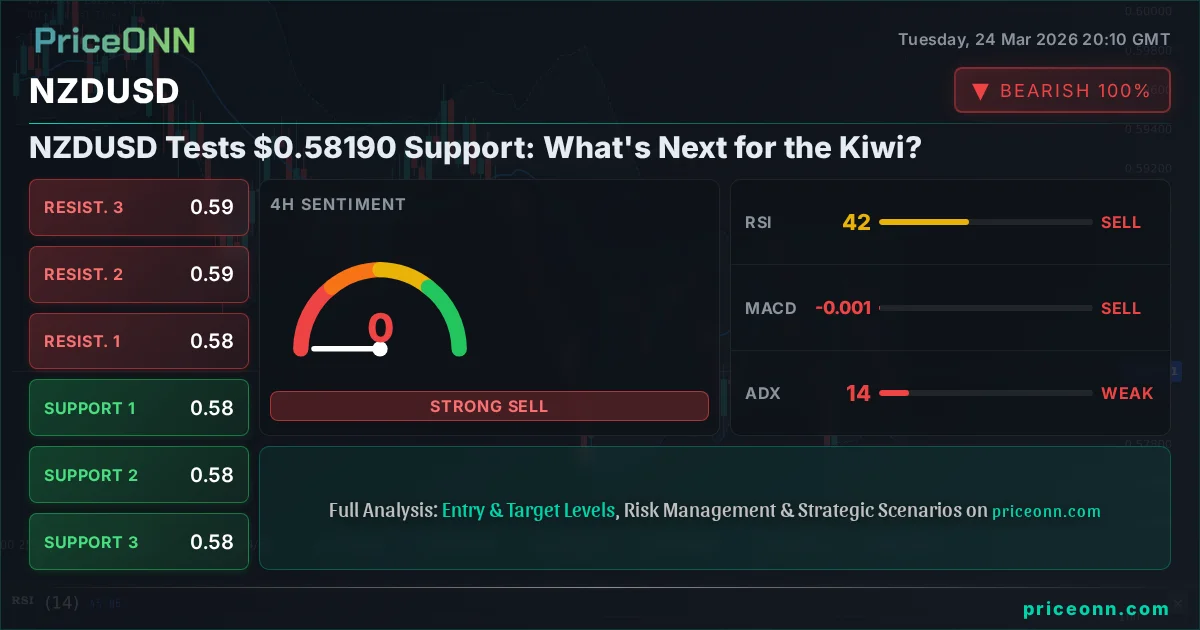
NZD/USD weakens below 0.5850 as US-Iran talks remain uncertain

Global Uncertainty Fuels Dollar Demand
The New Zealand Dollar, a currency closely watched by global markets, experienced a notable decline in early Wednesday trading. As Asian markets opened, the NZD/USD pair shed value, falling to a low of around 0.5830. This downward pressure is primarily driven by a surge in geopolitical tensions stemming from the Middle East, which is prompting investors to abandon riskier assets in favor of the perceived safety of the US Dollar.
The dynamics of the Kiwi are multifaceted, extending beyond domestic economic indicators. Its performance is intricately linked to the economic vitality of China, New Zealand’s largest trading partner. Any sign of weakness in the Chinese economy can directly translate into reduced demand for New Zealand’s exports, consequently impacting the nation's economic health and the value of its currency.
Furthermore, the global commodity landscape plays a pivotal role. Dairy prices, a cornerstone of New Zealand’s export revenue, significantly influence the currency's strength. Robust global demand for dairy products bolsters export earnings, providing a tailwind for the economy and the NZD.
Domestically, the Reserve Bank of New Zealand (RBNZ) operates with a mandate to maintain inflation within a specific range, targeting 1% to 3% with a midpoint focus of 2%. The central bank's monetary policy decisions, particularly adjustments to interest rates, are critical. When inflation pressures mount, the RBNZ may tighten policy by raising interest rates. This action not only aims to cool the economy but also tends to increase yields on New Zealand government bonds, making them more attractive to international investors and thereby supporting the Kiwi.
Conversely, a lower interest rate environment, or expectations thereof, can exert downward pressure on the NZD. The interest rate differential between New Zealand and major economies, especially the United States, is a key determinant for the NZD/USD pair's trajectory. A widening gap favoring the US can lead to capital outflows from New Zealand, weakening the currency.
Economic data releases from New Zealand are closely scrutinized. Strong performance in key indicators such as GDP growth, employment figures, and consumer confidence typically boosts the NZD. A robust economy attracts foreign direct investment and can embolden the RBNZ to pursue tighter monetary policy, especially if accompanied by rising inflation. Conversely, disappointing economic data often leads to currency depreciation.
The New Zealand Dollar often exhibits a 'risk-on' profile, meaning it tends to appreciate when global investors are optimistic about economic growth and perceive minimal market risk. During such periods, commodities often perform well, lifting commodity-linked currencies like the Kiwi. However, in times of heightened market volatility or significant economic uncertainty, investors typically de-risk their portfolios, selling assets perceived as higher-risk, such as the NZD, and seeking refuge in traditional safe havens like the US Dollar.
Market Ripple Effects
The recent slide in the NZD/USD below the 0.5850 level is more than just a minor currency fluctuation; it signals a broader shift in investor sentiment driven by geopolitical anxieties. The immediate impact is felt in the currency markets, with the US Dollar Index (DXY) likely to find continued support as safe-haven demand persists. This could create headwinds for other commodity-linked currencies such as the Australian Dollar (AUD), which often moves in tandem with the Kiwi due to similar economic drivers like commodity exports and proximity to China.
Beyond currency pairs, the implications extend to global equity markets, particularly those with significant exposure to emerging markets or commodity-dependent sectors. A sustained 'risk-off' environment can lead to broader sell-offs in equities as investors reassess growth prospects. Furthermore, the elevated cost of capital for emerging market borrowers could rise if the US Dollar continues its ascent, potentially impacting bond markets in those regions.
Traders should monitor upcoming RBNZ communications and New Zealand economic data closely. Any indication of domestic economic resilience could provide a floor for the NZD, but for now, external geopolitical risks appear to be the dominant force. The key question remains how long these Middle East tensions will persist and whether they escalate further, dictating the duration of the current dollar strength and risk aversion.
Track markets in real-time
Empower your investment decisions with AI-powered analysis, technical indicators and real-time price data.
Join Our Telegram Channel
Get breaking market news, AI analysis and trading signals delivered instantly to your Telegram.
Join Channel