EUR/USD drifts higher above 1.1600 amid hopes on US-Iran peace talks
Currency Pair Finds Traction on Geopolitical Rumors
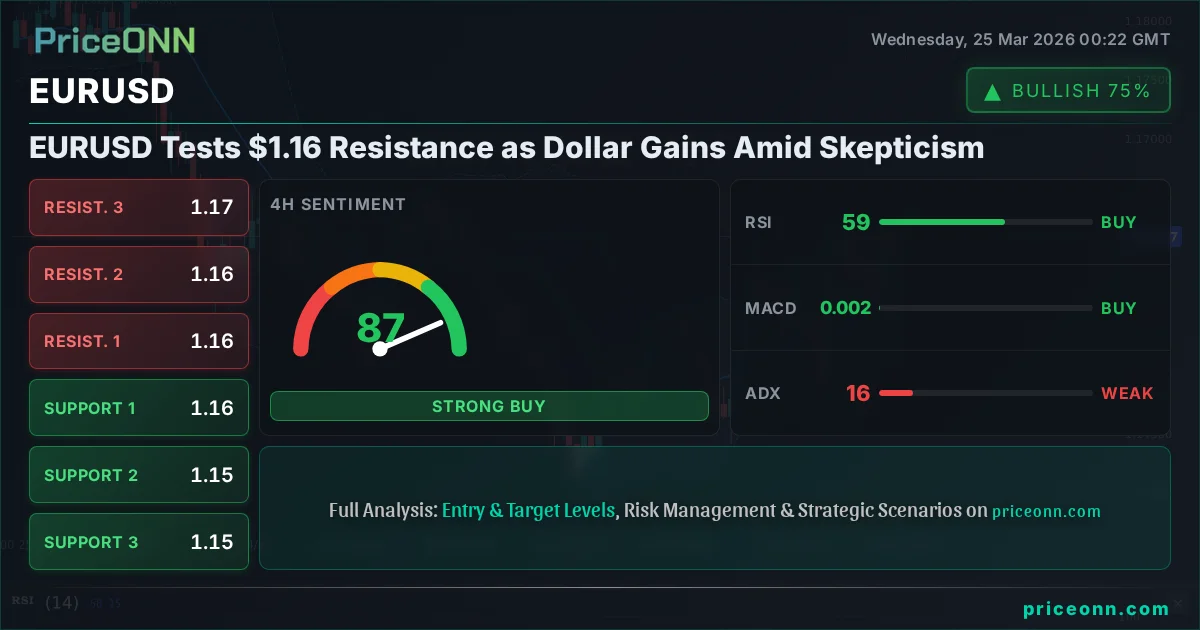
The EUR/USD exchange rate is exhibiting upward movement, inching closer to the 1.1630 mark during Wednesday's early Asian session. This climb sees the single European currency gaining ground against its US counterpart, buoyed by reports suggesting a potential diplomatic engagement between the United States and Iran, possibly commencing as early as Thursday.
The Euro, representing the collective economic power of the 20 European Union nations forming the Eurozone, stands as the second most frequently traded currency globally. In 2022, market data shows it was involved in a staggering 31% of all foreign exchange transactions, with daily turnover exceeding $2.2 trillion. This volume underscores its critical role in international finance.
Unsurprisingly, EUR/USD commands the largest share of the forex market, accounting for an estimated 30% of all trades. Its significance far outweighs other Euro crosses like EUR/JPY (4%), EUR/GBP (3%), and EUR/AUD (2%). Overseeing the Euro's monetary health is the European Central Bank (ECB) in Frankfurt. The ECB is tasked with setting interest rates and steering monetary policy to maintain price stability across the Eurozone.
ECB's Mandate and Economic Barometers
The ECB's core mission revolves around safeguarding price stability, a delicate balancing act that involves managing inflation or stimulating economic expansion. Its primary instrument for achieving this is the adjustment of interest rates. Generally, higher interest rates, or the anticipation thereof, tend to strengthen the Euro. Conversely, lower rates can exert downward pressure.
Monetary policy directives are formulated by the ECB Governing Council during eight scheduled meetings annually. These crucial decisions are made by the governors of the Eurozone's national central banks, alongside six permanent members, including the ECB President, Christine Lagarde. Economic indicators, particularly Eurozone inflation figures captured by the Harmonized Index of Consumer Prices (HICP), serve as vital econometric signals for the Euro's trajectory. An inflation rate exceeding projections, especially if breaching the ECB's 2% target, typically prompts the bank to implement rate hikes to curb rising prices.
A robust economic performance within the Eurozone is inherently beneficial for the single currency. It not only attracts a greater influx of foreign investment but also creates conditions where the ECB might consider raising interest rates, a move that directly bolishes the Euro's value. Conversely, weak economic data often leads to a depreciation of the Euro.
Key Economic Drivers for the Euro
The economic health of the four largest Eurozone economies – Germany, France, Italy, and Spain – carries disproportionate weight, as they collectively represent approximately 75% of the bloc's entire economic output. Therefore, economic reports originating from these nations are closely scrutinized by market participants.
Another significant metric influencing the Euro is the Trade Balance. This indicator quantifies the difference between a nation's earnings from exports and its expenditures on imports over a specified period. A country boasting strong demand for its exports will likely see its currency appreciate due to increased demand from international buyers seeking those goods. Consequently, a positive net Trade Balance typically reinforces a currency's strength, while a negative balance can have the opposite effect.
Market Ripple Effects
This development, while seemingly focused on geopolitical talks, carries potential implications far beyond the immediate participants. The prospect of de-escalation in US-Iran tensions could reduce global risk premiums, a factor that often benefits riskier assets and may put downward pressure on safe-haven currencies.
Traders will be closely watching how this geopolitical narrative unfolds. A successful diplomatic thaw could lead to increased oil supply if sanctions on Iran are eased, potentially impacting crude oil prices downwards. This, in turn, could influence inflation expectations and central bank policies globally. For currency markets, a reduction in geopolitical uncertainty might lead to a strengthening of the US Dollar Index (DXY) if global risk appetite shifts away from perceived safe havens. Conversely, if the market interprets this as a sign of US foreign policy pragmatism, it could offer subtle support to risk-sensitive currencies, though the immediate impact on EUR/USD will likely be driven by its relative interest rate differentials and economic outlook.
Track markets in real-time
Empower your investment decisions with AI-powered analysis, technical indicators and real-time price data.
Join Our Telegram Channel
Get breaking market news, AI analysis and trading signals delivered instantly to your Telegram.
Join Channel