
Oil Defies IEA's Record Reserve Release as Supply Crunch Grips Market


West Texas Intermediate (WTI) crude oil is holding near $85 a barrel despite the International Energy Agency (IEA) authorizing the release of 400 million barrels from strategic reserves. This unprecedented move, the largest coordinated action in the agency's history, aimed to dampen speculative fervor, but the market's reaction suggests deeper, more persistent supply-side issues are at play.
Market Context
The IEA's decision to tap into strategic reserves reflects growing anxiety over global oil supplies, particularly in light of recent geopolitical events. The release, equivalent to 6.6 million barrels per day over 60 days, sought to counter the impact of significant supply disruptions. However, the market's muted response indicates that the underlying issue – a substantial supply deficit – remains unresolved. WTI had briefly dipped to $76.76 before recovering.
Analysis & Drivers
The limited impact of the IEA's intervention can be attributed to several factors. First, the scale of the supply disruption far outweighs the reserve release. With events like the Strait of Hormuz closure taking an estimated 20 million barrels per day offline, the IEA's contribution only partially offsets the shortfall, leaving a gap of 13.4 million barrels per day. Second, the market had likely anticipated the IEA's move, with policy shifts of this magnitude rarely occurring without prior signals. This pre-emptive pricing likely absorbed much of the initial shock.
WTI Oil Price Drivers:
- Supply and Demand: Global economic growth fuels demand, while recessions curb it.
- Geopolitical Instability: Wars and sanctions disrupt supply chains.
- OPEC Decisions: Production quotas set by OPEC influence market balance.
- USD Value: A weaker dollar makes oil cheaper for international buyers.
- Inventory Reports: API and EIA data reflect supply/demand fluctuations.
Logistical challenges further complicate the situation. Moving reserves to refineries is not instantaneous. The time lag between the IEA's announcement and the actual delivery of oil adds to market uncertainty, especially in a volatile environment.
Trader Implications
Traders should closely monitor several key factors:
- Geopolitical Developments: Escalations or de-escalations in key regions will significantly impact supply expectations.
- OPEC+ Actions: Any shifts in OPEC+ production policy could exacerbate or alleviate supply pressures.
- Inventory Data: Weekly inventory reports from the API and EIA will provide insights into the current supply/demand balance.
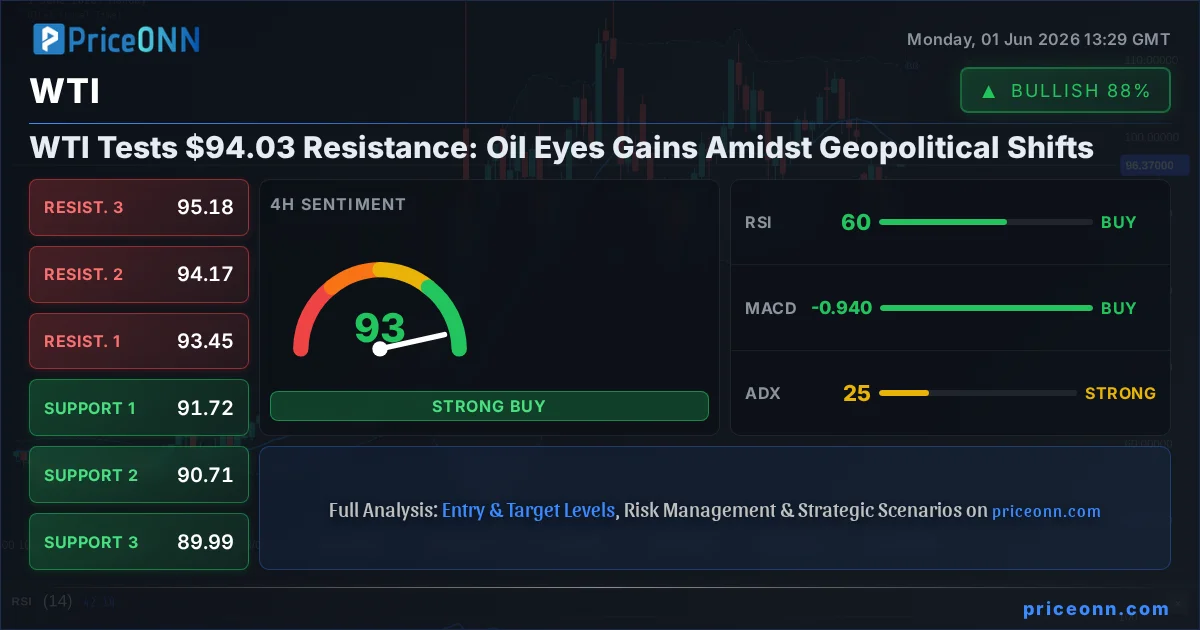
- Technical Levels: Watch for support around $80 and resistance near $88. A break below support could signal further downside, while a move above resistance might indicate renewed bullish momentum.
The 200-hour moving average is a key level to watch for potential support. Traders should also be aware that WTI is considered a "light" and "sweet" crude oil, easily refined and sourced in the US, making it a benchmark for the oil market.
Outlook
The oil market remains finely balanced, with geopolitical risks and supply constraints continuing to outweigh the impact of strategic reserve releases. Expect continued volatility in the near term, with prices sensitive to any new developments on the geopolitical front. Traders should remain nimble and prepared to adjust their positions based on evolving market conditions.
Track markets in real-time
Empower your investment decisions with AI-powered analysis, technical indicators and real-time price data.
Join Our Telegram Channel
Get breaking market news, AI analysis and trading signals delivered instantly to your Telegram.
Join Channel PriceONN News
Crude oil prices experienced a significant drop, with WTI futures falling over 1.8% to $87.25, as optimism grew for a U.S.-Iran deal potentially reopening the Strait of Hormuz.
PriceONN News
(RTTNews) - Crude oil prices have tumbled on Friday as expectations of the U.S. and Iran signing a Memorandum of Understanding run high. The MoU would allow for immediate reopening of the Strait of Hormuz and pave the way for the resumption of oil and energy trade.
PriceONN News
Crude oil futures experienced a dramatic intraday reversal on Thursday, soaring overnight on geopolitical fears only to pull back significantly as reports of a potential diplomatic understanding between the U.S. and Iran emerged.
PriceONN News
Iran's oil exports fell to their lowest level in at least six years in May as the U.S. naval blockade continued to choke off crude shipments and leave tens of millions of barrels stranded at sea. According to shipping data from Vortexa, Iran exported just 209,000 barrels per day (bpd) of crude oil and condensate in May, down from 1.34 million bpd in April and nearly 1.9 million bpd in March. Kpler had estimated May exports slightly higher at 260,000 bpd, but still the lowest level since the...
PriceONN News
Crude oil prices experienced a significant downturn as market sentiment shifted towards optimism about a potential US-Iran Memorandum of Understanding that could reopen the Strait of Hormuz. WTI futures fell nearly 2% on the news.
PriceONN News
Crude oil futures experienced a dramatic intraday reversal, soaring to $92.52 before pulling back significantly on Thursday. The volatile session was driven by shifting geopolitical narratives and U.S. inventory data.
PriceONN News
(RTTNews) - Crude oil futures skyrocketed overnight but have shown a significant pullback over the course of the trading day on Thursday.
PriceONN News
(RTTNews) - Extending the losses from yesterday's session, crude oil prices have gone into freefall on Wednesday as investor expectations on a potential U.S.-Iran agreement continue to rise despite the U.S. refusing to ease its demands.
PriceONN News
(RTTNews) - Crude oil prices have tumbled on Tuesday as optimism about a U.S.-Iran peace deal that could lead to reopening of the Strait of Hormuz soon grows despite reports of fresh U.S. strikes on Iran yesterday.
PriceONN News
South America has raised its oil exports more than the U.S. has done so far this year as key producers in the region boosted production and shipments to a world scrambling for crude that’s not dependent on the Strait of Hormuz. Over the past five years, South America’s biggest producer and exporter, Brazil, has started production at several new offshore platforms in the Santos pre-salt fields. Guyana has continuously increased overseas shipments as the Exxon-led consortium starts up...
PriceONN News
Africa's biggest refinery is getting bigger. Nigeria's Dangote refinery has started work on a second crude processing unit that will add another 700,000 barrels per day (bpd) of capacity, putting the complex on track to rival the world's largest refining site and giving billionaire owner Aliko Dangote a much larger role in global fuel markets. According to Dangote Petroleum Refinery CEO David Bird, construction is already underway at the Lekki site outside Lagos. The new refinery is expected to...
PriceONN News
The Iran war suddenly turned what had started as a year of oversupply in global oil and LNG markets into the worst oil and gas supply disruption in history. Three months after the U.S.-Israeli strikes on Iran began on February 28, the world has already lost 1 billion barrels of crude oil supply, oil and gas prices have found a new, much higher floor, and whipsaw with violent volatility nearly every day, trade routes have shifted, and tanker rates have spiked. Actual supply shortages are...