
The Oil Market Could Be Weeks From a Breaking Point
 PriceONN Editorial Desk
Multi-source verification
PriceONN Editorial Desk
Multi-source verification
Market Buffers Fraying Under Supply Strain
For nearly four months, the global oil market has navigated an unprecedented supply crisis stemming from a choked Strait of Hormuz, an event that initially threatened the most severe disruption in history. Yet, crude prices have stubbornly stayed under the $100 per barrel mark. This remarkable resilience, defying the potential loss of 13 million barrels per day (bpd) of supply, has been propped up not merely by optimism surrounding a potential U.S.-Iran accord, but by significant market stabilizers. These crucial cushions have absorbed the shock, preventing a steeper price ascent.
Key among these stabilizing forces were drastic import reductions by China, the planet's largest crude purchaser, pushing its intake to multi-year lows. Simultaneously, the United States amplified its crude exports to record levels, adding substantial supply to the global market. Developed nations also contributed by strategically releasing oil from their strategic reserves, a move that provided a vital, albeit temporary, reprieve during this extraordinary period.
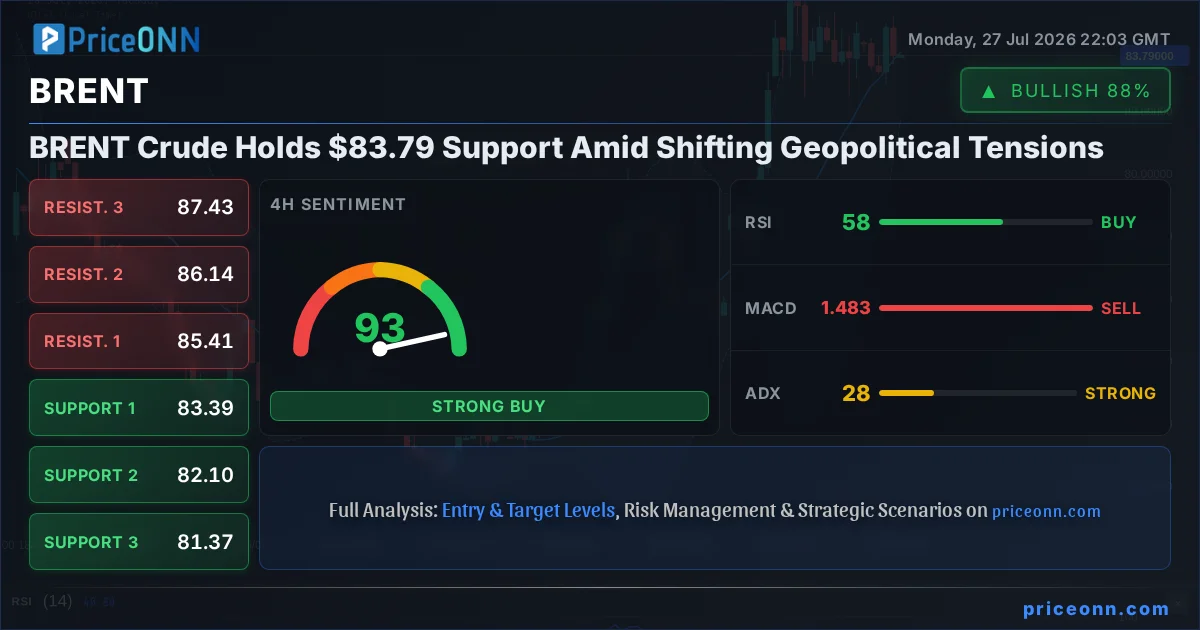
However, the efficacy of these buffers is rapidly diminishing. Inventories are being drawn down at an alarming pace, signaling that the market is approaching a critical juncture. Analysts warn that if tanker traffic through the Strait of Hormuz continues to be severely curtailed, a significant price spike could materialize within weeks.
The Looming Inflection Point
Warren Patterson, Head of Commodities Strategy at ING, articulated this concern, noting in a recent assessment that the end of July could represent a pivotal moment for the market. "From an inventory perspective, we believe that the end of July could be an inflection point for the market if there is no improvement in energy flows from the Persian Gulf," he stated. This inflection point, absent a swift resolution to the Hormuz transit issues, carries the potential to propel Brent Crude prices into the $120-$130 per barrel range this summer.
Such elevated pricing would undoubtedly intensify diplomatic pressure on the United States to broker a deal. Patterson further speculated that if an agreement remains elusive, energy-starved nations might eventually become more amenable to paying unofficial tolls to Iran for unimpeded passage through the Strait. ING’s baseline projection anticipates that Strait of Hormuz flows will remain significantly restricted through July, leading to a market deficit in the third quarter.
The bank forecasts Brent Crude to average $110 per barrel between July and September. A recovery in Middle Eastern flows is anticipated in the fourth quarter and into 2027, potentially easing prices thereafter. The three primary buffers-China's subdued imports, record U.S. exports, and strategic reserve releases-which have collectively helped anchor oil below the $100 threshold, are proving increasingly unsustainable.
China's Shifting Import Strategy
China's crude oil imports in May plunged to their lowest point since October 2017, a direct consequence of the elevated prices driven by the Hormuz situation. In a clear indication of its reluctance to pay premium prices for immediate crude, the world's leading importer began drawing down its substantial oil reserves last month. To manage the crisis so far, Beijing has curtailed refinery operations, limited export volumes, and reduced demand for transportation fuels, with consumers increasingly opting for electric vehicles over costly gasoline.
The central question for the oil market now revolves around how long China can sustain drawing down its inventories and reducing refinery output before re-engaging in more significant crude purchases. This decision will be a critical determinant of near-term price action.
Unsustainable Export Surge and Depleting Reserves
Similarly, the buffer provided by record-high U.S. oil and fuel exports, which have exceeded year-ago levels by 1.8 million bpd since the conflict began, is also reaching its limit. "These stronger exports are coming from inventory rather than additional supply growth," Patterson highlighted. A significant tightening in the U.S. domestic market could even prompt government intervention regarding export levels, presenting a clear upside risk to prices.
Finally, the strategic petroleum reserve (SPR) releases are nearing completion. In the United States, these releases are scheduled to conclude by the end of July. "After which the pace of tightening in the oil market is likely to pick up," especially with peak summer demand, the ING strategist observed. As these stabilizing factors evaporate, a few more weeks of severely restricted Strait of Hormuz traffic could propel the oil market into sustained triple-digit territory for the remainder of the summer, making a U.S.-Iran deal considerably more urgent for the current administration.
Reading Between the Lines
The current oil market dynamic presents a classic case of supply-side vulnerability masked by temporary buffers. The prolonged closure or severe restriction of the Strait of Hormuz, a critical chokepoint for global energy transport, has created a fundamental deficit that inventory drawdowns and export surges can only temporarily conceal. With these supports now weakening, the market faces a heightened risk of a sharp price recalibration upwards.
This situation has direct implications for energy markets and broader economic indicators. Traders should closely monitor developments in the Middle East, specifically regarding any shifts in Hormuz traffic, as well as Chinese import data and U.S. export trends. The potential for Brent Crude to breach the $120-$130 range underscores the fragility of the current price stability. Related assets to watch include the US Dollar Index (DXY), as rising oil prices can fuel inflation expectations and potentially influence Federal Reserve policy, impacting currency valuations. Additionally, energy sector equities and inflation-sensitive commodities like gold could see increased volatility. The key risk is a sustained disruption without a diplomatic resolution, forcing a rapid repricing of oil and potentially reigniting inflationary pressures globally.
Track markets in real-time
Empower your investment decisions with AI-powered analysis, technical indicators and real-time price data.
Join Our Telegram Channel
Get breaking market news, AI analysis and trading signals delivered instantly to your Telegram.
Join Channel PriceONN News
WTI crude oil plunged by more than 7% on 27 July 2026 after the US suspended a series of strikes against Iran over the weekend, raising hopes of a diplomatic solution and the reopening of shipping through the Strait of Hormuz. Brent crude also fell below $90 per barrel. Meanwhile, Bloomberg reported […] The post WTI Analysis: Gap Breaks Short-Term Trend as Price Remains Trapped Between the Poc and Profile Boundary appeared first on ActionForex.
PriceONN News
Oil prices continued to trend lower in early Asian trade on Tuesday as a fourth night passed without any attacks from either Iran or the United States. At the time of writing, WTI crude was trading at $81.55 per barrel, down 1.28% on the session, while Brent crude had slipped to $87.36 per barrel, a decline of 1.13%. On Monday, President Trump sought to boost hopes of a diplomatic resolution between Washington and Tehran by claiming that the U.S. was engaged in "good talks" with Iran. Iranian...
PriceONN News
(RTTNews) - Crude oil prices have gone into a tailspin on Monday, extending the losses from Friday's plunge after the U.S. halted nearly two weeks of military attacks against Iran following which near-term oil supply-disruption concerns reduced.
PriceONN News
The Houthi threats to shipping in the Red Sea and its chokepoint, the Bab el-Mandeb Strait, have forced at least one oil tanker carrying Saudi crude to Asia to choose the much longer route through the Suez Canal, the Mediterranean, and around Africa. The supertanker Olympic Luck, partially laden with Saudi crude at Yanbu on the Red Sea, transited the Suez Canal into the Mediterranean late on Sunday, according to shipping data monitored by Bloomberg. The U-turn from Bab el-Mandeb indicates that...
PriceONN News
China is likely to have increased its crude oil imports this month, with the daily average at 7.8 million barrels, according to calculations by Kpler, as cited by Bloomberg. Refiners have been buying more Russian crude and have seen more tankers arrive from the Middle East, the report noted. The figure could add fuel to oil’s rally, as the July average would be a solid increase from the 6.2 million barrels daily that Chinese refiners imported in June. That was the lowest import rate for China...
PriceONN News
Oil prices plunged by more than 5% in early Asian trade on Monday as the U.S. and Iran halted attacks after two weeks of escalation that had driven Brent above $100. At the time of writing, WTI crude was trading at $84.47, down 5.39%, while Brent crude had fallen to $91.80, a decline of 5.15%. The retreat came after Washington signaled on Friday that it would temporarily halt its bombing campaign against Iran. Talking to Face the Nation on Sunday, U.S. Ambassador to the United Nations Mike...
PriceONN News
U.S. airlines are grappling with soaring jet fuel costs again after the return of hostilities in the Middle East shattered the three-week-long U.S.-Iran ‘deal to make a deal’ and sent Brent crude oil prices soaring past $100 per barrel again. The U.S. jet fuel market has been tightening since March, although there haven’t been concerns about any shortages in America, unlike in Europe, which in April was supposed to run out of stockpiles within six weeks. Europe didn’t see shortages, but the...
PriceONN News
At the beginning of Donald Trump’s first term as U.S. President in 2017, a senior White House official commented off-the-record to OilPrice.com that: “We’re not going to put up with any more crap from the Saudis.” The comment had followed the end of the 2014-2016 Oil Price War that had seen the Kingdom rally its fellow OPEC members to ramp up their collective oil production in order to crash oil prices to cause the bankruptcy of as many American shale oil producers as possible, as analysed in...
PriceONN News
The European Union could save a lot on LNG imports by 2030 if it achieves its heat pump, solar, and wind installation targets…so much so that the bloc could save twice the gas it imports from Qatar, the Institute for Energy Economics and Financial Analysis (IEEFA) said on Tuesday. IEEFA, which advocates for an accelerated energy transition, estimates that heat pump deployment and increased solar and wind generation reduced the EU's natural gas demand by 8.8 bcm in 2024. That's equivalent to...
PriceONN News
The spike in oil prices and slowing private investments have been weighing on India’s economic growth, which is now seen at 6.6% in the fiscal year to March 2027, a full percentage-point drop from the 7.7% GDP growth in the prior fiscal year, a of economists showed on Tuesday. Nearly three dozen economists were surveyed between July 21 and 27 for the poll, in which some experts flagged weaker real economic activity than the headline figures have suggested in the past five months...
PriceONN News
The anti-government protests in Libya over power cuts and high electricity bills over the past few days escalated on Tuesday, with protesters entering the Mellitah Oil and Gas complex and threatening to halt gas and fuel supplies for both the domestic and international markets. Libya’s capital Tripoli has been the main stage of protests against the Government of National Unity led by Abdul Hamid Dbeibah. Protesters blocked streets and roads out of the capital earlier this week as a sign of...
PriceONN News
Australia’s government has launched a feasibility study for an oil refinery that, if approved, would be the first such facility to be built in the country in six decades. According to Prime Minister Anthony Albanese, a new refinery would strengthen Australia’s self-sufficiency in fuel supply, protecting it from potential future oil shocks, Reuters reported, citing the top official. “One of the things that building national resilience does is it makes Australia less vulnerable to the impact of...