
Oman Oil Terminal Attack Rattles the Market's Last Calm Corner
 PriceONN Editorial Desk
Multi-source verification
PriceONN Editorial Desk
Multi-source verification
The One Port Traders Thought Was Untouchable Just Got Hit
Oil markets had quietly written off Oman as a problem. Sitting just outside the Strait of Hormuz, the Gulf state looked like the rare corner of the region that buyers could lean on without sweating geopolitics. That assumption cracked this session.
Reports of a blast disrupting crude loadings at Mina Al Fahal, Oman's primary export terminal, pushed benchmark prices higher and delivered another reminder that talk of peace in the Persian Gulf is running well ahead of reality. At the time of writing, Brent crude changed hands at $95.37 per barrel and West Texas Intermediate traded at $93.04 per barrel on the futures market, both modestly firmer than Thursday.
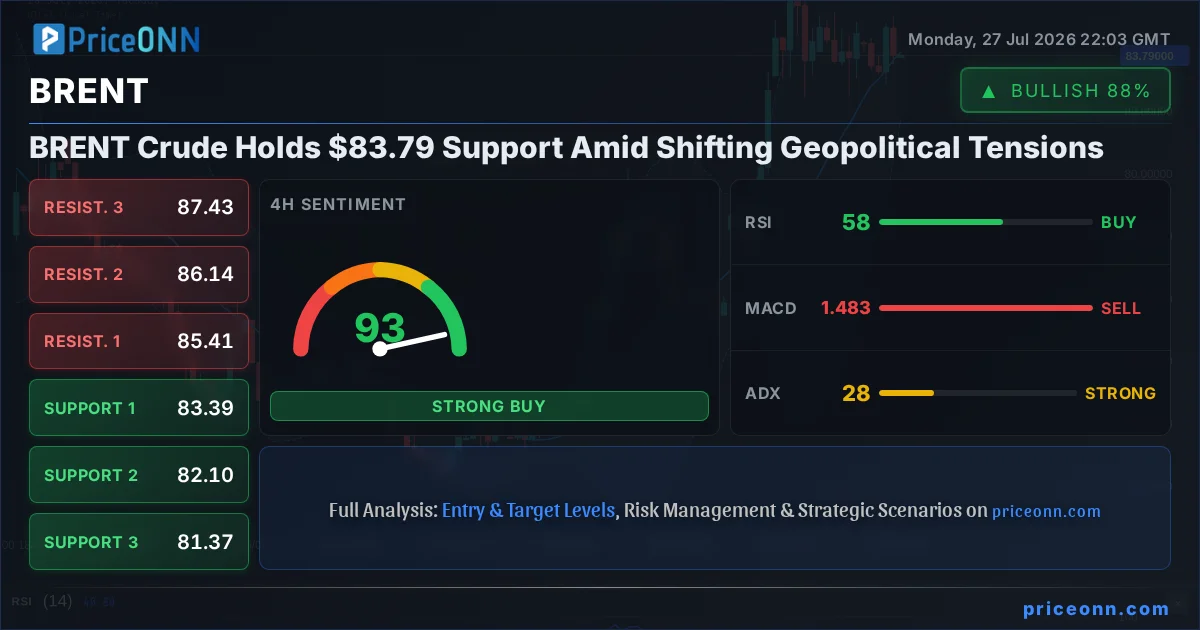
Thursday told a different story. Prices slid that day on coverage suggesting a ceasefire between Israel and Hezbollah was within reach. The optimism did not survive long. Follow-up reporting showed that Hezbollah rejected the U.S.-brokered ceasefire, snuffing out hopes of an end to Israeli strikes on Lebanon and, by extension, the friction between Washington and Tehran. Iran has staked any peace arrangement on a Lebanon ceasefire, so one rejection ripples across several fronts at once.
What Actually Happened at Mina Al Fahal
Trading sources, who were not named, indicated that loadings at the terminal have slipped by several days. Separate accounts attributed the explosion to a drone attack on the facility. No barrels were reported lost outright, but a multi-day delay at a key export point is enough to move a nervous market.
Here is why the location matters more than the size of the disruption. Oman's position beyond the chokepoint of Hormuz had turned it into a magnet for buyers betting the country would stay out of the fighting. That bet now carries a question mark.
Consider India. Earlier this week the country locked in a trade agreement with Oman specifically to secure crude that never has to thread through the Strait of Hormuz. India leans heavily on that waterway, with 45% of its crude purchases sourced from the Persian Gulf and 55% of its liquefied gas imports arriving the same way. A strike on the very terminal meant to provide an alternative route undercuts the entire premise of that workaround.
Reading Between the Lines
The flat price tells you fear returned. The bigger signal is that the market's geographic safety net is thinner than it looked a week ago. A drone reaching a port outside Hormuz means the conflict perimeter is widening, and that is a structural worry, not a one-day headline.
Watch four things from here. First, Brent and WTI spreads to regional grades, since buyers will pay up for barrels they believe are genuinely insulated. Second, USD/CAD and the Canadian dollar, a classic petro-currency that tends to firm when crude rallies on supply fear. Third, gold, which often catches a bid alongside oil when Middle East risk flares. Fourth, inflation-sensitive assets and energy equities, both of which react quickly to any sustained move above current levels.
The opportunity sits in volatility, not direction. If loadings at Mina Al Fahal resume on schedule and no second strike lands, the risk premium can drain out within days. If the drone account is confirmed and attacks spread, the calm corner of the oil map disappears for good. Traders chasing the headline number risk missing where the real action shows up first: tanker rerouting, freight rates, and the premium for barrels that avoid Hormuz entirely.
Track markets in real-time
Empower your investment decisions with AI-powered analysis, technical indicators and real-time price data.
Join Our Telegram Channel
Get breaking market news, AI analysis and trading signals delivered instantly to your Telegram.
Join Channel PriceONN News
Less than a month ago, analysts were warning of a looming glut of crude oil as tanker traffic via the Strait of Hormuz began to recover amid a U.S.-Iran ceasefire. Within days of these warnings, the ceasefire was a painful memory, missiles were flying again, and now Yemen’s Houthis are striking tankers in the Red Sea, which makes two blocked oil chokepoints and a very real danger of a global recession. Brent crude this week topped $100 per barrel on reports that the Houthis had struck two Saudi...
PriceONN News
WTI crude oil plunged by more than 7% on 27 July 2026 after the US suspended a series of strikes against Iran over the weekend, raising hopes of a diplomatic solution and the reopening of shipping through the Strait of Hormuz. Brent crude also fell below $90 per barrel. Meanwhile, Bloomberg reported […] The post WTI Analysis: Gap Breaks Short-Term Trend as Price Remains Trapped Between the Poc and Profile Boundary appeared first on ActionForex.
PriceONN News
China is likely to have increased its crude oil imports this month, with the daily average at 7.8 million barrels, according to calculations by Kpler, as cited by Bloomberg. Refiners have been buying more Russian crude and have seen more tankers arrive from the Middle East, the report noted. The figure could add fuel to oil’s rally, as the July average would be a solid increase from the 6.2 million barrels daily that Chinese refiners imported in June. That was the lowest import rate for China...
PriceONN News
Oil prices gave up earlier gains on Friday after reports that Pakistan is trying to broker a return to U.S.-Iran nuclear negotiations. China is strongly backing the effort as the conflict and the closure of the Strait of Hormuz continue to threaten its energy security and weigh on its economy. Brent crude for September delivery fell 4.4% to trade at $96.36 per barrel at 1.35 pm ET while WTI crude for September delivery was down 3.6% to change hands at $88.86/bbl. However, Standard Chartered...
PriceONN News
(RTTNews) - Partially offsetting the gains from five consecutive sessions, crude oil prices have plunged on Friday as investors opted to book profits made from the recent trades. While U.S. President Donald Trump threatened to intensify attacks on Iran, investors analyzed the imp
PriceONN News
Saudi Arabia may raise the price of the crude it ships to Asia via the Suez Canal, Reuters has reported, to reflect higher shipping costs due to the Houthi maritime blockade in the Red Sea. The price hike could reach $5 per barrel of crude. Citing unnamed sources, the publication said Aramco was responding to the need to redirect oil flows from its Red Sea port of Yanbu to the Ain Sukhra port in Egypt, from where the crude gets transported via the Suez-Mediterranean pipeline to the port of Sidi...
PriceONN News
Oil prices continued to trend lower in early Asian trade on Tuesday as a fourth night passed without any attacks from either Iran or the United States. At the time of writing, WTI crude was trading at $81.55 per barrel, down 1.28% on the session, while Brent crude had slipped to $87.36 per barrel, a decline of 1.13%. On Monday, President Trump sought to boost hopes of a diplomatic resolution between Washington and Tehran by claiming that the U.S. was engaged in "good talks" with Iran. Iranian...
PriceONN News
Crude oil prices are retreating after Brent hit $100 again last week as the United States and Iran took a break from hostilities over the weekend. Yet with the outcome of the war still highly uncertain, the outlook for stock markets has dimmed. Add to that Big Tech’s AI spending binge and fresh warnings about energy commodity shortages, and we are looking at extended market turbulence ahead. Last week saw a rare pile-up of adverse market developments that must have shaken the confidence of many...
PriceONN News
Chinese buyers that received the first U.S. LNG cargo in over a year plan to resell it on another market to profit from higher prices elsewhere and avoid paying a 25% tariff, sources familiar with the plans told Bloomberg on Monday. The Yangpu port in south China earlier this month received a cargo of U.S. LNG from the Plaquemines LNG export terminal operated by Venture Global in Louisiana’s Plaquemines Parish. This was the first U.S. shipment of gas to China in more than a year. But the gas...
PriceONN News
The Houthi threats to shipping in the Red Sea and its chokepoint, the Bab el-Mandeb Strait, have forced at least one oil tanker carrying Saudi crude to Asia to choose the much longer route through the Suez Canal, the Mediterranean, and around Africa. The supertanker Olympic Luck, partially laden with Saudi crude at Yanbu on the Red Sea, transited the Suez Canal into the Mediterranean late on Sunday, according to shipping data monitored by Bloomberg. The U-turn from Bab el-Mandeb indicates that...
PriceONN News
Tanker traffic through the Bab el-Mandeb Strait slumped to a multi-month low on Sunday amid Houthi attacks on Saudi oil infrastructure on the Red Sea coast. Only 11 tankers carrying commodities transited the Bab el-Mandeb chokepoint between the Red Sea and the Arabian Sea on Sunday, the lowest in months, according to Kpler’s shipping data cited by Reuters. Tanker traffic at the Red Sea started to slow a week ago after the Iran-aligned Houthis in Yemen announced a blockade on Saudi shipments and...
PriceONN News
European natural gas prices plunged by 8.6% at the open in Amsterdam on Monday as the United States paused strikes on Iran over the weekend and Tehran signaled a halt to retaliatory attacks across the Middle East. Hopes of de-escalation sank oil prices on Monday in Asian trade, too, with Brent Crude dropping to $90 per barrel. Europe’s benchmark natural gas prices, which had surged in the past two weeks amid the renewed hostilities, retreated on Monday from the multi-month highs of last week,...