
Rising Inflation and Iran Conflict Pressure Markets
 PriceONN Editorial Desk
Multi-source verification
PriceONN Editorial Desk
Multi-source verification
Global Tensions Ignite Price Swings
Last week witnessed significant turbulence across financial arenas, largely fueled by escalating geopolitical instability in the Middle East and persistent inflation signals. The specter of conflict near the Strait of Hormuz cast a long shadow, driving considerable volatility in crude oil markets. Prices for the benchmark commodity repeatedly flirted with the $100 per barrel mark as traders grappled with potential supply disruptions.
Simultaneously, economic data from the United States painted a concerning picture for price stability. The latest Producer Price Index (PPI) figures landed with a surprising upward thrust, exceeding forecasts and reinforcing the narrative that inflationary pressures are proving stubbornly resilient. This development has prompted a notable recalibration of market sentiment regarding monetary policy.
Shifting Rate Expectations Batter Equities
The prevailing expectation of imminent interest rate cuts has begun to evaporate. Instead, market participants are increasingly factoring in the possibility of further rate hikes by the U.S. Federal Reserve. This seismic shift in outlook placed immense pressure on U.S. stock indices, which experienced their fourth consecutive week of declines. Investor sentiment soured as the dual threats of elevated inflation and tighter monetary conditions took hold.
Central banks, meanwhile, largely adhered to pre-existing paths. Both the Federal Reserve and the Bank of England opted to hold their benchmark interest rates steady, a move widely anticipated by the market. Across the Pacific, the Bank of Japan also maintained its current accommodative stance. However, subtle commentary from Governor Ueda hinted at a greater openness to future policy adjustments, providing a brief, albeit temporary, boost to the Japanese Yen.
Gold, often a safe-haven asset, found itself under intense selling pressure, dipping below the $5,000 level. The precious metal shed approximately 10% of its value as speculative positions were unwound, exacerbated by the strengthening U.S. dollar.
Market Outlook: Navigating Choppy Waters
The ongoing geopolitical flare-up in Iran is expected to keep a lid on equity market performance in the near term. Coupled with rising U.S. inflation forecasts and the looming prospect of higher interest rates, the downside risks for stocks remain substantial. For now, a cautious, bearish stance appears warranted.
Traders might consider waiting for brief rallies toward the 10-day moving average before initiating short positions, given the prevailing bearish sentiment. Key resistance levels for major U.S. indices are noted at 46,500, 47,500, and 48,000, with significant support anticipated around 45,000, 44,500, and 44,000.
Japanese Equities Under Fire
The Nikkei index languished near its lowest points of the year. Higher crude oil prices and the contagion effect from the weakness in U.S. stock markets exerted considerable downward pressure. Furthermore, indications from the Bank of Japan regarding potential future rate adjustments added to the bearish narrative for Japanese equities. Short-term selling remains a dominant strategy.
A decisive breach below the 51,000 level could accelerate the downward trend, while pullbacks toward the 10-day moving average might present tactical entry points for short positions. Resistance levels are observed at 53,000, 54,750, 56,000, 57,000, and 58,000, with support at 51,000, 50,000, and 49,000.
USD/JPY's Upward Grind
The USD/JPY currency pair exhibited strength, buoyed by robust oil prices and testing resistance near the 160 level. Notably, there was a conspicuous absence of direct intervention from the Bank of Japan, despite the yen's rapid depreciation. While comments about potential intervention caused a brief dip, the pair quickly regained its footing, closing the week above its 10-day moving average, reinforcing a short-term bullish bias.
Range trading between 158 and 160 appears to be the most prudent short-term strategy. Key resistance is positioned at 160, 162, and 165, with support levels at 158.50, 158.00, and 156.50.
Gold's Precipitous Fall
Gold's surprising weakness, even amidst the Middle East tensions, coupled with a firm U.S. dollar, precipitated a sharp price collapse once the $5,000 support barrier gave way. Speculative capital exited the market en masse. While the current oversold condition might present fleeting short-term buying opportunities, a fall below the year's low around $4,400 could signal further significant declines.
Resistance is marked at $4,700, $4,850, $5,000, and $5,100, while critical support lies at $4,400, $4,300, $4,200, and $4,100.
Crude Oil's Tightening Grip
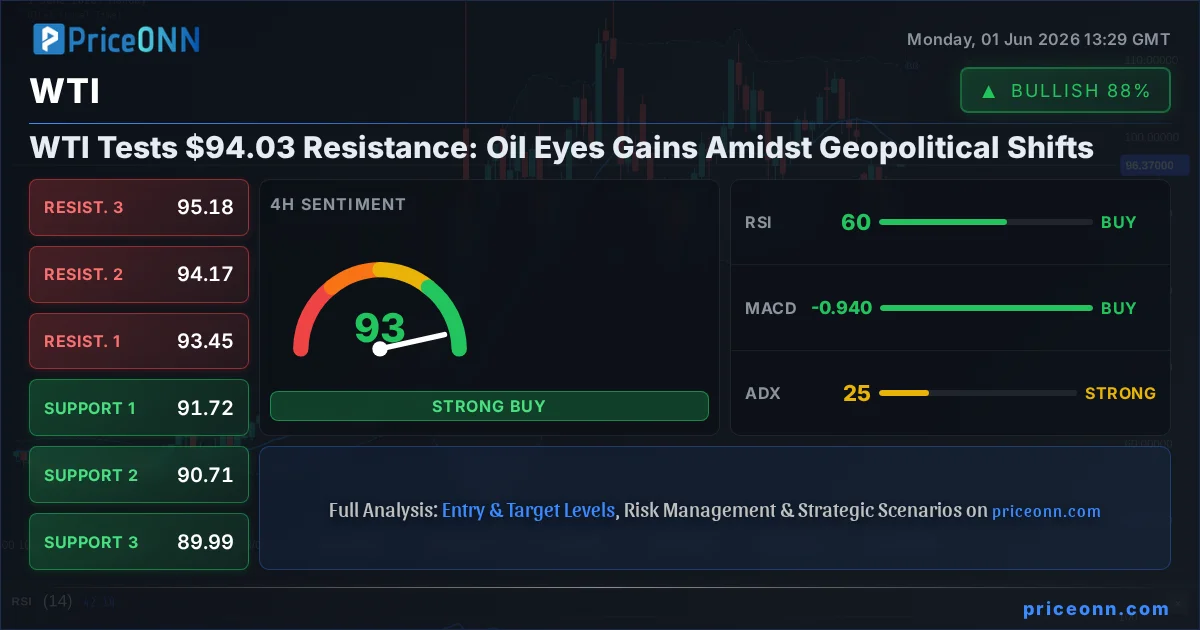
Resistance around the $100 per barrel level has capped further upside for crude oil, as the Iran conflict continues to fuel supply disruption fears. Despite this ceiling, oil has demonstrated resilience, maintaining its position above the 10-day moving average. As long as geopolitical tensions persist and prices hold this technical level, buying on temporary dips remains a favored strategy.
Resistance is identified at $100, $110, $120, $125, and $130. Support is situated at $90, $80, $75, $70, and $67.5.
Bitcoin's Range-Bound Struggle
Bitcoin has been testing resistance near the $75,000 mark, with recent price stability encouraging some speculative buying. However, the broader risk-off sentiment stemming from U.S. equity weakness has curtailed overall appetite for risk assets. Consequently, Bitcoin pulled back, settling within the middle ground of its recent $65,000 to $75,000 trading range. Range trading is advised for short-term positions.
Key resistance levels are at $75,000, $80,000, and $85,000, with support expected at $65,000, $60,000, and $55,000.
Market Ripple Effects
The confluence of escalating geopolitical risk in the Middle East and persistent inflation is creating a complex environment for traders. The elevated oil prices directly impact inflation expectations, potentially forcing central banks to maintain higher interest rates for longer. This, in turn, dampens economic growth prospects and puts pressure on risk assets like equities and cryptocurrencies.
Specifically, the US Dollar Index (DXY) may find further strength as the Fed remains hawkish, making dollar-denominated commodities like gold more expensive for holders of other currencies. Energy stocks, particularly those involved in oil exploration and production, could see short-term gains, but broader market weakness might offset these. Conversely, sectors sensitive to interest rates, such as technology and real estate, are likely to remain under pressure.
Traders should closely monitor oil price movements for any significant breaches above $100, which could trigger panic selling in equities and potentially lead to currency volatility. The upcoming U.S. Consumer Sentiment data will be critical for gauging inflation expectations and their impact on Fed policy.
Track markets in real-time
Empower your investment decisions with AI-powered analysis, technical indicators and real-time price data.
Join Our Telegram Channel
Get breaking market news, AI analysis and trading signals delivered instantly to your Telegram.
Join Channel PriceONN News
The US Dollar experienced a notable dip as a renewed ceasefire between the US and Iran spurred a rally in global equities, particularly in tech stocks. However, persistent core PCE inflation at 3.3% YoY continues to fuel 'higher for longer' rate expectations.
PriceONN News
Markets are pricing in a potential de-escalation in the US-Iran conflict, leading to a significant drop in crude oil prices and a weakening US Dollar as diplomatic efforts appear to be gaining traction.
PriceONN News
USD/JPY is testing the critical 160 level as stalled US-Iran negotiations and hawkish Federal Reserve rhetoric fuel inflation concerns and a potential for further rate hikes. Traders are closely watching upcoming US Non-Farm Payrolls and Eurozone CPI data for direction.
PriceONN News
The USD/JPY pair is flirting with the 160 level as stalled US-Iran negotiations and hawkish Federal Reserve rhetoric fuel inflation concerns. Traders are closely watching upcoming US Non-Farm Payrolls and Eurozone CPI data.
PriceONN News
EUR/USD stalled below 1.1660 as the US Dollar defied expectations, refusing to weaken despite reports of a US-Iran ceasefire extension. Market participants remain cautious, awaiting concrete confirmation and assessing lingering inflationary pressures.
PriceONN News
EUR/USD closed at 1.1640, showing resilience amid mixed signals. Easing US-Iran tensions initially pressured the dollar, but persistent inflation concerns and political ratification hurdles are keeping the greenback surprisingly steady.
PriceONN News
The EUR/USD faces headwinds as core US PCE inflation unexpectedly rose to 3.3% year-over-year, reinforcing a 'higher for longer' interest rate narrative. Meanwhile, a US-Iran ceasefire extension boosted global risk appetite, potentially drawing capital away from safe-haven currencies.
PriceONN News
EUR/USD stabilized around 1.1640 as reports of a US-Iran ceasefire extension and potential Strait of Hormuz reopening eased inflation fears. However, the US Dollar's resilience suggests lingering caution among forex traders.
PriceONN News
USDJPY has returned to the area of previous interventions. The ECB is moving towards a rate hike in June. The US dollar retreated on Friday amid new record highs for stock indices and rumours of amendments to the US-Iran agreement. However, tit-for-tat exchanges between the adversaries pushed the dollar index back into the support zone […] The post Yen Braces for a New Storm appeared first on ActionForex.
PriceONN News
The US Dollar experienced a notable decline last week as markets priced in a potential diplomatic resolution to the US-Iran conflict, leading to a drop in oil prices and Treasury yields. This shift in sentiment suggests a move away from stagflation fears towards a more stable economic outlook.
PriceONN News
Canada's labor market is showing signs of stabilization, with analysts predicting a dip in the unemployment rate to 6.8% in May, driven by an expected 25,000 new jobs. This follows a period of sluggish GDP growth and rising joblessness earlier in the year.
PriceONN News
Canada's economy showed signs of a slowdown in early 2026, but upcoming May jobs data is expected to reveal a modest uplift. Analysts anticipate the unemployment rate to fall to 6.8%.