
Sunrise Market Commentary
 PriceONN Editorial Desk
Multi-source verification
PriceONN Editorial Desk
Multi-source verification

Market Reopening Sees Repositioning Amid Geopolitical Hopes and Central Bank Signals
Following a long weekend, financial markets in the United States and the United Kingdom resumed trading yesterday. Initial movements reflected a repositioning of portfolios, driven by an optimistic sentiment surrounding a potential US-Iran agreement. This development provided a temporary boost to both bond and stock prices at the start of the week.
However, the enthusiasm for a geopolitical resolution appeared to be tempered by hawkish pronouncements from European central bankers. European bond markets, in particular, experienced underperformance, with yield curves steepening significantly. This move was largely attributed to commentary from the European Central Bank (ECB), signaling a more aggressive monetary policy stance ahead.
ECB's Hawkish Stance Fuels Bond Market Sell-off
ECB board member Isabel Schnabel emerged as a key voice, expressing strong support for a rate hike as early as June, even if a peace deal with Iran were to materialize by then. Schnabel emphasized the persistent nature of inflationary shocks, suggesting they are lasting longer than the ECB's adverse scenario outlined in March. Her remarks, prominently featured on the ECB's website, highlighted her view of the current economic climate as "a large and persistent shock."
In parallel, an interview with ECB Chief Economist Philip Lane, also released yesterday, offered a less direct but still significant signal. Echoing sentiments previously voiced by ECB President Christine Lagarde over the weekend, Lane hinted at an upward revision to the central bank's inflation forecasts. He further indicated that the ECB anticipates indirect price effects extending beyond immediate energy costs, a statement interpreted by many as a precursor to more immediate policy action. The market's implied probability of a June rate increase surged, climbing in tandem with front-end yields to reach approximately 90%.
Further clarity on the ECB's intentions may emerge from upcoming events. Speeches by ECB President Lagarde and the release of minutes from the April ECB meeting, where a rate hike was reportedly discussed, are anticipated tomorrow and could provide additional clues regarding the trajectory of monetary policy.
Consumer Confidence Dips as Inflationary Pressures Persist
Economic data released yesterday offered a less encouraging picture from the consumer front. The US Conference Board consumer confidence index for May saw a slight decline, inching down to 93.1 from 93.8 in the previous month. This downturn was largely ascribed to the intensifying inflationary impacts stemming from the ongoing conflict in the Middle East.
Consumers reported moderately less positive appraisals of both current business conditions and the prevailing labor market. These concerns were significant enough to outweigh modest improvements observed in consumers' expectations for the next six months. While consumers' average and median 12-month inflation expectations edged downward, they remained stubbornly elevated, standing at over 6% and more than 5% respectively. The financial markets registered little reaction to this data release.
Trading activity generally proceeded in an orderly fashion. Brent crude oil futures managed to hold just below the psychologically important $100 per barrel mark for most of the trading day. On US stock exchanges, a significant outperformance by Micron Technology propelled the Composite to a 1.2% gain and a minor intraday all-time high. The US dollar showed little directional movement, trading within a tight range between 1.16 and 1.1650 against the Euro. Today's economic calendar is sparse, suggesting that any headlines related to Iran could be a primary driver of intraday price action.
New Zealand Holds Rates But Signals Future Tightening; Australia's Inflation Mix
In a separate development, the Reserve Bank of New Zealand (RBNZ) kept its policy rate unchanged at 2.25%, a decision that met widespread expectations. However, the outcome of the Monetary Policy Committee meeting was far from unanimous, with three members advocating for a 25 basis point increase and three others favoring maintaining the status quo. Governor Adrian Orr ultimately cast the deciding vote in favor of holding rates steady.
The RBNZ's assessment indicates that inflation is projected to climb to 4.3% in the September quarter, a notable increase from 3.1% in the first quarter. This inflation surge is anticipated even as economic activity and spending show signs of weakening. Some businesses are experiencing squeezed profit margins due to rising costs, which in turn is curbing investment and hiring intentions. Consumer confidence has plummeted, and the housing market remains subdued.
Despite acknowledging that weak economic activity might dampen inflationary pressures in the medium term, the Committee concluded that the official cash rate will likely need to be increased sooner and by more than previously indicated in February. Projections within the new monetary policy statement suggest the policy rate could average 2.5% in Q3, rise to 3.1% next year, and reach 3.3% by the end of the policy horizon. The RBNZ forecasts growth to stabilize in Q2, followed by a modest 0.2% expansion in Q3, with average growth for this and next year projected at 0.7% and 1.7% respectively. The yield on New Zealand's 2-year government bond added 4.5 basis points to 3.54%. Money markets are now pricing in an 80% probability of a rate hike in July, and the New Zealand dollar has appreciated from the 0.584 area to trade near 0.5875 against the US dollar.
Meanwhile, Australia's Consumer Price Index (CPI) data for April presented a somewhat mixed economic picture this morning. Headline inflation registered at 0.4% month-on-month and 4.2% year-on-year, a decrease from 4.6% in March. However, the trimmed mean annual inflation rate saw a further increase, rising to 3.4% from 3.3% in March. Out of the eleven categories within the CPI, seven experienced a slowdown in annual growth compared to the previous month, with transport prices moderating the most. Automotive fuel prices fell by 7% month-on-month, partly due to a 50% reduction in the fuel excise duty implemented in April. The Australian Bureau of Statistics noted that the impact of higher oil prices has permeated through to products and services with significant freight and logistics costs. Annual housing inflation stood at 6.3% for the twelve months ending in April, reflecting escalating costs for electricity, new dwellings, and rents.
The yield on Australian 2-year government bonds eased slightly this morning, down 5 basis points to 4.54%. Market participants are attaching approximately an 80% probability to the scenario where the Reserve Bank of Australia (RBA) implements another 25 basis point rate hike by the end of the year. The Australian dollar experienced a marginal decline this morning, trading around 0.715 against the US dollar.
Market Ripple Effects
The central bank actions and geopolitical undertones discussed are creating significant ripples across global markets. The ECB's increasingly hawkish stance, underscored by Schnabel's comments, puts upward pressure on Eurozone yields and strengthens the Euro, potentially impacting currency pairs like EUR/USD. Conversely, the underperformance in European bonds could spill over into broader fixed-income markets, influencing global bond yields.
In the Antipodes, the RBNZ's close call on rates and forward guidance suggest a continued path of monetary tightening, which could support the New Zealand Dollar (NZD), especially against currencies where central banks are perceived as less aggressive. The mixed inflation data from Australia, with core inflation ticking higher, keeps the door open for further RBA tightening, offering support to the Australian Dollar (AUD). Traders will be closely watching the interplay between these commodity currencies and risk sentiment, which can be influenced by crude oil prices and US equity performance.
The persistent, elevated inflation expectations, even with moderating headline figures in some regions, suggest that central banks will remain focused on price stability. This environment generally favors currencies of commodity-exporting nations if global demand holds up, but also increases the risk of policy missteps that could spark volatility in assets like the S&P 500 or global equity indices.
Track markets in real-time
Empower your investment decisions with AI-powered analysis, technical indicators and real-time price data.
Join Our Telegram Channel
Get breaking market news, AI analysis and trading signals delivered instantly to your Telegram.
Join Channel PriceONN News
Gold fell to 4,047 USD per ounce on Tuesday, erasing gains from the previous session. Pressure on the metal is mounting amid fears that the Federal Reserve may raise rates as early as this week. Markets currently estimate the probability of such a move on Wednesday at over 33% – an unusually high level of […] The post Gold Declines, Focus on Fed and Falling Oil Prices appeared first on ActionForex.
PriceONN News
The US stock market is not factoring in the existing risks. Investors are increasingly focusing on the cash flows of S&P 500 companies. US stock indices have closed in the red the last two weeks, something that hasn’t happened since March. The stock market has weathered both the armed conflict in the Middle East and […] The post It’s Time to Weigh Up the Risks for the S&P 500 appeared first on ActionForex.
PriceONN News
(RTTNews) - Gold prices traded higher on Monday as oil prices tumbled amid eased Middle East tensions, helping ease inflation and interest-rate concerns ahead of crucial Fed, BoE and BoJ central bank meetings due this week.
PriceONN News
The dollar heads into a pivotal week trading near 101.80, just off a 15-month high, with the Fed’s July 29 meeting standing as the clear focal point. Markets currently price roughly a 65% chance of a hold, though renewed Middle East escalation has kept a hike back on the table for later this year. Energy […] The post US Dollar Index: a Defining Week for the King of the Markets appeared first on ActionForex.
PriceONN News
European Central Bank Governing Council member Peter Kazimir from Slovak reinforced the hawkish bias on Monday, arguing that policymakers will likely need to raise interest rates at least once more and warning that a worsening energy shock could ultimately require even more tightening than markets currently anticipate. His remarks come just days after the ECB […] The post ECB’s Kazimir Sees At Least One More Rate Hike, Warns Oil Shock Could Require More appeared first on ActionForex.
PriceONN News
On 21 July, Stats NZ reported an acceleration in inflation: the Consumer Price Index rose 1.5% in the second quarter, while the annual inflation rate climbed to 4.1%, its highest level in more than two years and slightly above analysts’ consensus forecast of 4.0%. The increase was driven primarily by higher fuel prices amid tensions […] The post NZD/USD: Inflation Surge Meets Strong US Dollar Pressure appeared first on ActionForex.
PriceONN News
US business activity accelerated at the start of the third quarter, with S&P Global’s Flash Composite PMI Output Index rising from 51.9 to 53.6 in July, its highest level in eight months. The improvement was driven by the services sector, where the Business Activity Index climbed from 51.2 to 53.6, also an eight-month high. Manufacturing, […] The post US PMI Hits Eight-Month High,Yet Rising Costs and Supply Delays Raise Caution appeared first on ActionForex.
PriceONN News
Market Overview The crypto market trended lower at the end of Monday, mirroring the US equity market, as it fell from a peak of $2.23T to $2.16T before returning to recent local lows of $2.18T by Tuesday morning. This marks yet another test of the 50-day moving average (MA) as support, which sellers have been […] The post Bitcoin Has Failed to Break Away from Its Long-Term Trend appeared first on ActionForex.
PriceONN News
The de-escalation of the conflict in the Middle East has sent Brent prices tumbling. The oil market could return to a surplus as early as the end of 2026. The US dollar and oil have lost their correlation. Brent recorded its worst daily fall in three months after reports of a ceasefire in the Middle […] The post Oil: A Surplus on the Horizon appeared first on ActionForex.
PriceONN News
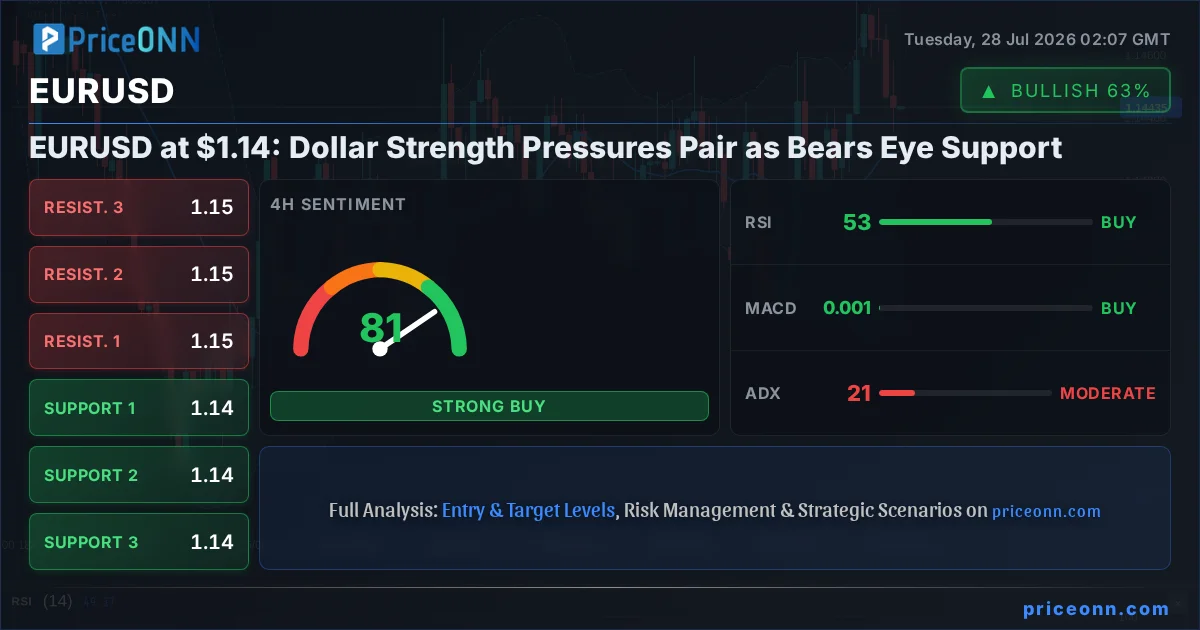
I am already riding two EURUSD sell entries. Another possible sell opportunity could be forming for traders that are not in yet. EURUSD Possible Bearish Scenario Watch for price to tap 4 Hour FVG (Purple) first. Watch for a bearish shift and bearish reversal signs in the FVG zone. Wait for all above to play […] The post Riding EURUSD Sellside appeared first on ActionForex.
PriceONN News
The Trump administration is weighing whether to extend access to some Chinese rare earth materials beyond the January 1, 2027 cutoff after U.S. producers acknowledged they cannot build sufficient domestic processing and magnet capacity before the deadline, Reuters reported on Monday. Industry executives and Pentagon suppliers told Reuters that U.S. processing and magnet manufacturing capacity remains insufficient to meet despite billions of dollars in federal support for new mines, separation...
PriceONN News
The ceasefire in the Middle East has disrupted the greenback’s plans. Strong PMI data and falling oil prices are helping the euro. The US dollar faced a downward gap at the start of the week as the Middle East de-escalation of the conflict came as an unwelcome surprise to speculators who had built up net […] The post De-Escalation Undermines the Greenback appeared first on ActionForex.