
U.S. Military Helping Move 7 Million Bpd Out of Persian Gulf, Wright Says
 PriceONN Editorial Desk
Multi-source verification
PriceONN Editorial Desk
Multi-source verification
The Unseen Hand Steering Oil Markets
The global oil market's reaction to escalating geopolitical tensions in the Middle East might seem muted, but a critical, largely undisclosed military initiative is playing a significant role. U.S. Energy Secretary Chris Wright provided a staggering figure: approximately 7 million barrels per day are now being successfully moved out of the Persian Gulf. This intervention helps to bridge the gap left by the severe disruption to tanker traffic through the vital Strait of Hormuz, a chokepoint that normally handles upwards of 20 million to 21 million barrels daily.
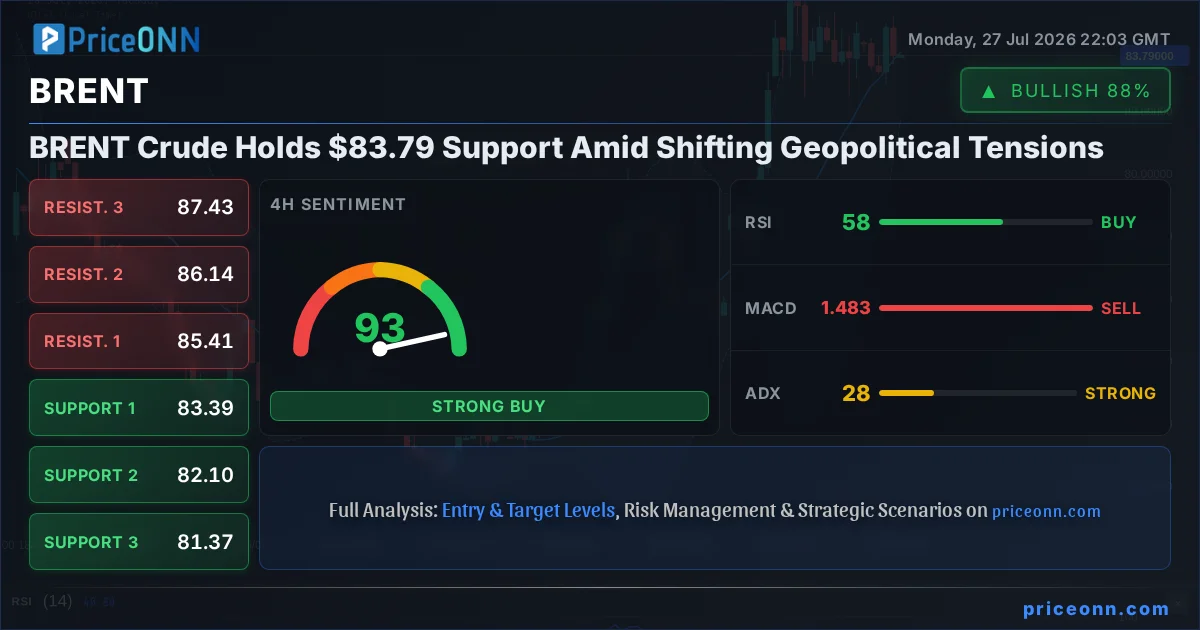
This revelation offers a potent explanation for why benchmark Brent crude futures have not surged to the triple-digit figures many anticipated. Instead, prices hovered around the $87 per barrel mark on Friday, even experiencing a notable daily decline of over 3.7%. This subdued response, considering that roughly two-thirds of typical Hormuz transit volumes remain obstructed, suggests a significant disconnect between market pricing and the reality on the ground. The pricing data indicates traders may have been bracing for a far more dire supply scarcity.
Trading desks, such as CIBC Private Wealth, had been operating under the assumption that only a fraction of normal flows, perhaps 3 million to 4 million barrels per day, were managing to navigate the troubled waters. This stark contrast between market expectations and Secretary Wright's disclosure highlights how a hidden logistical effort has reshaped the supply narrative. The market's pricing behavior suggests it was anticipating a much more severe outcome, a scenario that the current, albeit reduced, export levels are deflecting.
Behind the Scenes: Operation Facilitation
Secretary Wright detailed that this U.S. military-backed facilitation of cargo movements is a relatively recent development, one that has not been widely broadcast. "We have a military effort that we've not talked a lot about, which started more recently to get cargoes out," Wright stated during a recent energy forum. This operation is specifically designed to ensure that vital oil shipments are not entirely halted, even amidst the ongoing conflict that has effectively paralyzed normal transit through the Strait of Hormuz.
Crucially, Wright emphasized that no Iranian crude oil is currently being exported through the strait. The U.S. administration's stance is that a resumption of full transit flows is contingent upon reaching a diplomatic resolution with Tehran. However, Washington remains committed to finding pathways to restore oil movements in the region should negotiations falter. This coordinated effort represents the most explicit acknowledgment to date of how direct U.S. military engagement is actively supporting the continuation of a significant portion of global oil commerce.
Reading Between the Lines
The market's muted reaction to the Strait of Hormuz disruptions, despite the clear geopolitical risks, is now more understandable. The revelation of a 7 million bpd facilitation effort by the U.S. military fundamentally alters the supply-loss equation that traders had been factoring into their price models. This suggests that while the headlines scream crisis, the actual on-the-water supply impact, thanks to this undisclosed operation, is considerably less severe than feared.
This situation presents a fascinating case study in how geopolitical events and logistical countermeasures interact to shape commodity prices. Investors and traders must now reassess their exposure, understanding that the headline risk of a choked Strait of Hormuz is being actively mitigated. The focus may shift from the immediate threat of supply collapse to the sustainability of this military-backed solution and the potential for diplomatic breakthroughs. The absence of Iranian crude exports is a key point, indicating that while overall flow is being managed, specific trade routes remain impacted.
Looking ahead, the critical factors will be the longevity of the U.S. military's involvement and the progress of diplomatic talks. Any perceived weakening of the U.S. commitment or a breakdown in negotiations could quickly reignite fears of a supply crunch. Conversely, positive diplomatic developments could lead to a rapid normalization of flows, potentially pressuring oil prices lower.
Market Ripple Effects
The implications of this operation extend beyond just crude oil prices. The successful facilitation of 7 million bpd indirectly supports global economic activity by ensuring a more stable, albeit reduced, energy supply. This has knock-on effects for related markets. For instance, lower-than-expected oil prices can alleviate inflationary pressures, potentially influencing central bank policy regarding interest rates. This could provide a boost to sovereign bond markets and currencies of import-heavy economies.
The US Dollar Index (DXY) might see less upward pressure than anticipated if oil prices remain anchored, as high energy costs often correlate with a stronger dollar due to global demand dynamics. Furthermore, the ongoing situation could bolster the performance of energy stocks, particularly those with significant logistical infrastructure or those less directly exposed to the Strait of Hormuz chokepoint, as they benefit from a more stable, albeit tense, energy landscape. Conversely, countries heavily reliant on oil exports that are not part of this facilitated flow might face continued economic headwinds.
Track markets in real-time
Empower your investment decisions with AI-powered analysis, technical indicators and real-time price data.
Join Our Telegram Channel
Get breaking market news, AI analysis and trading signals delivered instantly to your Telegram.
Join Channel PriceONN News
WTI crude oil plunged by more than 7% on 27 July 2026 after the US suspended a series of strikes against Iran over the weekend, raising hopes of a diplomatic solution and the reopening of shipping through the Strait of Hormuz. Brent crude also fell below $90 per barrel. Meanwhile, Bloomberg reported […] The post WTI Analysis: Gap Breaks Short-Term Trend as Price Remains Trapped Between the Poc and Profile Boundary appeared first on ActionForex.
PriceONN News
Oil prices continued to trend lower in early Asian trade on Tuesday as a fourth night passed without any attacks from either Iran or the United States. At the time of writing, WTI crude was trading at $81.55 per barrel, down 1.28% on the session, while Brent crude had slipped to $87.36 per barrel, a decline of 1.13%. On Monday, President Trump sought to boost hopes of a diplomatic resolution between Washington and Tehran by claiming that the U.S. was engaged in "good talks" with Iran. Iranian...
PriceONN News
(RTTNews) - Crude oil prices have gone into a tailspin on Monday, extending the losses from Friday's plunge after the U.S. halted nearly two weeks of military attacks against Iran following which near-term oil supply-disruption concerns reduced.
PriceONN News
The Houthi threats to shipping in the Red Sea and its chokepoint, the Bab el-Mandeb Strait, have forced at least one oil tanker carrying Saudi crude to Asia to choose the much longer route through the Suez Canal, the Mediterranean, and around Africa. The supertanker Olympic Luck, partially laden with Saudi crude at Yanbu on the Red Sea, transited the Suez Canal into the Mediterranean late on Sunday, according to shipping data monitored by Bloomberg. The U-turn from Bab el-Mandeb indicates that...
PriceONN News
Oil prices plunged by more than 5% in early Asian trade on Monday as the U.S. and Iran halted attacks after two weeks of escalation that had driven Brent above $100. At the time of writing, WTI crude was trading at $84.47, down 5.39%, while Brent crude had fallen to $91.80, a decline of 5.15%. The retreat came after Washington signaled on Friday that it would temporarily halt its bombing campaign against Iran. Talking to Face the Nation on Sunday, U.S. Ambassador to the United Nations Mike...
PriceONN News
U.S. airlines are grappling with soaring jet fuel costs again after the return of hostilities in the Middle East shattered the three-week-long U.S.-Iran ‘deal to make a deal’ and sent Brent crude oil prices soaring past $100 per barrel again. The U.S. jet fuel market has been tightening since March, although there haven’t been concerns about any shortages in America, unlike in Europe, which in April was supposed to run out of stockpiles within six weeks. Europe didn’t see shortages, but the...
PriceONN News
At the beginning of Donald Trump’s first term as U.S. President in 2017, a senior White House official commented off-the-record to OilPrice.com that: “We’re not going to put up with any more crap from the Saudis.” The comment had followed the end of the 2014-2016 Oil Price War that had seen the Kingdom rally its fellow OPEC members to ramp up their collective oil production in order to crash oil prices to cause the bankruptcy of as many American shale oil producers as possible, as analysed in...
PriceONN News
The anti-government protests in Libya over power cuts and high electricity bills over the past few days escalated on Tuesday, with protesters entering the Mellitah Oil and Gas complex and threatening to halt gas and fuel supplies for both the domestic and international markets. Libya’s capital Tripoli has been the main stage of protests against the Government of National Unity led by Abdul Hamid Dbeibah. Protesters blocked streets and roads out of the capital earlier this week as a sign of...
PriceONN News
Crude oil prices are retreating after Brent hit $100 again last week as the United States and Iran took a break from hostilities over the weekend. Yet with the outcome of the war still highly uncertain, the outlook for stock markets has dimmed. Add to that Big Tech’s AI spending binge and fresh warnings about energy commodity shortages, and we are looking at extended market turbulence ahead. Last week saw a rare pile-up of adverse market developments that must have shaken the confidence of many...
PriceONN News
Tanker traffic through the Bab el-Mandeb Strait slumped to a multi-month low on Sunday amid Houthi attacks on Saudi oil infrastructure on the Red Sea coast. Only 11 tankers carrying commodities transited the Bab el-Mandeb chokepoint between the Red Sea and the Arabian Sea on Sunday, the lowest in months, according to Kpler’s shipping data cited by Reuters. Tanker traffic at the Red Sea started to slow a week ago after the Iran-aligned Houthis in Yemen announced a blockade on Saudi shipments and...
PriceONN News
European natural gas prices plunged by 8.6% at the open in Amsterdam on Monday as the United States paused strikes on Iran over the weekend and Tehran signaled a halt to retaliatory attacks across the Middle East. Hopes of de-escalation sank oil prices on Monday in Asian trade, too, with Brent Crude dropping to $90 per barrel. Europe’s benchmark natural gas prices, which had surged in the past two weeks amid the renewed hostilities, retreated on Monday from the multi-month highs of last week,...
PriceONN News
China is likely to have increased its crude oil imports this month, with the daily average at 7.8 million barrels, according to calculations by Kpler, as cited by Bloomberg. Refiners have been buying more Russian crude and have seen more tankers arrive from the Middle East, the report noted. The figure could add fuel to oil’s rally, as the July average would be a solid increase from the 6.2 million barrels daily that Chinese refiners imported in June. That was the lowest import rate for China...