
U.S. Waiver Fuels Surge in India's Russian Crude Imports
 PriceONN Editorial Desk
Multi-source verification
PriceONN Editorial Desk
Multi-source verification
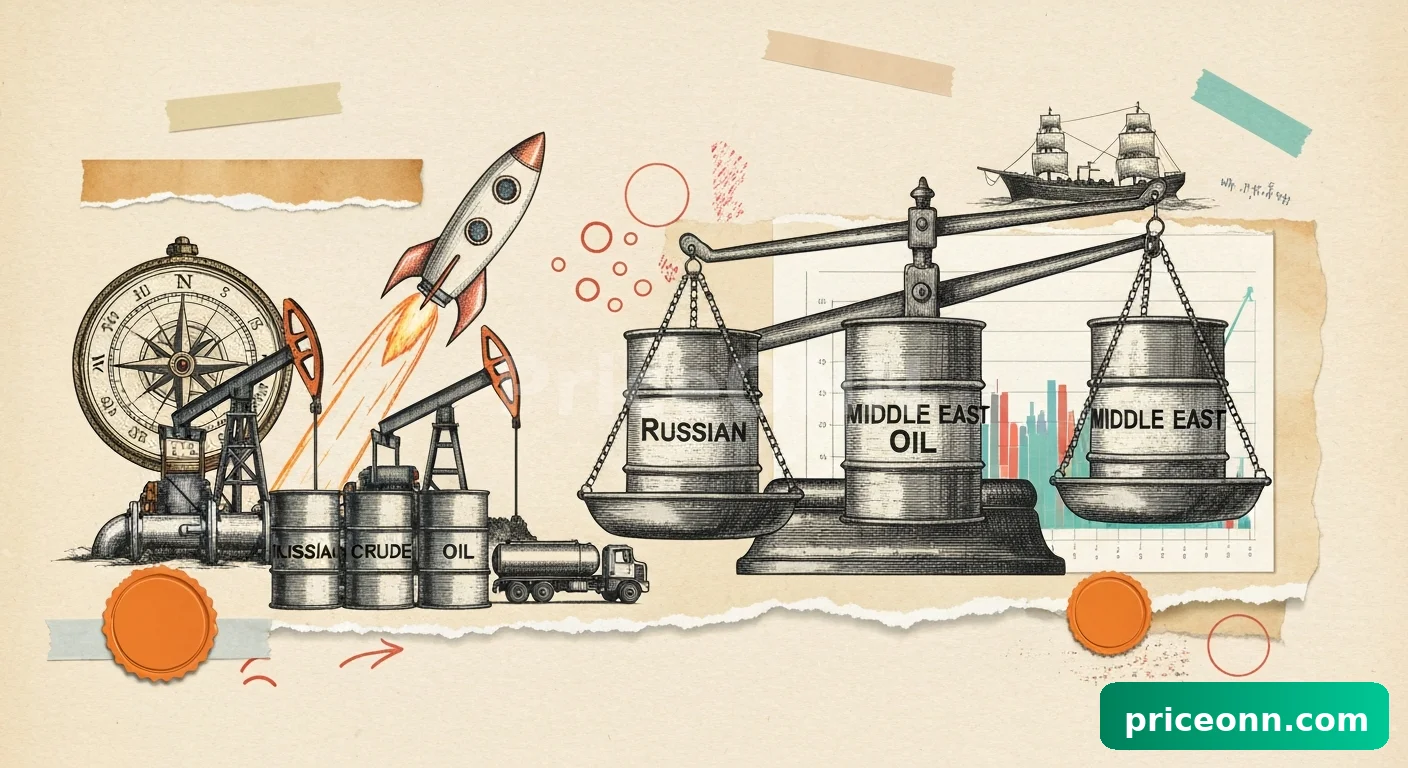
Asia's Thirst for Russian Oil Accelerates
A dramatic realignment is underway in the global oil tanker trade, with India emerging as a prime destination for Russian crude, outmaneuvering traditional buyers like China. Vessels previously bound for Chinese ports are now executing mid-voyage course corrections, veering towards Indian shores. This pivot is largely attributed to a critical U.S. waiver that eases restrictions on Russian crude purchases transported via tankers, coupled with significant supply shocks originating from the Middle East. These converging factors are compelling Indian refiners to re-engage with Russian oil supplies.
A compelling example of this trend is the Aqua Titan tanker. This vessel, which departed Russia's Baltic Sea port of Primorsk in mid-January with its initial destination flagged as Rizhao, China, has executed a significant turn. Now charting a course for India's Mangalore refinery, its estimated arrival is set for March 21, according to sophisticated tanker-tracking intelligence. This single journey underscores the palpable shift in trade routes and buyer priorities.
Market Dynamics Under Pressure
The current scramble for Russian crude highlights a stark contrast to earlier this year. Millions of barrels of Russian oil found themselves adrift on tankers, largely shunned by the international market due to U.S. sanctions and diplomatic pressure on India to curtail its imports. However, the landscape has fundamentally changed. The U.S. has effectively opened the door for Russian crude sales, creating a new competitive environment for supply in Asia.
This renewed demand and the tightening global supply picture have had a remarkable effect on pricing. Key Russian crude grades, which were recently trading at substantial discounts to the international benchmark Brent crude, have now flipped. Pricing data confirms these grades are commanding a premium, a testament to the increased competition and the perceived scarcity of readily available crude.
Vortexa's Chief Economist, David Wech, recently highlighted the accelerating pace of this market adjustment. He noted that since the beginning of March, the volume of Russian crude actively being transported on ships has decreased by over 20 million barrels. This represents a significant drawdown rate exceeding 2 million barrels per day.
Wech further elaborated on the specific dynamics influencing trade flows: "As the current relatively empty space between Sri Lanka and Singapore suggests, India has also drawn in cargoes that were already heading towards China, as replacement demand from Indian ports is stronger and voyage economics are better." He posited that while the recent U.S. waiver might have provided impetus, the more profound driver is the disruption to vital shipping lanes, specifically the closure of the Strait of Hormuz, which has triggered a palpable shortage of crude supply in the immediate region.
Reading Between the Lines
This repositioning of global oil flows carries significant implications for traders and investors. The U.S. waiver, while seemingly a technical adjustment, has acted as a catalyst, unlocking substantial volumes of Russian crude for buyers willing to engage. For India, this presents a strategic opportunity to secure energy at potentially more favorable terms compared to traditional suppliers, especially amidst the geopolitical uncertainty surrounding the Middle East.
The immediate impact is felt in the freight and spot markets, where tanker rates and crude differentials are adjusting rapidly. We are observing increased activity in the Indian Ocean as vessels reroute. The return of Russian crude to the water, albeit now primarily directed towards India, could exert some downward pressure on global crude prices if volumes are substantial enough to offset supply concerns elsewhere. However, the concurrent supply constraints from the Middle East introduce a strong bullish counter-narrative.
Traders should closely monitor the price spread between Russian Urals and Brent crude, as its sustained premium over Brent indicates robust demand and limited arbitrage opportunities. Furthermore, the geopolitical stability of the Middle East remains a critical factor. Any escalation of tensions or further disruptions to shipping through key chokepoints like the Strait of Hormuz could rapidly overshadow the influx of Russian crude and send oil prices soaring. The interplay between these forces will dictate market direction in the coming weeks. The U.S. dollar index (DXY) and the performance of energy stocks will also be key indicators to watch as crude market sentiment evolves.
Track markets in real-time
Empower your investment decisions with AI-powered analysis, technical indicators and real-time price data.
Join Our Telegram Channel
Get breaking market news, AI analysis and trading signals delivered instantly to your Telegram.
Join Channel PriceONN News
The Iran war suddenly turned what had started as a year of oversupply in global oil and LNG markets into the worst oil and gas supply disruption in history. Three months after the U.S.-Israeli strikes on Iran began on February 28, the world has already lost 1 billion barrels of crude oil supply, oil and gas prices have found a new, much higher floor, and whipsaw with violent volatility nearly every day, trade routes have shifted, and tanker rates have spiked. Actual supply shortages are...
PriceONN News
Crude oil prices experienced a significant drop, with WTI futures falling over 1.8% to $87.25, as optimism grew for a U.S.-Iran deal potentially reopening the Strait of Hormuz.
PriceONN News
Crude oil prices experienced a significant downturn as market sentiment shifted towards optimism about a potential US-Iran Memorandum of Understanding that could reopen the Strait of Hormuz. WTI futures fell nearly 2% on the news.
PriceONN News
(RTTNews) - Crude oil prices have tumbled on Friday as expectations of the U.S. and Iran signing a Memorandum of Understanding run high. The MoU would allow for immediate reopening of the Strait of Hormuz and pave the way for the resumption of oil and energy trade.
PriceONN News
Crude oil futures experienced a dramatic intraday reversal on Thursday, soaring overnight on geopolitical fears only to pull back significantly as reports of a potential diplomatic understanding between the U.S. and Iran emerged.
PriceONN News
Crude oil futures experienced a dramatic intraday reversal, soaring to $92.52 before pulling back significantly on Thursday. The volatile session was driven by shifting geopolitical narratives and U.S. inventory data.
PriceONN News
(RTTNews) - Crude oil futures skyrocketed overnight but have shown a significant pullback over the course of the trading day on Thursday.
PriceONN News
The market’s faith in an imminent US-Iran peace breakthrough has clearly weakened today - but it has not disappeared yet. Oil prices jumped again in after fresh military escalation around the Strait of Hormuz reignited fears of prolonged supply disruptions across the Gulf. Brent crude pushed back toward the mid-$90s after new U.S. strikes inside […] The post Brent Oil Holding Below $100 Suggests Markets Still See Room for a US-Iran Deal appeared first on ActionForex.
PriceONN News
(RTTNews) - Extending the losses from yesterday's session, crude oil prices have gone into freefall on Wednesday as investor expectations on a potential U.S.-Iran agreement continue to rise despite the U.S. refusing to ease its demands.
PriceONN News
The possibility of Iran developing a nuclear weapon is now higher than it was before the United States and Israel first attacked the country in February, the International Atomic Energy Agency has concluded in a report. The conclusion suggests the war has so far resulted in the opposite of what President Trump set out to do, namely, prevent Iran from developing a nuclear weapon. Bloomberg cited the report, which has restricted access, saying that in it, the IAEA had warned its member states...
PriceONN News
Iran's oil exports fell to their lowest level in at least six years in May as the U.S. naval blockade continued to choke off crude shipments and leave tens of millions of barrels stranded at sea. According to shipping data from Vortexa, Iran exported just 209,000 barrels per day (bpd) of crude oil and condensate in May, down from 1.34 million bpd in April and nearly 1.9 million bpd in March. Kpler had estimated May exports slightly higher at 260,000 bpd, but still the lowest level since the...
PriceONN News
(RTTNews) - Partially reversing three sessions of gains, crude oil prices have plunged on Wednesday as expectations of de-escalation in the Middle East rise following an Israel-Lebanon ceasefire announcement along with rising optimism on a U.S.-Iran deal over the weekend.