
USD/JPY Price Forecast: 20-day EMA acts as key support zone around 157.50
 PriceONN Editorial Desk
Multi-source verification
PriceONN Editorial Desk
Multi-source verification

Yen Finds a Foothold Amidst Policy Signals
The currency exchange between the US Dollar and the Japanese Yen is currently trading around 158.33, marking a 0.4% gain during Friday's Asian session. This uptick follows a significant downturn experienced on Thursday. Notably, the Japanese Yen has underperformed against its major currency counterparts today, even as the Bank of Japan (BoJ) signals a continued hawkish approach to its monetary policy. Recent market data shows the Yen was strongest against the Euro in today's trading.
The Bank of Japan, the nation's central bank, is tasked with managing monetary policy, issuing currency, and ensuring price stability. Its primary objective involves maintaining inflation at approximately 2%. Since 2013, the BoJ has pursued an ultra-accommodative monetary policy, employing Quantitative and Qualitative Easing (QQE) to stimulate economic activity and combat persistent low inflation. This strategy involved injecting liquidity through asset purchases, including government and corporate bonds.
In 2016, the BoJ intensified its easing measures, introducing negative interest rates and implementing direct control over the yield of its 10-year government bonds. A significant shift occurred in March 2024, when the central bank finally raised interest rates, marking a departure from its prolonged period of ultra-loose policy. This substantial stimulus program, however, contributed to a depreciation of the Yen against other major currencies.
The Yen's decline accelerated notably between 2022 and 2023. This period was characterized by a widening policy gap between the BoJ and other major central banks, which were aggressively hiking rates to combat multi-decade high inflation. The divergence in interest rate policies directly impacted the Yen's value, pushing it lower against currencies associated with higher yields.
However, 2024 has seen a partial reversal of this trend. The BoJ's decision to move away from its ultra-loose stance coincided with rising inflation in Japan, which surpassed the 2% target. Factors contributing to this inflationary pressure included the weaker Yen, coupled with a surge in global energy prices. Furthermore, the anticipation of rising domestic salaries, a critical component for sustained inflation, also played a role in shifting the economic landscape.
Reading Between the Lines
The recent price action in USD/JPY highlights a tug-of-war between the strengthening dollar and a Yen that, despite recent BoJ policy shifts, remains sensitive to interest rate differentials. The 20-day Exponential Moving Average (EMA), currently situated around the 157.50 level, is emerging as a critical technical support zone. A sustained hold above this level could signal continued upward momentum for the pair, while a decisive break below might open the door for further declines.
The market is grappling with the implications of the BoJ's recent policy normalization. While the move away from negative rates and QQE is a significant development, the pace and magnitude of future tightening remain uncertain. This policy divergence, even as it narrows, continues to influence Yen sentiment. Institutional flows suggest that while some carry trade unwinding may have occurred, the underlying demand for higher-yielding assets still puts pressure on the Yen.
The persistent weakness of the Yen, even with the BoJ's hawkish leanings, is a critical factor for Japanese economic stability. It contributes to imported inflation, potentially eroding purchasing power for consumers. However, it also benefits Japanese exporters. The delicate balance between controlling inflation and supporting economic growth remains the central challenge for policymakers.
Market Ripple Effects
The dynamics of the USD/JPY pair have broader implications across several financial markets. The US Dollar Index (DXY) often moves inversely to USD/JPY, meaning a stronger Yen could put slight downward pressure on the dollar's broader strength, though other factors heavily influence the DXY. Conversely, continued USD/JPY strength could bolster the DXY.
Secondly, the performance of the Yen impacts global risk sentiment. When the Yen weakens significantly, it can sometimes signal increased global risk appetite as investors borrow in low-yielding JPY to fund investments in higher-yielding, riskier assets. A strengthening Yen, conversely, can indicate a move towards safer assets. This makes global equity markets, particularly those sensitive to currency fluctuations and investor sentiment, a key area to watch.
Finally, the path of Japanese monetary policy and its effect on the Yen can influence commodity prices, especially those priced in dollars. A weaker Yen generally makes dollar-denominated commodities more expensive for Japanese buyers, potentially dampening demand. Therefore, tracking commodities like crude oil and gold in relation to USD/JPY movements offers additional insights into market interconnections.
Track markets in real-time
Empower your investment decisions with AI-powered analysis, technical indicators and real-time price data.
Join Our Telegram Channel
Get breaking market news, AI analysis and trading signals delivered instantly to your Telegram.
Join Channel PriceONN News
USDJPY has returned to the area of previous interventions. The ECB is moving towards a rate hike in June. The US dollar retreated on Friday amid new record highs for stock indices and rumours of amendments to the US-Iran agreement. However, tit-for-tat exchanges between the adversaries pushed the dollar index back into the support zone […] The post Yen Braces for a New Storm appeared first on ActionForex.
PriceONN News
AUD/USD’s late break of 0.7183 resistance suggests that pullback from 0.7277 has already completed at 0.7076, after defending 55 D EMA. Initial bias is back on the upside this week for retesting 0.7277 high first. Firm break there will resume larger up trend. For now, risk will stay on the upside as long as 0.7076 […] The post AUD/USD Weekly Report appeared first on ActionForex.
PriceONN News
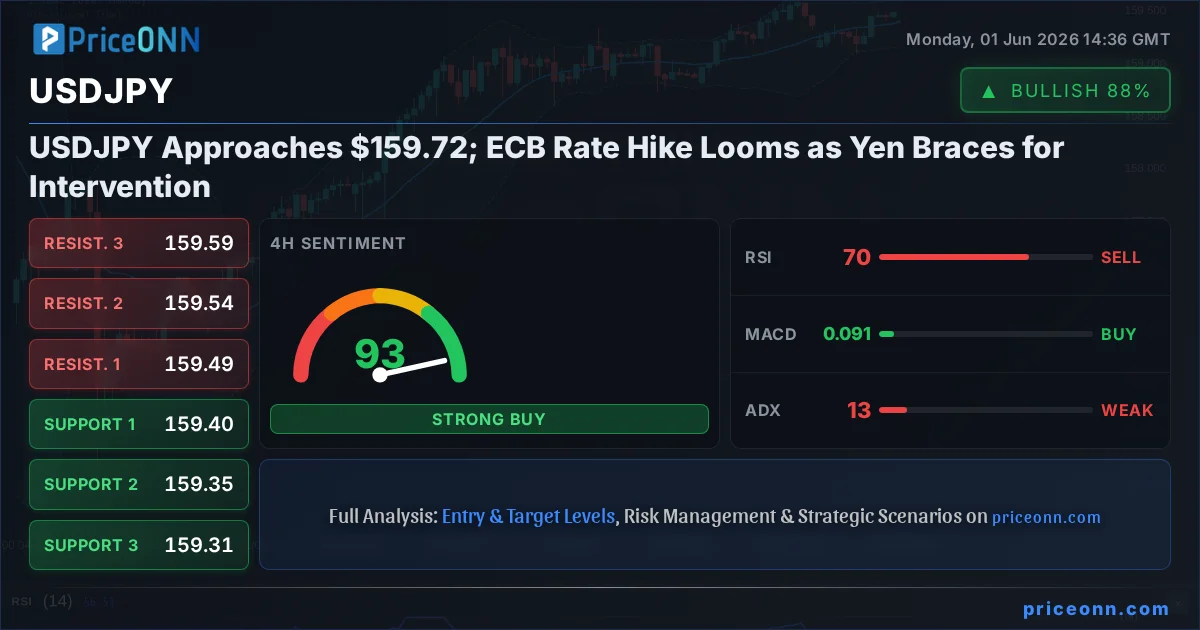
The USD/JPY pair is showing signs of upside exhaustion, struggling to overcome the 159.65 resistance level and trading below a key bullish trend line. This technical setup raises concerns about a potential pullback in the near term.
PriceONN News
Markets are pricing in a potential de-escalation in the US-Iran conflict, leading to a significant drop in crude oil prices and a weakening US Dollar as diplomatic efforts appear to be gaining traction.
PriceONN News
USD/CAD faces pressure as Canada's economy shows signs of stalling, with Q1 GDP contracting 0.1% and domestic demand weakening. This comes as trade negotiations and geopolitical shifts add layers of uncertainty.
PriceONN News
USD/CAD is showing signs of potential upward movement as Canada's economy grapples with a significant slowdown, marked by weak domestic demand and stalled investment, while trade negotiations loom large.
PriceONN News
USD/JPY is testing the critical 160 level as stalled US-Iran negotiations and hawkish Federal Reserve rhetoric fuel inflation concerns and a potential for further rate hikes. Traders are closely watching upcoming US Non-Farm Payrolls and Eurozone CPI data for direction.
PriceONN News
Canada's economy showed signs of weakness in early 2026, but upcoming May jobs data is expected to reveal a moderate uplift. Analysts anticipate job growth of around 25,000 positions and a potential dip in the unemployment rate to 6.8%.
PriceONN News
The USD/JPY pair is flirting with the 160 level as stalled US-Iran negotiations and hawkish Federal Reserve rhetoric fuel inflation concerns. Traders are closely watching upcoming US Non-Farm Payrolls and Eurozone CPI data.
PriceONN News
EUR/USD stalled below 1.1660 as the US Dollar defied expectations, refusing to weaken despite reports of a US-Iran ceasefire extension. Market participants remain cautious, awaiting concrete confirmation and assessing lingering inflationary pressures.
PriceONN News
The Japanese Yen is showing signs of renewed pressure, with USD/JPY approaching the psychologically significant 160 level. This comes as traders brace for key US jobs data and Eurozone inflation figures, all while lingering US-Iran tensions add a layer of uncertainty to market sentiment.
PriceONN News
EUR/USD closed at 1.1640, showing resilience amid mixed signals. Easing US-Iran tensions initially pressured the dollar, but persistent inflation concerns and political ratification hurdles are keeping the greenback surprisingly steady.