
Is the USD Poised for a Rally as NZ GDP Disappoints and US Economy Shows Resilience?


Market Context
The US dollar is under scrutiny following a mixed economic picture emerging from key global economies. New Zealand's Gross Domestic Product (GDP) data for the December quarter of 2025 revealed a sluggish +0.2% expansion. This figure significantly missed market expectations, which had largely anticipated a 0.5% rise, and fell short of the Reserve Bank of New Zealand's (RBNZ) own 0.5% forecast. The RBNZ's previous growth figures were also subject to downward revisions, with the September quarter's growth adjusted from 0.9% to 0.7% and the June quarter from -0.9% to -1.0%. These revisions paint a picture of an economy that, while not contracting, was struggling to regain substantial momentum before recent global events, such as the oil shock, began to impact broader economic activity.
On the other side of the Pacific, the US Federal Open Market Committee (FOMC) maintained a more optimistic, albeit cautious, stance at its March meeting. Despite acknowledging increased global uncertainty, the committee reaffirmed its focus on domestic economic conditions. Projections for US GDP growth were revised upwards, with expectations now set at 2.4% for 2026 and 2.3% for 2027, an increase from previous forecasts of 2.3% and 2.0% respectively. The longer-run neutral rate was also adjusted slightly higher to 2.0%. This outlook suggests a belief within the Fed that the US economy is on a firmer footing, driven by productivity gains and consumer spending, with inflation expected to be manageable despite temporary pressures from geopolitical events and tariffs.
Analysis & Drivers
The divergence in economic narratives between New Zealand and the United States presents a clear catalyst for currency market movements. The disappointing GDP figures from New Zealand suggest that the RBNZ may face increased pressure to adopt a more accommodative monetary policy stance, especially if global economic headwinds intensify. This could weigh on the New Zealand dollar (NZD) as interest rate differentials potentially widen in favor of other major currencies.
Conversely, the FOMC's upward revision to GDP growth forecasts and its relatively sanguine view on inflation provide a supportive backdrop for the US dollar (USD). The committee's focus on domestic strength and productivity gains, coupled with a constrained labor supply, implies a steady path for monetary policy. While the FOMC still anticipates rate cuts, the revised growth outlook might suggest a slower pace or fewer cuts than previously priced in by the market, particularly if inflation remains sticky. The Fed's assessment that inflation expectations are not a concern, unlike the RBA's perspective, highlights a key difference in central bank outlooks and could embolden the Fed to maintain its current policy path for longer, supporting the greenback.
Trader Implications
Traders will be closely monitoring upcoming economic data from both regions for confirmation or refutation of these trends. For the USD, key levels to watch include the 104.50 level on the DXY index, with a sustained move above this potentially signaling further upside. Support can be found around 103.80. Any indication from the FOMC of a more hawkish tilt, or persistent strength in US employment and inflation figures, could accelerate this trend.
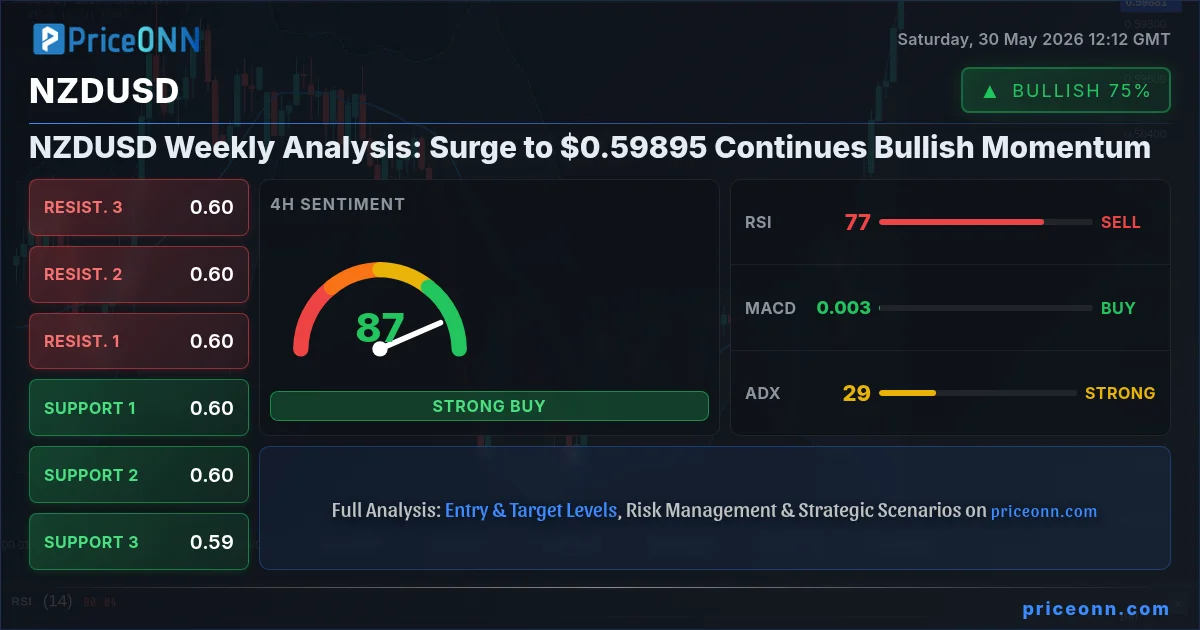
For the NZD, the immediate focus will be on any commentary from the RBNZ regarding the latest GDP print and its implications for future monetary policy. Key resistance for NZD/USD is seen at 0.6150, while support lies at 0.6080. A break below this support could open the door to further declines, especially if global risk sentiment deteriorates or if RBNZ officials signal a pivot towards easing. Cross-asset correlations, particularly with commodity prices influenced by geopolitical events, will also be crucial. Traders should be prepared for potential volatility around any RBNZ statements and US economic releases.
Outlook
The contrasting economic signals from New Zealand and the United States suggest a potential divergence in currency performance. The US dollar may find renewed strength as its domestic economy is perceived as more resilient, while the New Zealand dollar could face headwinds due to its softer growth trajectory and the potential for RBNZ policy adjustments. Upcoming inflation data from the US and any forward guidance from the RBNZ will be critical in shaping market sentiment in the short to medium term.
Track markets in real-time
Empower your investment decisions with AI-powered analysis, technical indicators and real-time price data.
Join Our Telegram Channel
Get breaking market news, AI analysis and trading signals delivered instantly to your Telegram.
Join Channel PriceONN News
USDJPY has returned to the area of previous interventions. The ECB is moving towards a rate hike in June. The US dollar retreated on Friday amid new record highs for stock indices and rumours of amendments to the US-Iran agreement. However, tit-for-tat exchanges between the adversaries pushed the dollar index back into the support zone […] The post Yen Braces for a New Storm appeared first on ActionForex.
PriceONN News
For a market supposedly obsessed with geopolitics, investors appear remarkably calm. The proposed US-Iran agreement remains unsigned, key details are still unresolved, and military exchanges between the two sides continue. Yet financial markets are behaving as though a lasting settlement is only a matter of time. Oil remains well below recent highs, Treasury yields are […] The post Trump Says “Relax”, Markets Appear To Be Listening Despite Ongoing Iran Tensions appeared first on ActionForex.
PriceONN News
USD/CAD is showing signs of potential weakness as Canada's economy struggles with a -0.1% Q1 GDP contraction and the specter of renewed trade uncertainties, while global oil prices react to Middle East truce hopes.
PriceONN News
The US Dollar experienced a notable decline last week as markets priced in a potential diplomatic resolution to the US-Iran conflict, leading to a drop in oil prices and Treasury yields. This shift in sentiment suggests a move away from stagflation fears towards a more stable economic outlook.
PriceONN News
Canada's labor market is showing signs of stabilization, with analysts predicting a dip in the unemployment rate to 6.8% in May, driven by an expected 25,000 new jobs. This follows a period of sluggish GDP growth and rising joblessness earlier in the year.
PriceONN News
The Canadian dollar faces headwinds as domestic demand cools and investment remains sluggish. However, upcoming trade negotiations could offer a much-needed catalyst for a rebound.
PriceONN News
Markets are pricing in a potential de-escalation in the US-Iran conflict, leading to a significant drop in crude oil prices and a weakening US Dollar as diplomatic efforts appear to be gaining traction.
PriceONN News
Canada's economy showed signs of a slowdown in early 2026, but upcoming May jobs data is expected to reveal a modest uplift. Analysts anticipate the unemployment rate to fall to 6.8%.
PriceONN News
The dominant story across financial markets last week was not artificial intelligence, central banks, or economic data. It was a dramatic shift in expectations regarding the future of the US-Iran conflict. Investors increasingly embraced the view that the three-month war is moving toward a diplomatic resolution after reports emerged that negotiators had drafted a 60-day […] The post US-Iran Endgame in Sight? Markets Vote for Peace as Oil, Yields and Dollar Fall appeared first on ActionForex.
PriceONN News
USD/CAD faces pressure as Canada's economy shows signs of stalling, with Q1 GDP contracting 0.1% and domestic demand weakening. This comes as trade negotiations and geopolitical shifts add layers of uncertainty.
PriceONN News
Canada's economy showed signs of life in early 2026, with analysts expecting a moderate job growth of around 25,000 positions and a potential dip in the unemployment rate to 6.8% for May.
PriceONN News
AUD/USD’s late break of 0.7183 resistance suggests that pullback from 0.7277 has already completed at 0.7076, after defending 55 D EMA. Initial bias is back on the upside this week for retesting 0.7277 high first. Firm break there will resume larger up trend. For now, risk will stay on the upside as long as 0.7076 […] The post AUD/USD Weekly Report appeared first on ActionForex.