
We Believe ECB Will Hike at Next Week’s Meeting or in April
 PriceONN Editorial Desk
Multi-source verification
PriceONN Editorial Desk
Multi-source verification
ECB's Tightrope Walk: Inflation vs. Growth
The European Central Bank faces a crucial decision point. Absent an unforeseen resolution to geopolitical tensions, the ECB confronts the specter of $100 per barrel oil and a complex policy challenge at its meeting next Thursday. The International Energy Agency's announcement that member nations would release a record 400 million barrels of oil from emergency reserves has failed to provide significant price relief. Attacks continue to disrupt key shipping lanes, exacerbating supply concerns.
Simultaneously, liquefied natural gas production remains halted due to ongoing disruptions since March 6. Rebuilding confidence and restoring supply chains will take time, even after the cessation of hostilities. This situation forces the ECB to act.
Having previously suggested its policy stance provided sufficient flexibility to manage balanced risks, the ECB may now need to demonstrate its commitment to price stability. Prior projections factored in an average Brent crude price of $62.50 per barrel for this year and the next, a level designed to help keep inflation near the 2% target. With the conflict in the Middle East dramatically altering this landscape, the ECB's scenario analysis will be critical.
Inflationary Pressures Mount
The ECB appears increasingly ready to act preemptively, having learned from past experiences that energy-related inflation shocks can trigger broader economic consequences. These consequences manifest through rising food prices, driven by fertilizer supply disruptions, and persistently elevated inflation expectations. ECB President Lagarde has acknowledged the divergence between perceived and actual inflation, highlighting the difficulties in anchoring inflation expectations. While headline inflation has decreased from the peak observed at the start of the conflict in Ukraine, core inflation remains stubbornly high.
Lagarde's recent statements, emphasizing vigilance towards developing inflation risks, mark a stark departure from the "transitory" narrative of early 2022. This shift suggests the central bank may not delay action until July, as it did in 2022. Failure to act risks pushing up the long end of the yield curve, driven by rising inflation risk premiums, and complicates the task of managing inflationary expectations.
The breakdown in German 10-year yields reflects the growing influence of inflation expectations on nominal yields, which have climbed to 2.3%, the highest level since 2023. This rise ends a two-year period of relative stability around the ECB's 2% inflation target. The persistent bear flattening of EMU yield curves signals a market expectation of a more assertive ECB response.
While the probability of a March rate hike is currently low (6%), the odds of action in April have risen significantly (25%).
Trade Tensions Escalate
The US Trade Representative has announced a new series of trade investigations that could lead to fresh import tariffs. These investigations, initiated under Section 301 of the Trade Act, target countries with alleged production overcapacity in sectors like aluminum, automobiles, electronics, and chemicals. Major economies, including China, the EU, Mexico, India, Japan, South Korea, and Taiwan, are subject to these probes. Separately, additional investigations may lead to import bans on goods produced with forced labor.
Australian consumer inflation expectations for March have reached their highest level since July 2023, accelerating to 5.2% from 5% in February. This data point strengthens the market's implied probability of a rate hike by the Reserve Bank of Australia (RBA) to 73%. Recent hawkish comments from RBA officials, warning against repeating past mistakes of allowing inflation to remain excessively high, have further fueled these expectations.
Market Ripple Effects
How will these developments impact portfolios and trading strategies?
The ECB's potential rate hike could have significant consequences for several asset classes:
- Euro (EUR): A rate hike would likely strengthen the euro against other major currencies, particularly the US dollar (USD).
- Government Bonds: Eurozone government bond yields are likely to rise, especially at the short end of the curve. The spread between German Bunds and peripheral bonds (Italian, Spanish, Greek) could widen if markets perceive increased risk.
- European Equities: The impact on European equities is less clear. While a stronger euro could hurt export-oriented companies, a decisive ECB response to inflation could boost investor confidence.
- Gold: Rising interest rates typically put downward pressure on gold prices, as they increase the opportunity cost of holding the precious metal.
Traders should closely monitor upcoming economic data releases, particularly inflation figures and PMI data, for further clues about the ECB's likely course of action. Key levels to watch include the EUR/USD exchange rate, German Bund yields, and the spread between core and peripheral Eurozone bond yields. A break above 1.10 in EUR/USD could signal further upside, while a widening of Eurozone bond spreads could indicate increased market stress.
Track markets in real-time
Empower your investment decisions with AI-powered analysis, technical indicators and real-time price data.
Join Our Telegram Channel
Get breaking market news, AI analysis and trading signals delivered instantly to your Telegram.
Join Channel PriceONN News
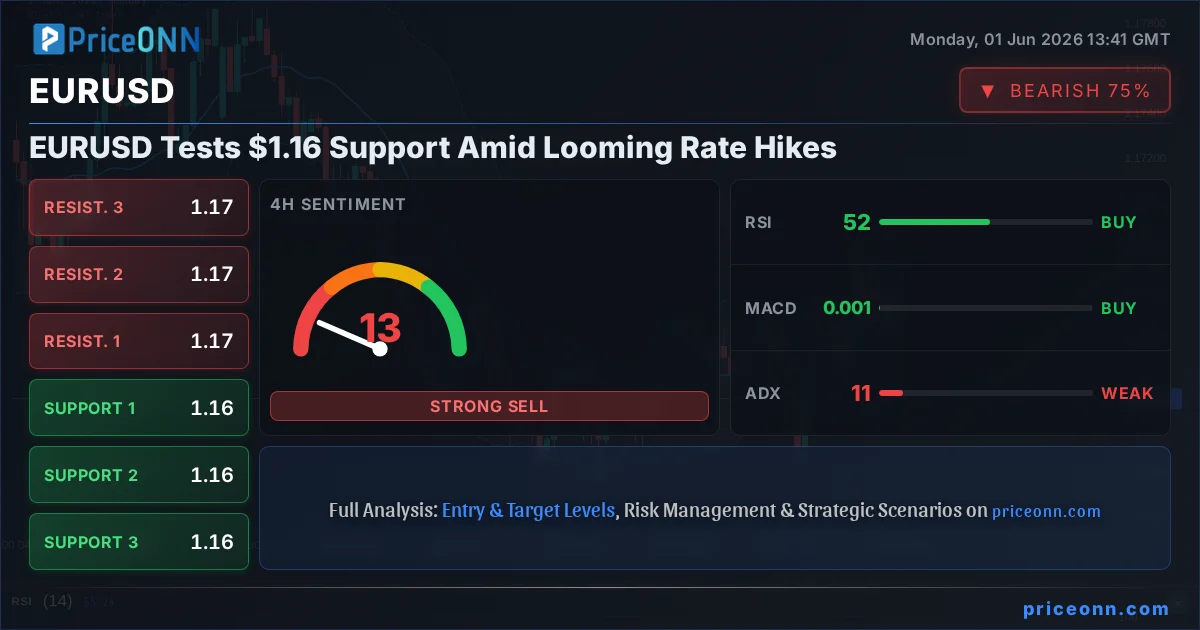
EUR/USD stalled below 1.1660 as the US Dollar defied expectations, refusing to weaken despite reports of a US-Iran ceasefire extension. Market participants remain cautious, awaiting concrete confirmation and assessing lingering inflationary pressures.
PriceONN News
The US Dollar experienced a notable dip as a renewed ceasefire between the US and Iran spurred a rally in global equities, particularly in tech stocks. However, persistent core PCE inflation at 3.3% YoY continues to fuel 'higher for longer' rate expectations.
PriceONN News
EUR/USD closed at 1.1640, showing resilience amid mixed signals. Easing US-Iran tensions initially pressured the dollar, but persistent inflation concerns and political ratification hurdles are keeping the greenback surprisingly steady.
PriceONN News
The EUR/USD faces headwinds as core US PCE inflation unexpectedly rose to 3.3% year-over-year, reinforcing a 'higher for longer' interest rate narrative. Meanwhile, a US-Iran ceasefire extension boosted global risk appetite, potentially drawing capital away from safe-haven currencies.
PriceONN News
EUR/USD stabilized around 1.1640 as reports of a US-Iran ceasefire extension and potential Strait of Hormuz reopening eased inflation fears. However, the US Dollar's resilience suggests lingering caution among forex traders.
PriceONN News
USD/JPY is testing the critical 160 level as stalled US-Iran negotiations and hawkish Federal Reserve rhetoric fuel inflation concerns and a potential for further rate hikes. Traders are closely watching upcoming US Non-Farm Payrolls and Eurozone CPI data for direction.
PriceONN News
The USD/JPY pair is flirting with the 160 level as stalled US-Iran negotiations and hawkish Federal Reserve rhetoric fuel inflation concerns. Traders are closely watching upcoming US Non-Farm Payrolls and Eurozone CPI data.
PriceONN News
Oil markets have stabilised lower for now and global equity markets have rallied this week on the back of renewed optimism around a deal in the Middle East. On Thursday afternoon, media reports emerged that the US and Iranian negotiators had settled on a Memorandum of Understanding (MOU) that would extend the ceasefire by 60 […] The post Weekly Focus – Optimism Around Iran Deal Lifts Market Sentiment appeared first on ActionForex.
PriceONN News
USDJPY has returned to the area of previous interventions. The ECB is moving towards a rate hike in June. The US dollar retreated on Friday amid new record highs for stock indices and rumours of amendments to the US-Iran agreement. However, tit-for-tat exchanges between the adversaries pushed the dollar index back into the support zone […] The post Yen Braces for a New Storm appeared first on ActionForex.
PriceONN News
The US Dollar experienced a notable decline last week as markets priced in a potential diplomatic resolution to the US-Iran conflict, leading to a drop in oil prices and Treasury yields. This shift in sentiment suggests a move away from stagflation fears towards a more stable economic outlook.
PriceONN News
Canada's labor market is showing signs of stabilization, with analysts predicting a dip in the unemployment rate to 6.8% in May, driven by an expected 25,000 new jobs. This follows a period of sluggish GDP growth and rising joblessness earlier in the year.
PriceONN News
Markets are pricing in a potential de-escalation in the US-Iran conflict, leading to a significant drop in crude oil prices and a weakening US Dollar as diplomatic efforts appear to be gaining traction.