
Why Did the Bank of Japan Hold Rates as Oil Prices Spike Amid Geopolitical Fears?


The Bank of Japan (BoJ) is poised to keep its benchmark interest rate unchanged at 0.75% at the conclusion of its monetary policy meeting this Thursday. This anticipated decision reflects a strategic pause as policymakers navigate a complex economic landscape, heavily influenced by the recent surge in global oil prices exacerbated by geopolitical tensions.
Market Context
The current economic climate presents a delicate balancing act for the BoJ. Analysts note that the spike in crude oil prices, a direct consequence of escalating geopolitical events, introduces significant uncertainty regarding both the immediate economic trajectory and the central bank's long-term inflation objectives. For years, the BoJ maintained an exceptionally accommodative monetary policy, initiated in 2013 with Quantitative and Qualitative Easing (QQE). This strategy involved substantial asset purchases to inject liquidity, aiming to combat persistent deflationary pressures and stimulate economic growth. Further easing measures were implemented in 2016, including negative interest rates and yield curve control on 10-year government bonds.
However, a notable policy shift began to materialize in March 2024, when the BoJ signaled a move away from its ultra-loose stance, commencing a gradual normalization process. This pivot was prompted by a rise in inflation, partly attributed to a weaker yen and increasing global commodity costs. The yen had experienced consistent depreciation during the period of expansive monetary policy, especially as other major central banks aggressively raised rates to combat multi-decade high inflation. This policy divergence widened, significantly weakening the yen against major global currencies.
Analysis & Drivers
The confluence of a depreciating yen and soaring energy prices in late 2023 and early 2024 propelled Japanese inflation above the BoJ's 2% target. Additional contributing factors included expectations of rising domestic wages, a critical element for sustained inflation. This scenario has created a complex environment for the central bank, necessitating a careful approach to monetary policy. The current geopolitical instability, particularly impacting energy supply chains, directly fuels inflationary concerns. Higher energy costs translate into increased operational expenses for businesses and higher living costs for consumers, potentially dampening economic activity even as inflation rises.
Market data indicates that oil prices have seen a substantial increase in recent weeks, driven by supply disruption fears stemming from the ongoing conflict involving Iran. This has added a layer of unpredictability to inflation forecasts, making it challenging for central banks to set clear policy paths. For Japan, a net importer of energy, these price increases have a direct and pronounced impact on its trade balance and domestic price levels. The BoJ must weigh the risk of imported inflation against the need to support domestic economic recovery, which is still showing signs of fragility.
Trader Implications
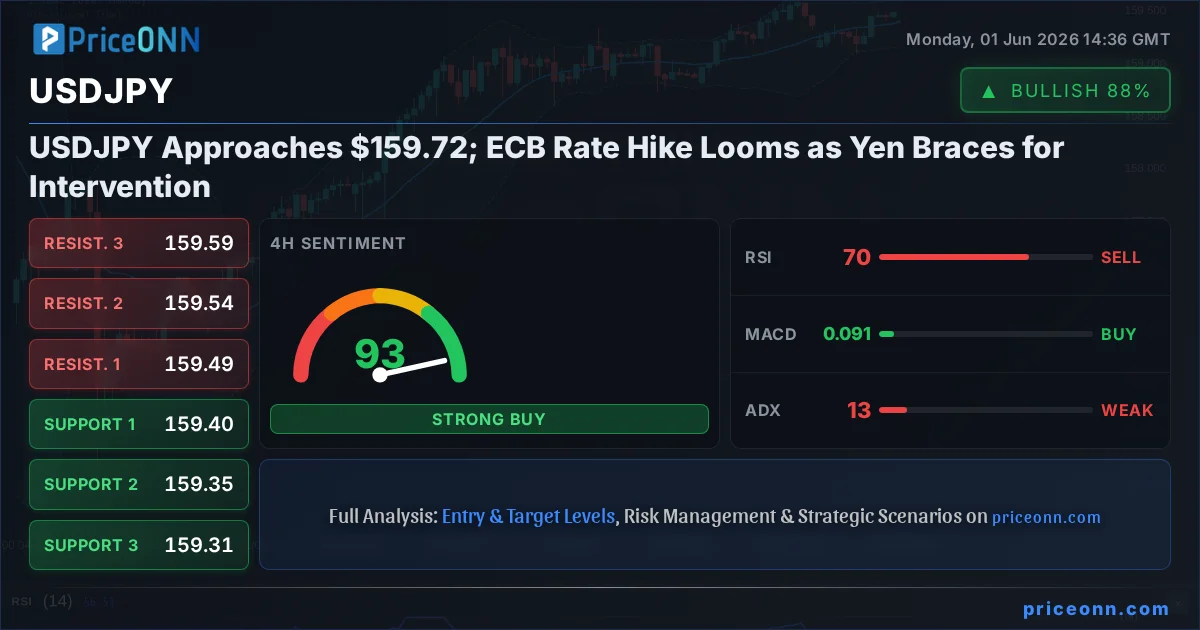
Traders should closely monitor the BoJ's policy statement for any subtle shifts in language that might signal future policy adjustments. While a rate hold is expected, any indication of a more hawkish or dovish tone could impact yen crosses. Key levels to watch for USD/JPY include the 152.00 resistance level, which has acted as a significant barrier in recent trading sessions. A sustained move above this level, potentially fueled by persistent inflation concerns or differing central bank outlooks, could open the door for further appreciation of the dollar against the yen. Conversely, any signs of concern from the BoJ regarding the impact of high energy prices on domestic demand could lead to yen strengthening.
The current market sentiment suggests that the BoJ will prioritize stability in the short term, avoiding aggressive tightening that could stifle nascent economic recovery. However, sustained high oil prices could force a reassessment. Traders should remain vigilant for any official commentary on the inflation outlook and the potential for currency intervention if the yen experiences excessive volatility. Key technical support for USD/JPY is currently observed around the 149.50 mark.
Outlook
Looking ahead, the Bank of Japan's monetary policy will likely remain data-dependent, with a keen focus on inflation trends and global economic conditions. While the immediate expectation is a rate hold, persistent inflationary pressures from energy markets and potential shifts in global monetary policy could prompt future changes. The market will be watching for signs of whether the current inflation is perceived as transitory or structural by the BoJ. Upcoming wage data and consumer price index figures will be crucial in shaping the central bank's outlook for the remainder of the year.
Frequently Asked Questions
What is the current benchmark interest rate in Japan?
The Bank of Japan's benchmark interest rate is currently set at 0.75%. It is widely expected to remain at this level following the upcoming monetary policy meeting.
How are high oil prices affecting the Bank of Japan's decision?
High oil prices are contributing to inflationary pressures, creating uncertainty about Japan's economic outlook and making the BoJ cautious about adjusting interest rates. This surge in energy costs, driven by geopolitical events, adds complexity to managing inflation targets.
What are the key levels to watch for USD/JPY?
Traders should monitor the 152.00 resistance level for potential upside continuation and the 149.50 support level for potential downside correction in the USD/JPY pair, as market sentiment reacts to BoJ policy expectations and oil price movements.
Track markets in real-time
Empower your investment decisions with AI-powered analysis, technical indicators and real-time price data.
Join Our Telegram Channel
Get breaking market news, AI analysis and trading signals delivered instantly to your Telegram.
Join Channel PriceONN News
The Iran war suddenly turned what had started as a year of oversupply in global oil and LNG markets into the worst oil and gas supply disruption in history. Three months after the U.S.-Israeli strikes on Iran began on February 28, the world has already lost 1 billion barrels of crude oil supply, oil and gas prices have found a new, much higher floor, and whipsaw with violent volatility nearly every day, trade routes have shifted, and tanker rates have spiked. Actual supply shortages are...
PriceONN News
Crude oil prices experienced a significant drop, with WTI futures falling over 1.8% to $87.25, as optimism grew for a U.S.-Iran deal potentially reopening the Strait of Hormuz.
PriceONN News
Crude oil prices experienced a significant downturn as market sentiment shifted towards optimism about a potential US-Iran Memorandum of Understanding that could reopen the Strait of Hormuz. WTI futures fell nearly 2% on the news.
PriceONN News
(RTTNews) - Crude oil prices have tumbled on Friday as expectations of the U.S. and Iran signing a Memorandum of Understanding run high. The MoU would allow for immediate reopening of the Strait of Hormuz and pave the way for the resumption of oil and energy trade.
PriceONN News
Crude oil futures experienced a dramatic intraday reversal on Thursday, soaring overnight on geopolitical fears only to pull back significantly as reports of a potential diplomatic understanding between the U.S. and Iran emerged.
PriceONN News
Crude oil futures experienced a dramatic intraday reversal, soaring to $92.52 before pulling back significantly on Thursday. The volatile session was driven by shifting geopolitical narratives and U.S. inventory data.
PriceONN News
Crude oil futures experienced a dramatic reversal, soaring overnight to $92.52 before plummeting nearly 6% to $89 a barrel. This volatility was driven by escalating US-Iran tensions followed by reports of a potential preliminary diplomatic understanding.
PriceONN News
(RTTNews) - Crude oil futures skyrocketed overnight but have shown a significant pullback over the course of the trading day on Thursday.
PriceONN News
The market’s faith in an imminent US-Iran peace breakthrough has clearly weakened today - but it has not disappeared yet. Oil prices jumped again in after fresh military escalation around the Strait of Hormuz reignited fears of prolonged supply disruptions across the Gulf. Brent crude pushed back toward the mid-$90s after new U.S. strikes inside […] The post Brent Oil Holding Below $100 Suggests Markets Still See Room for a US-Iran Deal appeared first on ActionForex.
PriceONN News
(RTTNews) - Extending the losses from yesterday's session, crude oil prices have gone into freefall on Wednesday as investor expectations on a potential U.S.-Iran agreement continue to rise despite the U.S. refusing to ease its demands.
PriceONN News
(RTTNews) - Crude oil prices have tumbled on Tuesday as optimism about a U.S.-Iran peace deal that could lead to reopening of the Strait of Hormuz soon grows despite reports of fresh U.S. strikes on Iran yesterday.
PriceONN News
Crude oil benchmarks experienced a sharp decline of over 5% this week, driven by renewed optimism surrounding U.S.-Iran peace talks and a potential easing of Middle East tensions. Both Brent and WTI futures saw significant drops as market sentiment shifted towards de-escalation.