
Why Did Crude Oil Surge Past $99 Amid Escalating Middle East Tensions?

Crude oil prices experienced a dramatic surge on Friday, with West Texas Intermediate (WTI) futures for May delivery climbing by 5.63% to $99.80 per barrel. This sharp upward movement comes as escalating geopolitical tensions in the Middle East and supply disruptions from Russia have overshadowed diplomatic efforts and driven market participants to brace for a protracted period of constrained supply.
Market Context
The energy market witnessed a significant reversal on Friday, with WTI crude oil not only paring earlier losses but also pushing well above the $93.50 mark as the European trading session opened. This rebound was primarily fueled by heightened anxieties surrounding the ongoing conflict involving Iran. Market participants are now preparing for the possibility of a prolonged regional engagement, which typically leads to supply chain vulnerabilities. Simultaneously, Russian oil exporters are signaling potential force majeure on shipments from key Baltic Sea ports, including Ust-Luga and Primorsk, following a series of Ukrainian drone strikes that crippled critical infrastructure. These two ports represent a substantial portion of Russia’s seaborne crude and product exports, adding another layer of concern to global supply availability.
Analysis & Drivers
The primary catalyst for Friday's oil price surge appears to be the hardening stance taken by Iran. The Islamic Revolutionary Guards Corps (IRGC) asserted full control over the Strait of Hormuz, a critical chokepoint for global energy transit, and reportedly shut it down for vessel traffic, warning of severe repercussions for any ships attempting to pass. This declaration marks a significant escalation in the month-long Gulf confrontation. The potential closure of this vital waterway, through which millions of barrels of oil pass daily, creates substantial supply disruption risks. Adding to the supply crunch, Russian oil producers are contemplating force majeure declarations on Baltic port cargoes due to infrastructure damage from drone attacks. This situation, coupled with the effective closure of the Strait of Hormuz, has significantly reduced global oil market slack. Paradoxically, despite these operational damages, Russia's oil revenues are reportedly surging as Brent and Urals crude trade near $100 per barrel, driven by the war-induced supply constraints.
Trader Implications
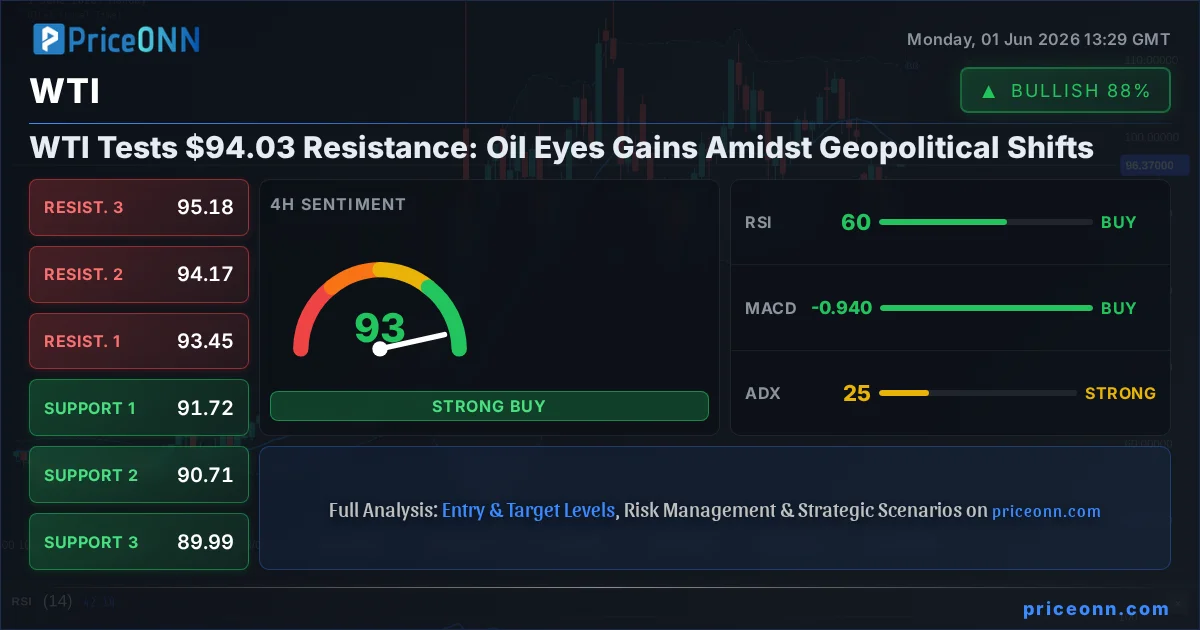
Traders should closely monitor developments in the Strait of Hormuz and the operational status of Russia's Baltic export terminals. Key price levels to watch for WTI include the immediate resistance at the $100 psychological mark and potential support around the $95.00 to $96.00 range, should any de-escalation occur. The market sentiment is heavily tilted towards risk-on for oil prices due to these supply-side disruptions. Any further escalation in the Middle East or sustained damage to Russian export capacity could push prices considerably higher. Conversely, a swift diplomatic resolution or a significant increase in production from non-disrupted regions could lead to a sharp correction. The US Dollar's performance will also be a factor, as a stronger dollar typically weighs on dollar-denominated commodities like oil.
Outlook
The immediate outlook for crude oil remains bullish, predicated on the ongoing geopolitical instability and supply disruptions. With the Strait of Hormuz under threat and Russian export capacity compromised, the market has very little room for error. Analysts anticipate that shortages, already impacting Asia, could soon extend to Europe. While US diplomatic efforts were reportedly ongoing, Iran's rigid stance and the extension of a pause on US attacks until April 6th suggest that tensions will likely persist. Traders should prepare for continued price volatility, with upward pressure dominating as long as these supply risks remain elevated. The potential for prices to retest or surpass the $100 mark is high in the short term.
Frequently Asked Questions
What is the significance of the Strait of Hormuz for oil prices?
The Strait of Hormuz is a critical chokepoint through which approximately 30% of the world's seaborne oil trade passes daily. Its closure or severe disruption, as threatened by Iran, directly curtails global supply, leading to significant price spikes like the one observed, pushing WTI towards $100 per barrel.
How are Ukrainian drone strikes impacting Russian oil exports?
Ukrainian drone strikes have targeted critical infrastructure at Russia's key Baltic Sea export terminals, such as Ust-Luga. This has led to halted oil loadings and prompted Russian producers to consider declaring force majeure, potentially removing significant volumes from global markets and contributing to higher prices.
What is the near-term price forecast for WTI crude oil?
Given the escalating geopolitical tensions in the Middle East and ongoing supply disruptions from Russia, the near-term outlook for WTI crude oil is bullish. Traders should watch for potential moves towards and beyond the $100 per barrel level, with support identified around $95-$96.
Track markets in real-time
Empower your investment decisions with AI-powered analysis, technical indicators and real-time price data.
Join Our Telegram Channel
Get breaking market news, AI analysis and trading signals delivered instantly to your Telegram.
Join Channel PriceONN News
Crude oil prices experienced a significant drop, with WTI futures falling over 1.8% to $87.25, as optimism grew for a U.S.-Iran deal potentially reopening the Strait of Hormuz.
PriceONN News
(RTTNews) - Crude oil prices have tumbled on Friday as expectations of the U.S. and Iran signing a Memorandum of Understanding run high. The MoU would allow for immediate reopening of the Strait of Hormuz and pave the way for the resumption of oil and energy trade.
PriceONN News
Crude oil futures experienced a dramatic intraday reversal on Thursday, soaring overnight on geopolitical fears only to pull back significantly as reports of a potential diplomatic understanding between the U.S. and Iran emerged.
PriceONN News
Global oil prices are treading water after a significant 5% slump, as market sentiment grapples with cautious optimism over Middle East de-escalation efforts versus lingering geopolitical uncertainties. Brent crude hovers near $104.72 and WTI near $98.07.
PriceONN News
Crude oil prices experienced a significant downturn as market sentiment shifted towards optimism about a potential US-Iran Memorandum of Understanding that could reopen the Strait of Hormuz. WTI futures fell nearly 2% on the news.
PriceONN News
Crude oil futures experienced a dramatic intraday reversal, soaring to $92.52 before pulling back significantly on Thursday. The volatile session was driven by shifting geopolitical narratives and U.S. inventory data.
PriceONN News
(RTTNews) - Crude oil futures skyrocketed overnight but have shown a significant pullback over the course of the trading day on Thursday.
PriceONN News
(RTTNews) - Extending the losses from yesterday's session, crude oil prices have gone into freefall on Wednesday as investor expectations on a potential U.S.-Iran agreement continue to rise despite the U.S. refusing to ease its demands.
PriceONN News
(RTTNews) - Crude oil prices have tumbled on Tuesday as optimism about a U.S.-Iran peace deal that could lead to reopening of the Strait of Hormuz soon grows despite reports of fresh U.S. strikes on Iran yesterday.
PriceONN News
(RTTNews) - After surging early in the day, crude oil prices have tumbled over the course of the trading session on Thursday. With the downturn, crude oil is extending the losses from the two previous sessions, as investors watch the developments in U.S.-Iran peace talks.
PriceONN News
Iran's oil exports fell to their lowest level in at least six years in May as the U.S. naval blockade continued to choke off crude shipments and leave tens of millions of barrels stranded at sea. According to shipping data from Vortexa, Iran exported just 209,000 barrels per day (bpd) of crude oil and condensate in May, down from 1.34 million bpd in April and nearly 1.9 million bpd in March. Kpler had estimated May exports slightly higher at 260,000 bpd, but still the lowest level since the...
PriceONN News
The Iran war suddenly turned what had started as a year of oversupply in global oil and LNG markets into the worst oil and gas supply disruption in history. Three months after the U.S.-Israeli strikes on Iran began on February 28, the world has already lost 1 billion barrels of crude oil supply, oil and gas prices have found a new, much higher floor, and whipsaw with violent volatility nearly every day, trade routes have shifted, and tanker rates have spiked. Actual supply shortages are...