
Why Did Gold Tumble to $4,400 Amid Renewed Middle East Tensions?
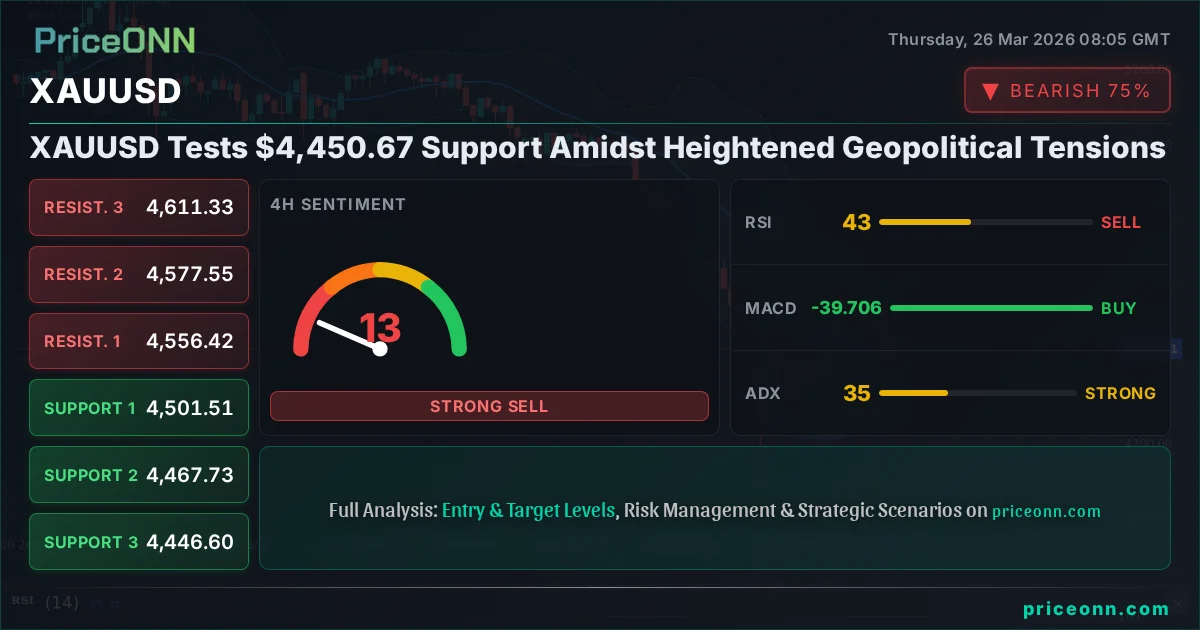
Gold prices have retreated significantly, with XAU/USD tumbling by 2% to near the $4,400 mark during Thursday’s European trading session. This sharp reversal comes as renewed geopolitical tensions in the Middle East appear to be overriding the precious metal’s traditional safe-haven status, prompting a sell-off after a brief consolidation around the $4,500 level.
Market Context
The yellow metal had shown resilience earlier in the Asian session, stalling a prior day's slide and hovering below the psychological $4,500 threshold. However, the overnight rejection from the 100-day Simple Moving Average (SMA) proved to be a precursor to Thursday’s substantial decline. The upside momentum for gold has been capped by a firmer US Dollar (USD), which typically exerts downward pressure on dollar-denominated commodities like gold.
Historically, gold has been a cornerstone of financial stability, valued as a store of value and a hedge against inflation and currency devaluation. Its appeal as a safe-haven asset is particularly pronounced during times of economic uncertainty and geopolitical turmoil. Central banks, major holders of gold, have been significant buyers, with a record 1,136 tonnes acquired in 2022 alone, signaling a strategic diversification of reserves, especially among emerging economies like China, India, and Turkey.
Analysis & Drivers
The recent price action suggests that while gold's fundamental drivers-such as central bank demand, inflation hedging, and its inverse correlation with the US Dollar-remain in play, immediate geopolitical risks are taking precedence. The re-emergence of Middle East tensions has likely triggered a flight to safety, but paradoxically, this may be benefiting assets other than gold in the short term, or leading to profit-taking after recent gains.
The strength of the US Dollar is a critical factor weighing on gold. As gold is priced in USD, a stronger dollar makes the metal more expensive for holders of other currencies, thus dampening demand. Market data indicates that the dollar has found renewed support, likely on the back of expectations surrounding US monetary policy or a perceived increase in global risk aversion that favors the dollar as a liquidity asset.
Furthermore, gold’s inverse relationship with riskier assets like equities is also a key consideration. A sell-off in risk markets can typically favor gold, but the current environment might see a complex interplay where perceived safe-haven demand is directed towards other assets or where the dollar's strength dominates.
Trader Implications
Traders should closely monitor the $4,400 level, which has now become a significant area of support following Thursday's sharp fall. A break below this level could signal further downside, potentially targeting the next key support around $4,350. Conversely, a sustained recovery above $4,450, and more importantly, a decisive move back above the 100-day SMA (currently hovering near $4,500), would be necessary to regain bullish momentum.
Key factors to watch include:
- Geopolitical Developments Developments in the Middle East will be paramount in dictating short-term sentiment.
- US Dollar Index (DXY) Continued strength in the DXY above 104.00 will likely keep gold prices under pressure.
- Interest Rate Expectations Any shifts in expectations for future US Federal Reserve policy could impact both the dollar and gold.
The current market sentiment appears to be shifting away from gold as the primary safe-haven, at least temporarily. Traders should exercise caution and look for clear directional signals, as the interplay between geopolitical fears and dollar strength creates a volatile environment.
Outlook
Looking ahead, gold's trajectory will likely remain sensitive to geopolitical headlines and the performance of the US Dollar. While the long-term fundamentals supporting gold, particularly central bank accumulation and its role as an inflation hedge, remain intact, immediate price action may be dictated by risk sentiment and currency movements. A sustained de-escalation of Middle East tensions or a significant weakening of the dollar could pave the way for a recovery, but until then, prices may struggle to reclaim higher ground.
Frequently Asked Questions
What caused the sharp drop in gold prices to $4,400?
Gold (XAU/USD) fell sharply to near $4,400 due to a renewed surge in Middle East geopolitical tensions, which, despite gold's safe-haven status, led to profit-taking and was exacerbated by a strengthening US Dollar.
What is the immediate support level for gold?
The immediate support level for gold is around $4,400. A decisive move below this could lead to further declines, potentially testing the $4,350 mark, while resistance is eyed near the $4,500 level.
Will central bank buying continue to support gold prices?
Central bank buying has historically supported gold, with record purchases in 2022. While this underlying demand remains a bullish factor, short-term price movements are currently being influenced more by geopolitical events and USD strength, suggesting price volatility may persist.
Track markets in real-time
Empower your investment decisions with AI-powered analysis, technical indicators and real-time price data.
Join Our Telegram Channel
Get breaking market news, AI analysis and trading signals delivered instantly to your Telegram.
Join Channel
PriceONN