
Why Did Gold Slip Today as US-Iran Tensions and Rate Hike Fears Mount?

Gold (XAU/USD) saw its upward momentum stall on Thursday, declining from recent highs as a complex interplay of geopolitical uncertainty and shifting interest rate outlooks dominated market sentiment.
Market Context
The precious metal, traditionally a barometer of global stability, snapped a two-day winning streak. The latest price action suggests that lingering uncertainty surrounding US-Iran negotiations is creating a cautious mood among investors. However, the more significant driver appears to be the growing expectation of continued hawkish monetary policy globally. This outlook is largely a response to an inflation shock originating from the oil markets, which is pressuring central banks to maintain higher interest rates for longer.
Historically, gold's appeal as a safe haven asset is amplified during periods of geopolitical stress and economic uncertainty. Its intrinsic value, independent of any single government or financial institution, makes it a sought-after hedge against inflation and currency devaluation. This enduring characteristic is reflected in the significant accumulation of gold by central banks. In 2022 alone, central banks purchased approximately 1,136 tonnes of gold, a record acquisition valued at roughly $70 billion, according to industry data. This trend is particularly notable among emerging economies, with countries like China, India, and Turkey leading the charge in expanding their gold reserves.
Analysis & Drivers
The current market narrative for gold is a delicate balance between its safe-haven appeal and the headwinds presented by monetary policy. While US-Iran tensions might typically bolster gold prices, the overarching concern for traders is the potential for sustained high inflation. An oil-driven inflation shock can force central banks into a corner, necessitating tighter monetary conditions to combat rising prices. This scenario typically leads to an increase in bond yields and a strengthening dollar, both of which are historically inverse to gold's performance.
Analysts note that gold's price dynamics are closely tied to its relationship with major global benchmarks. It often moves inversely to the US Dollar and US Treasuries. A weaker dollar typically supports gold prices, offering investors a diversification opportunity. Conversely, a strong dollar, often a byproduct of aggressive monetary tightening, can put downward pressure on the yellow metal. Furthermore, gold's correlation with riskier assets like equities also plays a role; robust stock market performance can dampen gold's appeal, while sharp equity sell-offs tend to boost its safe-haven demand.
Trader Implications
Traders are closely monitoring several key factors. The progression of US-Iran negotiations will be critical for short-term sentiment. Any signs of de-escalation could reduce gold's immediate safe-haven premium, while increased rhetoric or actions could reignite demand. More importantly, the global interest rate outlook remains paramount. Any indications from major central banks, particularly the US Federal Reserve, regarding their stance on inflation and future rate decisions will significantly influence gold's trajectory.
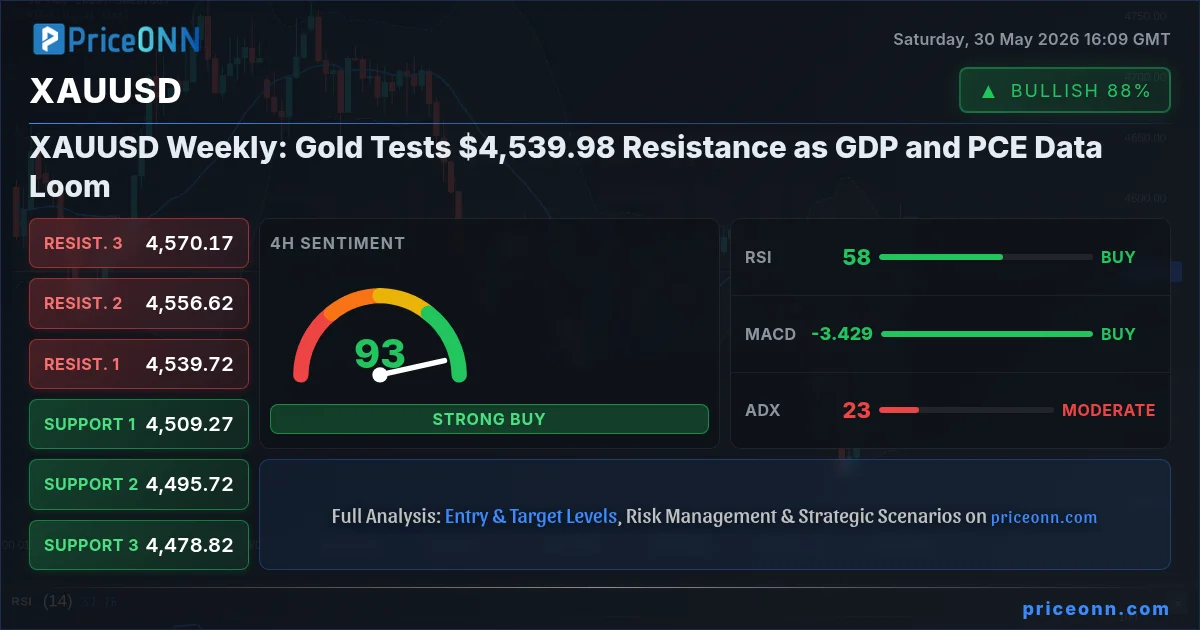
Key technical levels to watch include the immediate support around $2,300 per ounce and resistance near the recent highs. A decisive break below key support could signal further downside, potentially targeting the $2,250 mark. Conversely, a resurgence of inflation fears or a dovish shift in central bank commentary could propel gold back towards $2,350 and beyond.
Outlook
The immediate future for gold appears to hinge on the evolving geopolitical landscape and the persistence of inflationary pressures. If inflation remains stubbornly high, forcing central banks to maintain a hawkish stance, gold could face headwinds. However, any significant geopolitical escalation or a sudden shift towards looser monetary policy could quickly reverse the trend. Market participants should remain vigilant for central bank communications and developments in the Middle East.
Frequently Asked Questions
What caused gold prices to fall on Thursday?
Gold prices declined on Thursday due to a combination of factors including uncertainty surrounding US-Iran negotiations and expectations of sustained high global interest rates, driven by an oil-induced inflation shock. This environment typically pressures safe-haven assets like gold.
How are central bank gold purchases impacting the market?
Central bank gold purchases, which reached 1,136 tonnes in 2022, signal strong institutional demand for gold as a reserve asset. This consistent buying provides underlying support for gold prices, especially during times of economic uncertainty.
What are the key price levels to watch for gold?
Traders should monitor immediate support around $2,300 per ounce. A break below this level could lead to a test of $2,250. Resistance is observed near recent highs, with a move above $2,350 potentially signaling a renewed upward trend.
Track markets in real-time
Empower your investment decisions with AI-powered analysis, technical indicators and real-time price data.
Join Our Telegram Channel
Get breaking market news, AI analysis and trading signals delivered instantly to your Telegram.
Join Channel PriceONN News
Gold prices experienced a significant decline on Wednesday, falling over 1% as diplomatic optimism surrounding U.S.-Iran talks grew, despite ongoing military actions. The June gold contract settled at $4,444.50.
PriceONN News
Gold prices experienced a significant downturn, shedding 2% this week to settle near $4,444.50 per ounce. This decline is attributed to evolving U.S.-Iran diplomatic efforts and concerns over potential central bank rate hikes.
PriceONN News
(RTTNews) - Gold prices traded lower on Wednesday, extending losses from the previous session as investors fretted about oil-driven inflation and the potential impact on interest rates.
PriceONN News
Gold prices fell on Friday as concerns over crude oil inventories and the prolonged closure of the Strait of Hormuz fueled inflation anxieties, overshadowing U.S.-Iran peace talks. The June Comex Gold contract settled down 0.55% at $4,517.40.
PriceONN News
Gold futures broke above $4,500 per ounce on Friday, driven by increasing optimism for a de-escalation in the U.S.-Iran conflict and the potential reopening of the Strait of Hormuz. Silver also saw significant gains, reflecting a broader shift towards precious metals as geopolitical tensions ease.
PriceONN News
(RTTNews) - After moving sharply lower earlier in the day, the price of gold has shown a significant turnaround over the course of the trading session on Thursday.
PriceONN News
Gold prices fell below the $4500 mark on Wednesday, extending previous losses as oil prices tumbled and geopolitical tensions between the US and Iran remained a key market driver. Investors are weighing inflation concerns against hopes of de-escalation.
PriceONN News
(RTTNews) - Extending the losses from yesterday's session, gold prices have slumped on Wednesday as traders watch the ongoing efforts to end the U.S.-Iran standoff with cautious optimism while the blockade on the Strait of Hormuz continues. The rising inflationary pressure weighe
PriceONN News
Gold prices retreated to $4,504.30 per troy ounce despite ongoing geopolitical tensions and the closure of the Strait of Hormuz, suggesting a complex market dynamic beyond typical safe-haven demand. Silver, however, managed a modest gain.
PriceONN News
(RTTNews) - Gold prices have edged lower on Tuesday amid renewed concerns of inflationary pressure following fresh U.S. military strikes on Iran yesterday while the Strait of Hormuz remains closed for oil and energy transit.
PriceONN News
(RTTNews) - Gold prices were little changed on Wednesday, recouping early losses despite a stronger dollar and higher U.S. Treasury yields.
PriceONN News
(RTTNews) - Gold prices have soared on Friday amid rising optimism about an end to the Middle East war with the chances of reopening of the Strait of Hormuz and resumption of oil and energy trade growing stronger.