
Why Did Oil Prices Jump 4.4% Today Amid Geopolitical Volatility?


West Texas Intermediate (WTI) crude oil futures experienced a significant rally on Tuesday, climbing 4.43% to trade at $92.03 per barrel, as market participants grappled with conflicting reports regarding potential U.S.-Iran peace negotiations. This sharp upward movement contrasted with a previous day's decline, underscoring the market's sensitivity to geopolitical developments in the Middle East.
Market Context: Geopolitical Tensions and Conflicting Narratives
The surge in oil prices was primarily ignited by news that U.S. President Donald Trump had announced "very good and productive talks" aimed at ending hostilities between the U.S. and Iran. This announcement, made over the weekend, had initially spurred confidence that the conflict might de-escalate, leading to a sharp drop in prices on Monday. However, the market sentiment dramatically shifted when Iran's semi-official news agency Mehr denied any ongoing U.S.-Iran talks, with Iranian officials subsequently rejecting claims of negotiations. This lack of official substantiation from Iran created immediate uncertainty and fueled a renewed rally in oil prices.
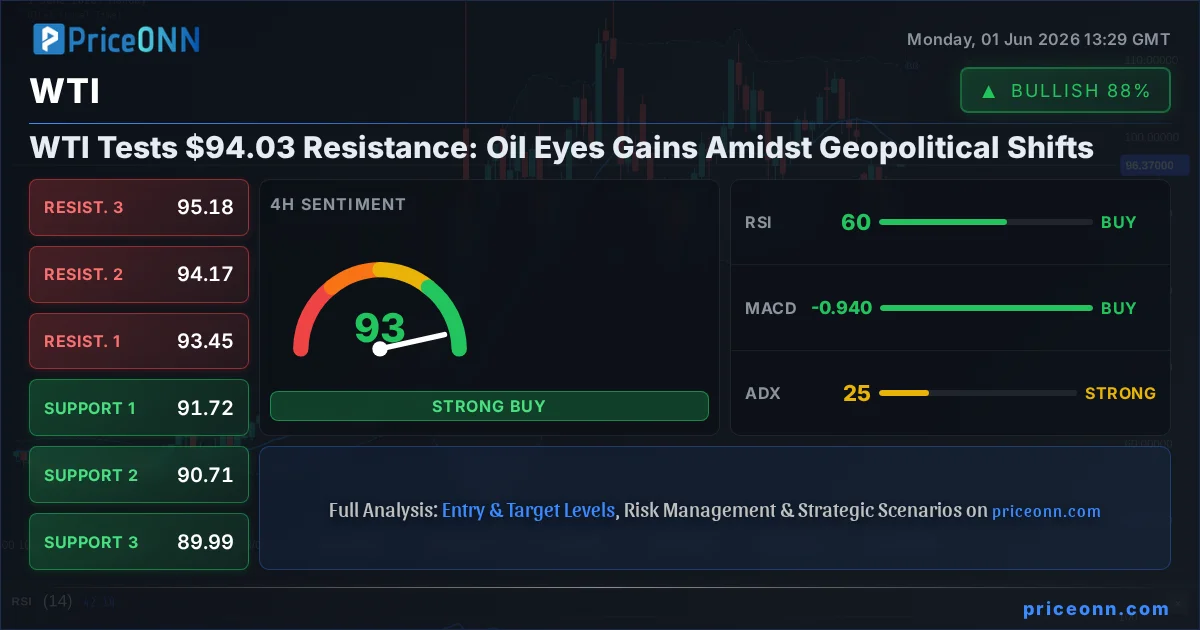
The ongoing conflict, now in its twenty-fifth day, has severely impacted global energy supply chains. Earlier in the week, Israel's attack on Iran's South Pars gas field crippled its primary energy source. Iran retaliated by targeting critical energy infrastructure in Israel and neighboring Arab nations hosting U.S. bases, including Qatar's Ras Laffan Liquified Natural Gas plant and Kuwait's Mina al-Ahmadi refinery. The continued blockade of the Strait of Hormuz since February 28 has stranded numerous oil tankers, exacerbating supply concerns and driving up demand-side pressures.
Analysis & Drivers: Inventory Surprises and Production Resilience
Adding another layer of complexity to the market picture, U.S. crude oil inventories saw an unexpected build. The American Petroleum Institute (API) reported an increase of 2.3 million barrels for the week ending March 20. This figure deviates sharply from the analyst consensus, which had anticipated a drawdown of 1.3 million barrels, and also contrasts with the preceding week's substantial 6.556 million barrel accumulation. This unexpected inventory rise suggests that demand might be softer than anticipated, or that supply adjustments are not aligning with market expectations.
Despite these inventory shifts, U.S. domestic oil production has shown resilience, albeit with a slight dip. Output has contracted for four consecutive weeks, with a reported decrease of 10,000 barrels per day (bpd) in the week ending March 13, bringing the average to 13.668 million bpd. While this represents a marginal decline, production remains higher by 95,000 bpd compared to the same period last year, indicating a robust underlying production capacity.
Meanwhile, refined product inventories also presented a mixed bag. Gasoline stockpiles increased by 500,000 barrels in the week ending March 20, though they remain approximately 3% above the typical five-year average. Distillate fuel inventories also saw shifts, details of which are still emerging.
The nation's Strategic Petroleum Reserve (SPR) remained unchanged for several weeks, holding steady at 415.4 million barrels as of March 20, indicating no immediate strategic adjustments by U.S. authorities.
Trader Implications: Navigating Volatility and Key Levels
Traders are currently navigating a highly volatile environment where geopolitical narratives can rapidly override fundamental data. The conflicting reports on U.S.-Iran talks highlight the critical importance of official confirmations and the potential for swift price reversals. Key resistance for WTI crude is likely around the $95-$100 per barrel range, while immediate support may be found near the $88-$90 per barrel level. Investors should closely monitor any further statements from Iranian officials and U.S. diplomatic channels.
The unexpected inventory build also warrants attention. If subsequent data confirms a trend of rising U.S. crude stocks, it could begin to weigh on prices, provided geopolitical tensions do not further escalate. Traders should also keep an eye on the Strait of Hormuz shipping status and any further attacks on energy infrastructure, as these events have a direct and immediate impact on global oil supply and pricing.
Outlook: Continued Uncertainty and Supply Risk Premium
The outlook for crude oil remains heavily influenced by the unpredictable geopolitical situation in the Middle East. While the denial of peace talks has pushed prices higher, any renewed diplomatic overtures, even if unsubstantiated, could trigger sharp corrections. The market is likely to continue pricing in a significant risk premium due to the ongoing conflict and potential for further supply disruptions. Traders should remain vigilant, as the delicate balance between geopolitical events and inventory data will dictate price direction in the near term. Upcoming official inventory reports from the Energy Information Administration (EIA) will be crucial for assessing the true state of U.S. supply and demand.
Frequently Asked Questions
What caused the sudden jump in WTI crude oil prices on Tuesday?
WTI crude oil surged by 4.43% to $92.03 per barrel due to conflicting reports about U.S.-Iran peace talks. Initial positive news was countered by Iran's denial of ongoing negotiations, creating significant market uncertainty and driving prices upward.
How do U.S. crude oil inventories impact current prices?
An unexpected inventory build of 2.3 million barrels for the week ending March 20 suggests potentially softer demand or misaligned supply expectations, which can pressure prices. However, this fundamental data is currently being overshadowed by geopolitical risks.
What is the short-term outlook for crude oil prices?
The outlook remains highly volatile, with prices sensitive to geopolitical developments in the Middle East and any official statements regarding U.S.-Iran relations. Traders should watch for potential price risk premiums driven by supply disruption fears, with key levels to monitor around $90 and $95 per barrel.
Track markets in real-time
Empower your investment decisions with AI-powered analysis, technical indicators and real-time price data.
Join Our Telegram Channel
Get breaking market news, AI analysis and trading signals delivered instantly to your Telegram.
Join Channel PriceONN News
Crude oil prices experienced a significant drop, with WTI futures falling over 1.8% to $87.25, as optimism grew for a U.S.-Iran deal potentially reopening the Strait of Hormuz.
PriceONN News
Crude oil prices experienced a significant downturn as market sentiment shifted towards optimism about a potential US-Iran Memorandum of Understanding that could reopen the Strait of Hormuz. WTI futures fell nearly 2% on the news.
PriceONN News
(RTTNews) - Crude oil prices have tumbled on Friday as expectations of the U.S. and Iran signing a Memorandum of Understanding run high. The MoU would allow for immediate reopening of the Strait of Hormuz and pave the way for the resumption of oil and energy trade.
PriceONN News
Crude oil futures experienced a dramatic intraday reversal on Thursday, soaring overnight on geopolitical fears only to pull back significantly as reports of a potential diplomatic understanding between the U.S. and Iran emerged.
PriceONN News
(RTTNews) - Extending the losses from yesterday's session, crude oil prices have gone into freefall on Wednesday as investor expectations on a potential U.S.-Iran agreement continue to rise despite the U.S. refusing to ease its demands.
PriceONN News
(RTTNews) - Crude oil prices have tumbled on Tuesday as optimism about a U.S.-Iran peace deal that could lead to reopening of the Strait of Hormuz soon grows despite reports of fresh U.S. strikes on Iran yesterday.
PriceONN News
Iran's oil exports fell to their lowest level in at least six years in May as the U.S. naval blockade continued to choke off crude shipments and leave tens of millions of barrels stranded at sea. According to shipping data from Vortexa, Iran exported just 209,000 barrels per day (bpd) of crude oil and condensate in May, down from 1.34 million bpd in April and nearly 1.9 million bpd in March. Kpler had estimated May exports slightly higher at 260,000 bpd, but still the lowest level since the...
PriceONN News
The Iran war suddenly turned what had started as a year of oversupply in global oil and LNG markets into the worst oil and gas supply disruption in history. Three months after the U.S.-Israeli strikes on Iran began on February 28, the world has already lost 1 billion barrels of crude oil supply, oil and gas prices have found a new, much higher floor, and whipsaw with violent volatility nearly every day, trade routes have shifted, and tanker rates have spiked. Actual supply shortages are...
PriceONN News
Crude oil futures experienced a dramatic intraday reversal, soaring to $92.52 before pulling back significantly on Thursday. The volatile session was driven by shifting geopolitical narratives and U.S. inventory data.
PriceONN News
(RTTNews) - Crude oil futures skyrocketed overnight but have shown a significant pullback over the course of the trading day on Thursday.
PriceONN News
The market’s faith in an imminent US-Iran peace breakthrough has clearly weakened today - but it has not disappeared yet. Oil prices jumped again in after fresh military escalation around the Strait of Hormuz reignited fears of prolonged supply disruptions across the Gulf. Brent crude pushed back toward the mid-$90s after new U.S. strikes inside […] The post Brent Oil Holding Below $100 Suggests Markets Still See Room for a US-Iran Deal appeared first on ActionForex.
PriceONN News
South America has raised its oil exports more than the U.S. has done so far this year as key producers in the region boosted production and shipments to a world scrambling for crude that’s not dependent on the Strait of Hormuz. Over the past five years, South America’s biggest producer and exporter, Brazil, has started production at several new offshore platforms in the Santos pre-salt fields. Guyana has continuously increased overseas shipments as the Exxon-led consortium starts up...