
Why Did Oil Prices Rebound Above $93.50 Amid Escalating Iran Tensions?

Crude oil prices have demonstrated a sharp reversal, with West Texas Intermediate (WTI) futures climbing back above $93.50 per barrel as the European trading session opened on Friday. This recovery follows earlier declines, indicating a market still highly sensitive to geopolitical developments, particularly the escalating tensions surrounding Iran.
Market Context: Shifting Sands in Oil Valuations
Earlier in the week, oil benchmarks were trading lower, with Brent crude at $107.98 and WTI at $94.12. These levels represented a pullback from Monday's figures, where Brent had surpassed $111 and WTI traded above $98. The initial downward pressure was attributed to statements suggesting a potential end to regional hostilities, leading traders to price in a de-escalation. However, this sentiment appears to have been short-lived as anxieties surrounding a potentially protracted conflict in Iran have resurfaced, driving prices higher once more.
Despite the recent dip and subsequent rebound, both Brent and WTI benchmarks remain significantly elevated compared to the start of the year. This persistent upward trend highlights the underlying supply-side sensitivities within the global energy market, which appear to be outweighing hopes for immediate diplomatic resolutions.
Analysis & Drivers: Geopolitics Versus Peace Prospects
The primary driver behind the recent volatility in oil prices is the complex interplay between de-escalation hopes and the persistent threat of broader regional conflict. While pronouncements suggesting an imminent end to hostilities initially spurred a sell-off, market data now indicates that traders are re-evaluating the situation, bracing for a potentially prolonged period of instability in Iran.
Industry reports indicate that analysts are modeling various scenarios. A base-case scenario anticipates a swift de-escalation, which would prevent severe damage to global energy supply chains. However, alternative scenarios warn of significant market disruption should the conflict persist or escalate. Such an outcome could trigger widespread economic headwinds, impacting global demand and further tightening supply.
The pricing of WTI, a key indicator of global oil market health, is intrinsically linked to the balance of supply and demand. While global economic growth typically influences demand, the oil market remains acutely vulnerable to supply disruptions. Political instability, conflicts, and sanctions can severely curtail production and trade flows, leading to sharp price increases. Furthermore, the strategic decisions of OPEC regarding production levels and the valuation of the US Dollar continue to exert influence on crude prices.
Trader Implications: Navigating Volatility
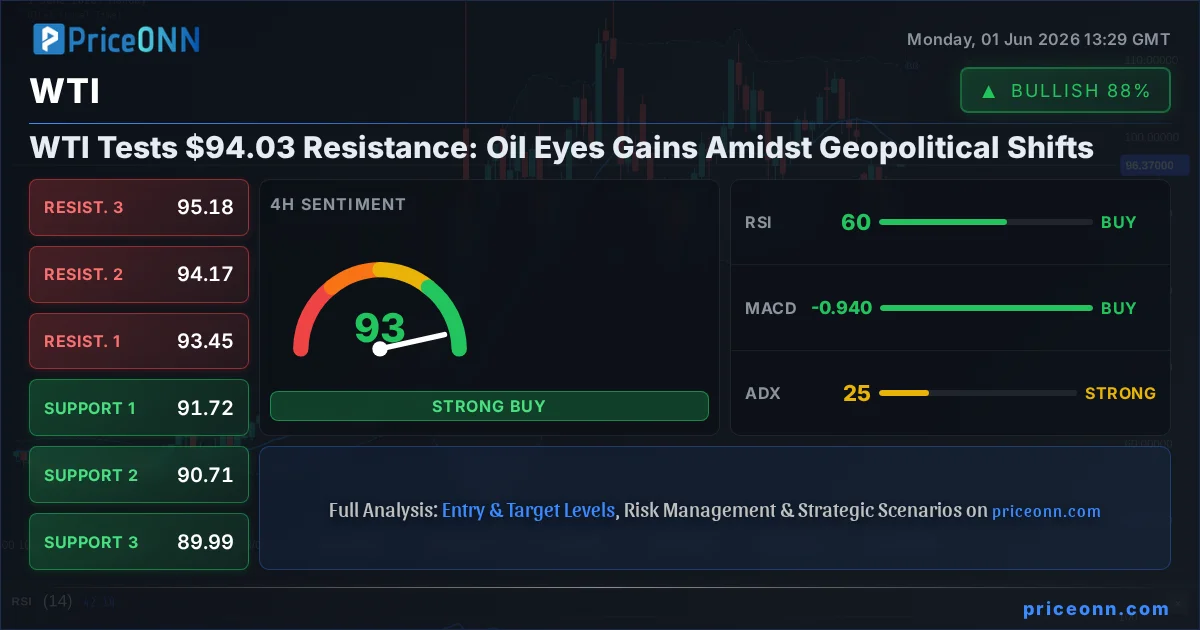
Traders are advised to closely monitor geopolitical developments in the Middle East, as these remain the most significant catalyst for short-term price movements. Key levels to watch for WTI include immediate resistance around the $94.00-$95.00 mark, with further upside potential towards $100 if tensions significantly escalate. Conversely, a sustained de-escalation or a clear diplomatic breakthrough could see prices retreat towards the $90.00 support level.
The current market sentiment suggests a cautious approach. While peace prospects initially drove prices down, the resurgent geopolitical risk indicates that upside potential remains significant. Traders should be prepared for continued volatility and consider risk management strategies, particularly if positions are held overnight.
Outlook
The immediate future for oil prices hinges on the evolving situation in Iran. Should diplomatic efforts succeed in achieving a rapid de-escalation, a further price correction is likely. However, any indication of prolonged conflict or regional spillover could send WTI and Brent prices sharply higher, potentially retesting recent peaks. The market's sensitivity to supply-side shocks suggests that even a perception of heightened risk could be enough to sustain elevated price levels.
Frequently Asked Questions
What is the current price of WTI crude oil?
As of Friday's European session opening, West Texas Intermediate (WTI) crude oil futures were trading back above $93.50 per barrel, reversing earlier losses due to renewed geopolitical concerns.
Why did oil prices rebound after initially falling?
The initial decline was driven by hopes of a de-escalation in Middle East conflicts. However, the rebound occurred as market participants began to brace for a potentially protracted war in Iran, increasing geopolitical risk premiums.
What are the key price levels for WTI to watch?
Traders should watch immediate resistance around $94.00-$95.00. A significant escalation could push prices towards $100, while a successful de-escalation might see prices test the $90.00 support level.
Track markets in real-time
Empower your investment decisions with AI-powered analysis, technical indicators and real-time price data.
Join Our Telegram Channel
Get breaking market news, AI analysis and trading signals delivered instantly to your Telegram.
Join Channel PriceONN News
Crude oil prices experienced a significant drop, with WTI futures falling over 1.8% to $87.25, as optimism grew for a U.S.-Iran deal potentially reopening the Strait of Hormuz.
PriceONN News
Crude oil prices experienced a significant downturn as market sentiment shifted towards optimism about a potential US-Iran Memorandum of Understanding that could reopen the Strait of Hormuz. WTI futures fell nearly 2% on the news.
PriceONN News
(RTTNews) - Crude oil prices have tumbled on Friday as expectations of the U.S. and Iran signing a Memorandum of Understanding run high. The MoU would allow for immediate reopening of the Strait of Hormuz and pave the way for the resumption of oil and energy trade.
PriceONN News
Crude oil futures experienced a dramatic intraday reversal on Thursday, soaring overnight on geopolitical fears only to pull back significantly as reports of a potential diplomatic understanding between the U.S. and Iran emerged.
PriceONN News
(RTTNews) - Extending the losses from yesterday's session, crude oil prices have gone into freefall on Wednesday as investor expectations on a potential U.S.-Iran agreement continue to rise despite the U.S. refusing to ease its demands.
PriceONN News
(RTTNews) - Crude oil prices have tumbled on Tuesday as optimism about a U.S.-Iran peace deal that could lead to reopening of the Strait of Hormuz soon grows despite reports of fresh U.S. strikes on Iran yesterday.
PriceONN News
(RTTNews) - After surging early in the day, crude oil prices have tumbled over the course of the trading session on Thursday. With the downturn, crude oil is extending the losses from the two previous sessions, as investors watch the developments in U.S.-Iran peace talks.
PriceONN News
Global oil prices are treading water after a significant 5% slump, as market sentiment grapples with cautious optimism over Middle East de-escalation efforts versus lingering geopolitical uncertainties. Brent crude hovers near $104.72 and WTI near $98.07.
PriceONN News
Iran's oil exports fell to their lowest level in at least six years in May as the U.S. naval blockade continued to choke off crude shipments and leave tens of millions of barrels stranded at sea. According to shipping data from Vortexa, Iran exported just 209,000 barrels per day (bpd) of crude oil and condensate in May, down from 1.34 million bpd in April and nearly 1.9 million bpd in March. Kpler had estimated May exports slightly higher at 260,000 bpd, but still the lowest level since the...
PriceONN News
The Iran war suddenly turned what had started as a year of oversupply in global oil and LNG markets into the worst oil and gas supply disruption in history. Three months after the U.S.-Israeli strikes on Iran began on February 28, the world has already lost 1 billion barrels of crude oil supply, oil and gas prices have found a new, much higher floor, and whipsaw with violent volatility nearly every day, trade routes have shifted, and tanker rates have spiked. Actual supply shortages are...
PriceONN News
Crude oil futures experienced a dramatic intraday reversal, soaring to $92.52 before pulling back significantly on Thursday. The volatile session was driven by shifting geopolitical narratives and U.S. inventory data.
PriceONN News
(RTTNews) - Crude oil futures skyrocketed overnight but have shown a significant pullback over the course of the trading day on Thursday.