
Why Did Oil Prices Surge Amidst Geopolitical Tensions and Shifting Energy Policies?

Global oil prices have seen a notable surge, driven by a confluence of escalating geopolitical risks and evolving domestic energy strategies. The disruption of critical shipping lanes, particularly in the Middle East, has sent shockwaves through the market, raising concerns about supply security and pushing benchmarks higher.
Market Context
The recent uptick in crude oil prices is largely attributed to heightened tensions in the Middle East, which have led to the closure of vital shipping arteries. This has created immediate supply chain anxieties, forcing traders to price in a significant risk premium. For instance, the Strait of Hormuz, a crucial chokepoint for global energy flows, has seen restricted commercial vessel traffic, directly impacting the availability of crude. This supply-side shock comes at a time when industrial production in major economies like China is showing signs of recovery, increasing demand for energy inputs.
In China, industrial profits saw a substantial 15.2% increase in the January-February period compared to the previous year, an acceleration from December's 5.3% rise. This growth was primarily fueled by a rebound in factory activity and rising product prices, with high-tech manufacturing, semiconductors, and raw material producers leading the gains. However, market data indicates that this positive economic momentum could be threatened by the spillover effects of escalating geopolitical conflicts, potentially weighing on the nation's growth outlook despite its significant oil reserves and investments in alternative energy sources.
Analysis & Drivers
The primary catalyst for the current oil price rally is the geopolitical instability in the Middle East. The disruption of key transit routes has created an immediate supply crunch, pushing prices upwards as market participants scramble to secure available barrels. Analysts note that the market is highly sensitive to any further escalation in the region, which could lead to more sustained price increases.
Adding to the complexity are domestic policy shifts in energy-producing nations. In the United Kingdom, for example, discussions surrounding new North Sea oil and gas exploration are facing legal and political hurdles. Reports indicate that decisions on granting new licenses, such as those for Shell's Jackdaw site and Equinor's Rosebank field, are subject to stringent environmental reviews and fall under the purview of specific government officials, rather than being a straightforward executive approval. This internal policy debate, while not directly causing the immediate price surge, highlights the intricate balance between energy security, environmental concerns, and the transition to renewable sources, which can influence long-term supply expectations and market sentiment.
Trader Implications
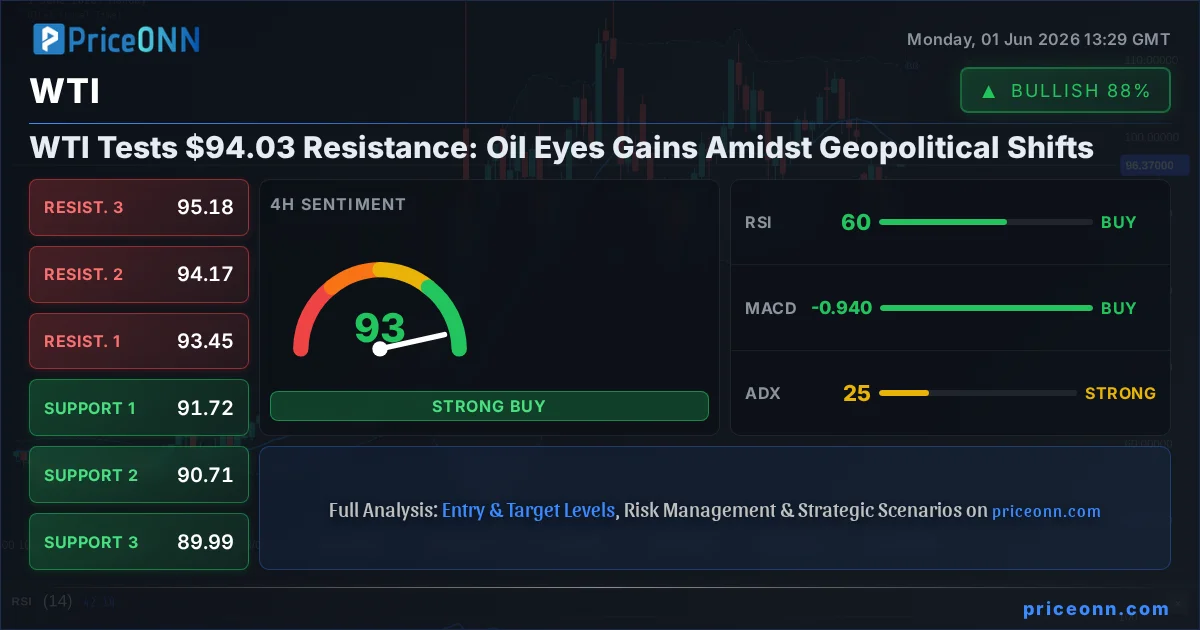
Traders should closely monitor developments in the Middle East, as any further escalation could lead to rapid price movements. Key resistance levels for crude oil benchmarks are being tested, with significant upside potential if supply disruptions persist. Conversely, a de-escalation of tensions could trigger a sharp correction.
Key levels to watch include the $85 per barrel mark for Brent crude and the $80 per barrel level for West Texas Intermediate (WTI). A sustained break above these levels could signal further upward momentum. Traders should also pay attention to official statements regarding energy policy from major economies and the outcomes of legal reviews for new exploration projects, as these can impact future supply dynamics.
For those looking to capitalize on volatility, consider strategies that account for both potential upside from supply shocks and downside risk from a swift resolution of geopolitical conflicts or a slowdown in global demand. Options strategies like straddles or strangles could be employed to profit from significant price swings in either direction.
Outlook
The outlook for oil prices remains highly uncertain, heavily contingent on the geopolitical situation in the Middle East and the effectiveness of domestic energy policies in ensuring supply stability. While immediate pressures point towards higher prices due to supply concerns, a potential easing of tensions or a significant shift in policy could lead to price moderation. The ongoing debate around energy transition versus security will likely continue to create volatility in the energy markets throughout the year.
Frequently Asked Questions
What is the primary reason for the current surge in oil prices?
The primary driver is escalating geopolitical tensions in the Middle East, which have disrupted critical oil supply routes like the Strait of Hormuz. This has created immediate supply scarcity, pushing prices upwards.
How are domestic energy policies affecting the oil market?
Domestic policies, such as those in the UK concerning North Sea exploration, introduce complexities. Legal and environmental reviews for new projects can impact long-term supply expectations and add to market uncertainty, even if they don't directly cause immediate price spikes.
What are the key price levels traders should watch for crude oil?
Traders should monitor the $85 per barrel level for Brent crude and $80 per barrel for WTI. A sustained move above these points could indicate further upward price action, while a failure to hold these levels might suggest a correction.
Track markets in real-time
Empower your investment decisions with AI-powered analysis, technical indicators and real-time price data.
Join Our Telegram Channel
Get breaking market news, AI analysis and trading signals delivered instantly to your Telegram.
Join Channel PriceONN News
Crude oil prices experienced a significant downturn as market sentiment shifted towards optimism about a potential US-Iran Memorandum of Understanding that could reopen the Strait of Hormuz. WTI futures fell nearly 2% on the news.
PriceONN News
The Iran war suddenly turned what had started as a year of oversupply in global oil and LNG markets into the worst oil and gas supply disruption in history. Three months after the U.S.-Israeli strikes on Iran began on February 28, the world has already lost 1 billion barrels of crude oil supply, oil and gas prices have found a new, much higher floor, and whipsaw with violent volatility nearly every day, trade routes have shifted, and tanker rates have spiked. Actual supply shortages are...
PriceONN News
Crude oil prices experienced a significant drop, with WTI futures falling over 1.8% to $87.25, as optimism grew for a U.S.-Iran deal potentially reopening the Strait of Hormuz.
PriceONN News
(RTTNews) - Crude oil prices have tumbled on Friday as expectations of the U.S. and Iran signing a Memorandum of Understanding run high. The MoU would allow for immediate reopening of the Strait of Hormuz and pave the way for the resumption of oil and energy trade.
PriceONN News
Crude oil futures experienced a dramatic intraday reversal on Thursday, soaring overnight on geopolitical fears only to pull back significantly as reports of a potential diplomatic understanding between the U.S. and Iran emerged.
PriceONN News
Crude oil futures experienced a dramatic intraday reversal, soaring to $92.52 before pulling back significantly on Thursday. The volatile session was driven by shifting geopolitical narratives and U.S. inventory data.
PriceONN News
Crude oil futures experienced a dramatic reversal, soaring overnight to $92.52 before plummeting nearly 6% to $89 a barrel. This volatility was driven by escalating US-Iran tensions followed by reports of a potential preliminary diplomatic understanding.
PriceONN News
(RTTNews) - Crude oil futures skyrocketed overnight but have shown a significant pullback over the course of the trading day on Thursday.
PriceONN News
The market’s faith in an imminent US-Iran peace breakthrough has clearly weakened today - but it has not disappeared yet. Oil prices jumped again in after fresh military escalation around the Strait of Hormuz reignited fears of prolonged supply disruptions across the Gulf. Brent crude pushed back toward the mid-$90s after new U.S. strikes inside […] The post Brent Oil Holding Below $100 Suggests Markets Still See Room for a US-Iran Deal appeared first on ActionForex.
PriceONN News
(RTTNews) - Extending the losses from yesterday's session, crude oil prices have gone into freefall on Wednesday as investor expectations on a potential U.S.-Iran agreement continue to rise despite the U.S. refusing to ease its demands.
PriceONN News
(RTTNews) - Crude oil prices have tumbled on Tuesday as optimism about a U.S.-Iran peace deal that could lead to reopening of the Strait of Hormuz soon grows despite reports of fresh U.S. strikes on Iran yesterday.
PriceONN News
Crude oil benchmarks experienced a sharp decline of over 5% this week, driven by renewed optimism surrounding U.S.-Iran peace talks and a potential easing of Middle East tensions. Both Brent and WTI futures saw significant drops as market sentiment shifted towards de-escalation.