
Why Did Oil Prices Tumble 5% Today Amid Easing Strait of Hormuz Tensions?


Crude oil prices witnessed a significant sell-off on Monday, with West Texas Intermediate (WTI) futures for April delivery plummeting by $5.38, or 5.45%, to settle at $93.33 per barrel. This sharp reversal comes after three consecutive sessions of gains, as traders engaged in profit-taking and initial signs emerged of easing tensions around the Strait of Hormuz.
Market Context
The recent surge in oil prices was largely fueled by escalating geopolitical tensions in the Middle East, specifically the conflict involving Iran, which began on February 28. The closure of the Strait of Hormuz, a critical chokepoint for global oil exports, had severely restricted supply from Arabian nations. This scarcity, coupled with storage limitations, forced a reduction in production, sending prices skyward and contributing to global inflation. Market data shows that WTI crude had reached $98.71 a barrel last Friday, reflecting the market's anxiety over supply disruptions.
Analysis & Drivers
The primary catalyst for Monday's price decline appears to be a shift in market sentiment regarding the Strait of Hormuz. While the conflict continues, there have been indications that transit restrictions might be easing. Reports indicate that several vessels, including an oil tanker and LPG carriers linked to Pakistan, were permitted to cross the chokepoint over the weekend. Furthermore, the United States has allowed Iranian tankers to transit, and intelligence suggests that military strikes on Kharg Island, a key Iranian oil export terminal, did not damage oil infrastructure. These developments, however tentative, have led traders to reassess the immediate supply crunch. Simultaneously, Iraq is actively working to restore its northern oil export route via the Kirkuk-Turkey pipeline to Ceyhan. This initiative, aimed at bypassing export disruptions through the Persian Gulf, could add a significant volume of crude to the market, potentially easing supply concerns. The pipeline, capable of transporting 200,000 to 250,000 barrels per day, is reportedly undergoing final testing and could be operational within a week, although Baghdad is still seeking Kurdish approval for transit.
Trader Implications
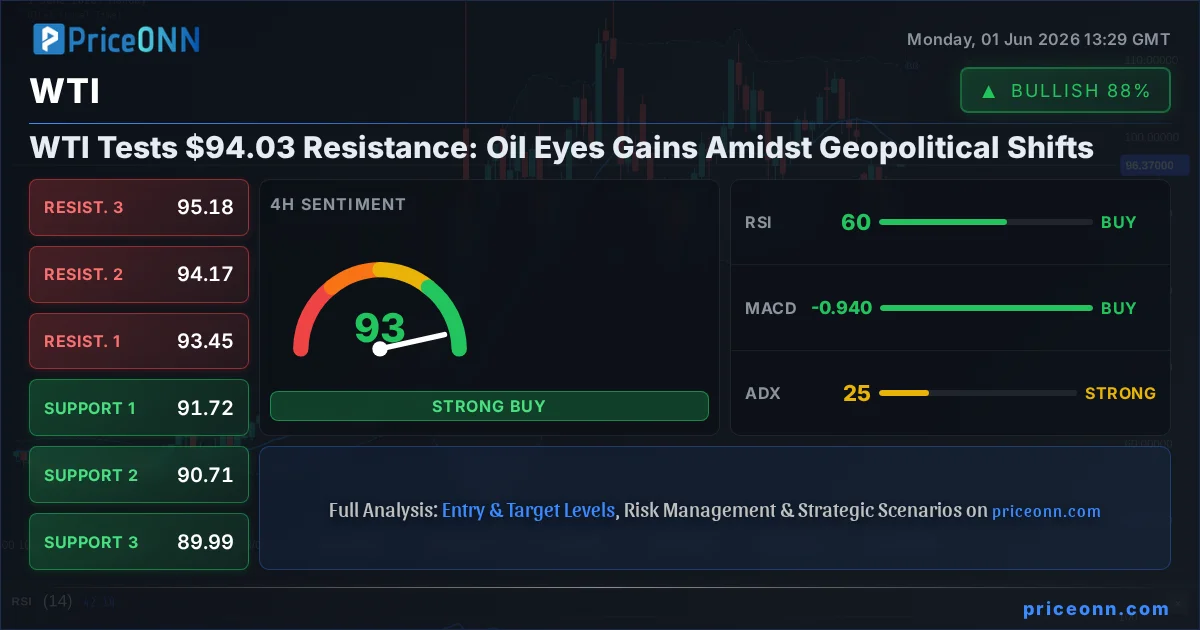
The sudden price drop presents a critical juncture for traders. The immediate implication is a potential shift from a supply-driven rally to a more demand-focused outlook, assuming geopolitical risks do not re-escalate dramatically. Key levels to watch include the $93.00 support level for WTI, which has now been breached. A sustained break below this could signal further downside, potentially targeting the $90.00 psychological level. Conversely, any resurgence in Middle East tensions or further confirmation of supply restrictions could quickly reverse this trend. Traders should monitor news flow regarding the Strait of Hormuz and the operational status of the Kirkuk-Turkey pipeline closely. The potential for central banks to adopt a more hawkish stance in response to earlier inflationary pressures also remains a background risk factor, which could dampen demand expectations.
Outlook
Looking ahead, the oil market remains highly sensitive to geopolitical developments. While Monday's price action suggests a temporary reprieve from supply fears, the underlying conflict is far from resolved. The successful restoration of Iraq's northern export route would introduce additional supply, but its full capacity may not offset broader regional disruptions. Traders should brace for continued volatility as the market navigates these competing factors. Upcoming economic data releases and central bank commentary will also play a role in shaping demand expectations.
Frequently Asked Questions
What caused the sharp decline in crude oil prices today?
Crude oil prices fell by over 5%, with WTI dropping to $93.33 per barrel, due to profit-taking by traders and initial signs of easing tensions around the Strait of Hormuz, suggesting a potential abatement of supply restrictions.
What is the significance of the Kirkuk-Turkey pipeline restoration?
Iraq is revamping the Kirkuk-Ceyhan pipeline to export 200,000 to 250,000 barrels per day of crude, bypassing potential disruptions in the Persian Gulf. This could increase overall supply if fully operational, though it is still awaiting final approvals.
What are the key price levels to watch for WTI crude?
Following the break below $93.00, traders will be watching this level as potential resistance. A further decline could target the $90.00 mark, while any renewed supply concerns could push prices back towards the recent highs near $99.00.
Track markets in real-time
Empower your investment decisions with AI-powered analysis, technical indicators and real-time price data.
Join Our Telegram Channel
Get breaking market news, AI analysis and trading signals delivered instantly to your Telegram.
Join Channel PriceONN News
Crude oil prices experienced a significant drop, with WTI futures falling over 1.8% to $87.25, as optimism grew for a U.S.-Iran deal potentially reopening the Strait of Hormuz.
PriceONN News
(RTTNews) - Crude oil prices have tumbled on Friday as expectations of the U.S. and Iran signing a Memorandum of Understanding run high. The MoU would allow for immediate reopening of the Strait of Hormuz and pave the way for the resumption of oil and energy trade.
PriceONN News
Crude oil futures experienced a dramatic intraday reversal on Thursday, soaring overnight on geopolitical fears only to pull back significantly as reports of a potential diplomatic understanding between the U.S. and Iran emerged.
PriceONN News
Global oil prices are treading water after a significant 5% slump, as market sentiment grapples with cautious optimism over Middle East de-escalation efforts versus lingering geopolitical uncertainties. Brent crude hovers near $104.72 and WTI near $98.07.
PriceONN News
Crude oil prices experienced a significant downturn as market sentiment shifted towards optimism about a potential US-Iran Memorandum of Understanding that could reopen the Strait of Hormuz. WTI futures fell nearly 2% on the news.
PriceONN News
Crude oil futures experienced a dramatic intraday reversal, soaring to $92.52 before pulling back significantly on Thursday. The volatile session was driven by shifting geopolitical narratives and U.S. inventory data.
PriceONN News
(RTTNews) - Crude oil futures skyrocketed overnight but have shown a significant pullback over the course of the trading day on Thursday.
PriceONN News
(RTTNews) - Extending the losses from yesterday's session, crude oil prices have gone into freefall on Wednesday as investor expectations on a potential U.S.-Iran agreement continue to rise despite the U.S. refusing to ease its demands.
PriceONN News
(RTTNews) - Crude oil prices have tumbled on Tuesday as optimism about a U.S.-Iran peace deal that could lead to reopening of the Strait of Hormuz soon grows despite reports of fresh U.S. strikes on Iran yesterday.
PriceONN News
(RTTNews) - After surging early in the day, crude oil prices have tumbled over the course of the trading session on Thursday. With the downturn, crude oil is extending the losses from the two previous sessions, as investors watch the developments in U.S.-Iran peace talks.
PriceONN News
Iran's oil exports fell to their lowest level in at least six years in May as the U.S. naval blockade continued to choke off crude shipments and leave tens of millions of barrels stranded at sea. According to shipping data from Vortexa, Iran exported just 209,000 barrels per day (bpd) of crude oil and condensate in May, down from 1.34 million bpd in April and nearly 1.9 million bpd in March. Kpler had estimated May exports slightly higher at 260,000 bpd, but still the lowest level since the...
PriceONN News
The Iran war suddenly turned what had started as a year of oversupply in global oil and LNG markets into the worst oil and gas supply disruption in history. Three months after the U.S.-Israeli strikes on Iran began on February 28, the world has already lost 1 billion barrels of crude oil supply, oil and gas prices have found a new, much higher floor, and whipsaw with violent volatility nearly every day, trade routes have shifted, and tanker rates have spiked. Actual supply shortages are...