
Why Did WTI Crude Oil Plunge Below $105? Fed Minutes and Treasury Yields Loom Large


WTI Crude Oil experienced a notable downturn, reversing sharply from the pivotal $105.00 resistance level. This price action suggests a potential move towards the $95.00 support level as broader market sentiment remains cautious due to rising Treasury yields and upcoming Federal Reserve minutes.
Market Context
The energy market witnessed a significant reversal as WTI Crude Oil failed to sustain its upward momentum above $105.00. Market data shows that this level, which has acted as a ceiling since early April, combined with the upper daily Bollinger Band, proved too strong for the commodity. The downward reversal suggests that the recent impulse waves have been halted, indicating a shift in short-term sentiment. This pullback occurred as Brent crude also eased back below $109, contributing to a broader stabilization in risk sentiment, though underlying tensions persist.
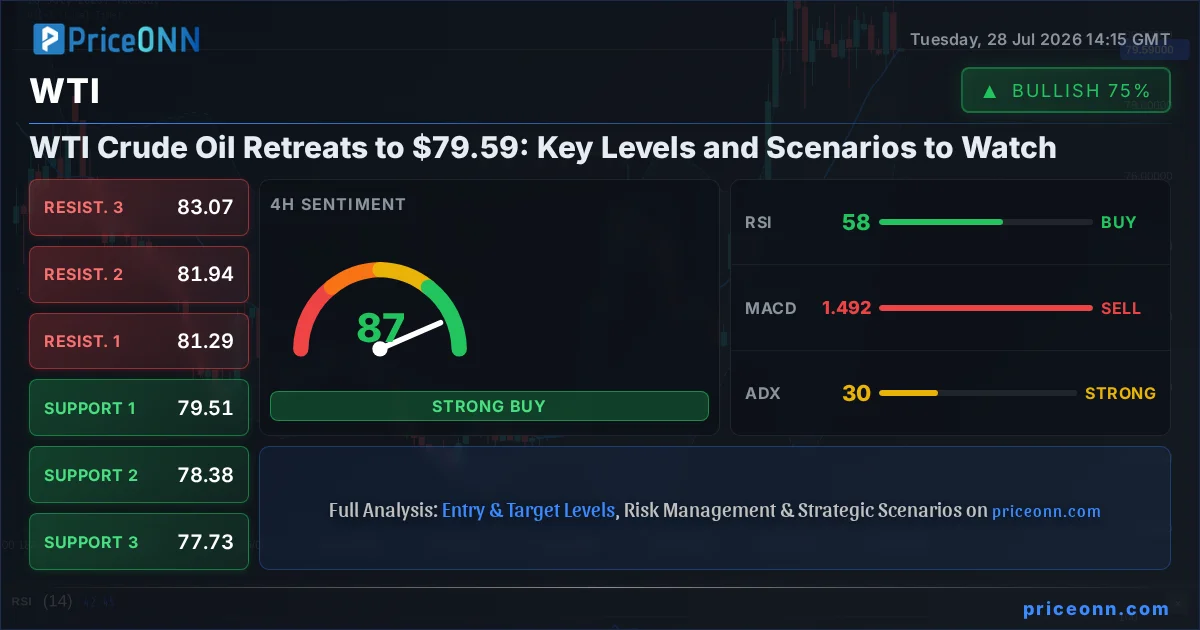
Analysis & Drivers
Several key factors are driving this volatility in crude oil. Firstly, the persistent rise in U.S. Treasury yields is a significant headwind. The 10-year Treasury yield has surged above 4.65%, with the 30-year yield piercing 5.15%, its highest level since 2007. Analysts note that if the 10-year yield decisively breaks above 4.75%, it could trigger a substantial capital rotation out of equities and into bonds. This tightening financial condition poses a challenge to asset valuations across the board, including commodities that are sensitive to global economic growth prospects.
Secondly, the impending release of the FOMC minutes from the April meeting is creating uncertainty. Following a surprisingly divided decision to hold rates steady, markets are bracing for a potentially hawkish tone. Such a stance from the Federal Reserve could further support higher interest rates for longer, dampening economic activity and demand for energy. Simultaneously, elevated oil prices, even with the recent dip, continue to put pressure on global inflation and could prompt diplomatic efforts to stabilize energy markets, especially given the ongoing Middle East conflict.
Trader Implications
For traders, the immediate focus is on the $95.00 level as a potential downside target for WTI Crude Oil. A decisive break below this support could signal further declines. Key technical indicators to watch include the lower daily Bollinger Band and previous correction lows. On the upside, the $105.00 level now acts as strong resistance. Traders should monitor the Federal Reserve's commentary from the FOMC minutes closely, as any indication of a hawkish bias could reinforce the bearish sentiment in oil.
Risk management is paramount. Given the sensitivity to both bond yields and central bank policy, traders should be prepared for continued choppiness. A sustained move higher in Treasury yields beyond the 4.75% mark for the 10-year could exacerbate selling pressure across risk assets, including oil. Conversely, any de-escalation in Middle East tensions or signs of easing inflation could provide temporary support for crude prices.
Outlook
The outlook for WTI Crude Oil remains cautiously bearish in the short term, contingent on the interplay between Treasury yields, Federal Reserve policy signals, and geopolitical developments in the Middle East. While a test of the $95.00 support appears plausible, a significant shift in inflation data or a sudden geopolitical de-escalation could alter this trajectory. Traders will be looking for clear directional cues from the FOMC minutes and the reaction of bond markets in the coming days.
Frequently Asked Questions
What is the immediate support level for WTI Crude Oil?
The immediate downside target for WTI Crude Oil is the $95.00 support level, which represents the low of a previous correction. A break below this level could indicate further bearish momentum.
How are rising Treasury yields impacting oil prices?
Rising Treasury yields, particularly the 10-year yield nearing 4.75%, tighten financial conditions, which can dampen economic growth expectations and reduce demand for commodities like oil. This also makes riskier assets less attractive relative to safer bonds.
What should traders watch for regarding the FOMC minutes?
Traders should watch for any indication of a hawkish tone from the FOMC minutes. A more aggressive stance on inflation or a prolonged higher-rate outlook could pressure oil prices lower by signaling tighter monetary policy and slower economic growth.
Track markets in real-time
Empower your investment decisions with AI-powered analysis, technical indicators and real-time price data.
Join Our Telegram Channel
Get breaking market news, AI analysis and trading signals delivered instantly to your Telegram.
Join Channel PriceONN News
WTI crude oil plunged by more than 7% on 27 July 2026 after the US suspended a series of strikes against Iran over the weekend, raising hopes of a diplomatic solution and the reopening of shipping through the Strait of Hormuz. Brent crude also fell below $90 per barrel. Meanwhile, Bloomberg reported […] The post WTI Analysis: Gap Breaks Short-Term Trend as Price Remains Trapped Between the Poc and Profile Boundary appeared first on ActionForex.
PriceONN News
(RTTNews) - Crude oil prices have gone into a tailspin on Monday, extending the losses from Friday's plunge after the U.S. halted nearly two weeks of military attacks against Iran following which near-term oil supply-disruption concerns reduced.
PriceONN News
Oil prices continued to trend lower in early Asian trade on Tuesday as a fourth night passed without any attacks from either Iran or the United States. At the time of writing, WTI crude was trading at $81.55 per barrel, down 1.28% on the session, while Brent crude had slipped to $87.36 per barrel, a decline of 1.13%. On Monday, President Trump sought to boost hopes of a diplomatic resolution between Washington and Tehran by claiming that the U.S. was engaged in "good talks" with Iran. Iranian...
PriceONN News
China is likely to have increased its crude oil imports this month, with the daily average at 7.8 million barrels, according to calculations by Kpler, as cited by Bloomberg. Refiners have been buying more Russian crude and have seen more tankers arrive from the Middle East, the report noted. The figure could add fuel to oil’s rally, as the July average would be a solid increase from the 6.2 million barrels daily that Chinese refiners imported in June. That was the lowest import rate for China...
PriceONN News
Oil prices plunged by more than 5% in early Asian trade on Monday as the U.S. and Iran halted attacks after two weeks of escalation that had driven Brent above $100. At the time of writing, WTI crude was trading at $84.47, down 5.39%, while Brent crude had fallen to $91.80, a decline of 5.15%. The retreat came after Washington signaled on Friday that it would temporarily halt its bombing campaign against Iran. Talking to Face the Nation on Sunday, U.S. Ambassador to the United Nations Mike...
PriceONN News
Saudi Arabia may raise the price of the crude it ships to Asia via the Suez Canal, Reuters has reported, to reflect higher shipping costs due to the Houthi maritime blockade in the Red Sea. The price hike could reach $5 per barrel of crude. Citing unnamed sources, the publication said Aramco was responding to the need to redirect oil flows from its Red Sea port of Yanbu to the Ain Sukhra port in Egypt, from where the crude gets transported via the Suez-Mediterranean pipeline to the port of Sidi...
PriceONN News
Chinese buyers that received the first U.S. LNG cargo in over a year plan to resell it on another market to profit from higher prices elsewhere and avoid paying a 25% tariff, sources familiar with the plans told Bloomberg on Monday. The Yangpu port in south China earlier this month received a cargo of U.S. LNG from the Plaquemines LNG export terminal operated by Venture Global in Louisiana’s Plaquemines Parish. This was the first U.S. shipment of gas to China in more than a year. But the gas...
PriceONN News
The Houthi threats to shipping in the Red Sea and its chokepoint, the Bab el-Mandeb Strait, have forced at least one oil tanker carrying Saudi crude to Asia to choose the much longer route through the Suez Canal, the Mediterranean, and around Africa. The supertanker Olympic Luck, partially laden with Saudi crude at Yanbu on the Red Sea, transited the Suez Canal into the Mediterranean late on Sunday, according to shipping data monitored by Bloomberg. The U-turn from Bab el-Mandeb indicates that...
PriceONN News
Tanker traffic through the Bab el-Mandeb Strait slumped to a multi-month low on Sunday amid Houthi attacks on Saudi oil infrastructure on the Red Sea coast. Only 11 tankers carrying commodities transited the Bab el-Mandeb chokepoint between the Red Sea and the Arabian Sea on Sunday, the lowest in months, according to Kpler’s shipping data cited by Reuters. Tanker traffic at the Red Sea started to slow a week ago after the Iran-aligned Houthis in Yemen announced a blockade on Saudi shipments and...
PriceONN News
European natural gas prices plunged by 8.6% at the open in Amsterdam on Monday as the United States paused strikes on Iran over the weekend and Tehran signaled a halt to retaliatory attacks across the Middle East. Hopes of de-escalation sank oil prices on Monday in Asian trade, too, with Brent Crude dropping to $90 per barrel. Europe’s benchmark natural gas prices, which had surged in the past two weeks amid the renewed hostilities, retreated on Monday from the multi-month highs of last week,...
PriceONN News
Oil prices gave up earlier gains on Friday after reports that Pakistan is trying to broker a return to U.S.-Iran nuclear negotiations. China is strongly backing the effort as the conflict and the closure of the Strait of Hormuz continue to threaten its energy security and weigh on its economy. Brent crude for September delivery fell 4.4% to trade at $96.36 per barrel at 1.35 pm ET while WTI crude for September delivery was down 3.6% to change hands at $88.86/bbl. However, Standard Chartered...
PriceONN News
U.S. airlines are grappling with soaring jet fuel costs again after the return of hostilities in the Middle East shattered the three-week-long U.S.-Iran ‘deal to make a deal’ and sent Brent crude oil prices soaring past $100 per barrel again. The U.S. jet fuel market has been tightening since March, although there haven’t been concerns about any shortages in America, unlike in Europe, which in April was supposed to run out of stockpiles within six weeks. Europe didn’t see shortages, but the...