
Why Did WTI Crude Oil Plunge Below $95 After Reaching $101 Amid Escalating Middle East Tensions?


West Texas Intermediate (WTI) crude oil experienced a dramatic intraday reversal on Monday, plummeting over 3% from an intraday high of $101.19 to settle below the $95 mark. This sharp decline followed a broader rally that had seen WTI climb significantly amidst escalating geopolitical tensions in the Middle East, specifically the ongoing conflict involving Iran.
Market Context
The price action of WTI crude oil has been highly volatile, reflecting the sensitive nature of energy markets to global conflicts. Earlier in the day, WTI had surged to an intraday high of $101.19, marking a 32% rebound from recent lows. This rally was predominantly fueled by concerns over potential supply disruptions stemming from the 17th day of the US-Iran war. Attacks on critical energy infrastructure, including the key Fujairah oil export port in the UAE, amplified these fears. Fujairah, a vital hub located outside the Strait of Hormuz, suspended oil loadings following renewed attacks, threatening to further tighten global supply chains.
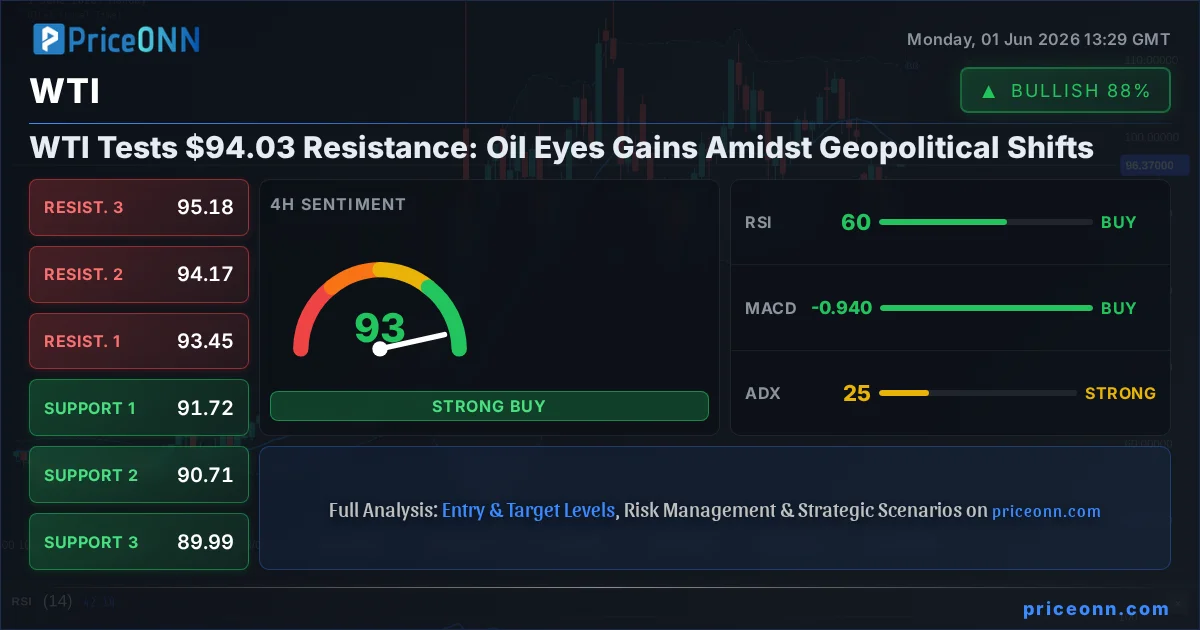
The market's reaction was swift, with Brent crude also surpassing $106 per barrel. However, the initial bullish momentum began to fade as traders reassessed the immediate impact and the broader geopolitical landscape. The price reversal below $95 suggests that the initial risk premium may be cooling, or that other market forces are coming into play.
Analysis & Drivers
The primary driver for the earlier surge in WTI was the escalating conflict in the Middle East, which directly threatened critical oil supply routes. The repeated attacks on the Fujairah port, a crucial alternative to the Strait of Hormuz, underscored the vulnerability of energy infrastructure. Reports indicated that Iran had vowed retaliation after previous strikes on its Kharg Island, intensifying fears of wider regional instability impacting oil production and transit.
However, the subsequent slide below $95 indicates a potential shift in market sentiment. Analysts note that while geopolitical risks remain, the immediate supply impact might be less severe than initially feared, or that other factors are weighing on prices. These could include the possibility of diplomatic resolutions, the resilience of alternative supply routes, or even broader economic concerns that temper demand expectations. Prediction market data suggests that a ceasefire might not occur until June, implying that geopolitical risk premiums could persist, but the market's immediate reaction suggests a more nuanced interpretation of the current events.
Trader Implications
For traders, the rapid reversal in WTI crude oil presents both opportunities and significant risks. The key resistance level to watch is now around the $105.85 mark, where momentum appeared to falter. A failure to decisively break above this level could lead to a further corrective pullback, with potential downside targets identified near $92.60 and even $88.36.
Conversely, a sustained breakout above $105.85 could reopen the upside, with targets extending towards $116-$119. Traders should closely monitor developments in the Middle East, particularly any further attacks or de-escalation efforts. Additionally, weekly oil inventory reports from the API and EIA, due on Tuesday and Wednesday respectively, will provide crucial insights into supply and demand dynamics. Given the volatility, maintaining strict risk management protocols, such as setting appropriate stop-losses, is paramount. A weaker U.S. Dollar could provide underlying support for oil prices, making it more affordable for holders of other currencies.
Outlook
The short-term outlook for WTI crude oil remains highly uncertain, heavily dependent on the trajectory of the US-Iran conflict and its impact on regional energy infrastructure. While the immediate price reaction suggests a cooling of the risk premium, the underlying geopolitical tensions are likely to persist. Traders should anticipate continued volatility as the market digests incoming news. The potential for supply disruptions remains a significant bullish factor, but any signs of de-escalation or improved diplomatic channels could trigger further price declines. The market will be closely watching for any official statements from involved nations and international bodies, as well as the resilience of energy infrastructure in the face of ongoing threats.
Frequently Asked Questions
What caused the sharp drop in WTI Crude Oil prices below $95?
WTI Crude Oil fell sharply below $95 per barrel after reaching an intraday high of $101.19 due to a cooling of the immediate geopolitical risk premium following earlier escalations. While tensions remain, the market may be reassessing the direct impact on supply or anticipating other market influences.
What are the key price levels to watch for WTI Crude Oil?
Traders should monitor the $105.85 level as key resistance. A failure to break above this could lead to a pullback towards $92.60-$88.36. Conversely, a breakout above $105.85 could target higher levels around $116-$119.
What is the short-term outlook for WTI Crude Oil prices?
The short-term outlook is highly volatile and dependent on geopolitical developments in the Middle East. While supply disruption fears provide bullish support, any de-escalation could lead to further price declines. Traders should remain vigilant and manage risk closely.
Track markets in real-time
Empower your investment decisions with AI-powered analysis, technical indicators and real-time price data.
Join Our Telegram Channel
Get breaking market news, AI analysis and trading signals delivered instantly to your Telegram.
Join Channel PriceONN News
Crude oil prices experienced a significant drop, with WTI futures falling over 1.8% to $87.25, as optimism grew for a U.S.-Iran deal potentially reopening the Strait of Hormuz.
PriceONN News
(RTTNews) - Crude oil prices have tumbled on Friday as expectations of the U.S. and Iran signing a Memorandum of Understanding run high. The MoU would allow for immediate reopening of the Strait of Hormuz and pave the way for the resumption of oil and energy trade.
PriceONN News
Crude oil futures experienced a dramatic intraday reversal on Thursday, soaring overnight on geopolitical fears only to pull back significantly as reports of a potential diplomatic understanding between the U.S. and Iran emerged.
PriceONN News
Crude oil futures experienced a dramatic intraday reversal, soaring to $92.52 before pulling back significantly on Thursday. The volatile session was driven by shifting geopolitical narratives and U.S. inventory data.
PriceONN News
Brent crude prices surged towards the mid-$90s amid fears of supply disruptions from Middle East tensions, only to pare gains later as whispers of a potential US-Iran diplomatic understanding emerged.
PriceONN News
(RTTNews) - Crude oil futures skyrocketed overnight but have shown a significant pullback over the course of the trading day on Thursday.
PriceONN News
Global oil prices are treading water after a significant 5% slump, as market sentiment grapples with cautious optimism over Middle East de-escalation efforts versus lingering geopolitical uncertainties. Brent crude hovers near $104.72 and WTI near $98.07.
PriceONN News
WTI Crude Oil futures experienced a sharp decline of over 5.6%, falling to $98.26 per barrel as diplomatic efforts between the U.S. and Iran gained significant momentum, easing supply disruption fears.
PriceONN News
(RTTNews) - Oil prices were little changed on Thursday, after having fallen over 5 percent in the previous session amid optimism over a possible easing of Middle East tensions. Brent crude futures for July delivery were down 0.3 percent at $104.72 a barrel while WTI crude futures
PriceONN News
Crude oil prices experienced a sharp decline, with WTI futures for July delivery falling 5.66% to $98.26. This drop is largely attributed to renewed diplomatic efforts aimed at de-escalating the U.S.-Iran conflict and easing tensions around the Strait of Hormuz.
PriceONN News
The Iran war suddenly turned what had started as a year of oversupply in global oil and LNG markets into the worst oil and gas supply disruption in history. Three months after the U.S.-Israeli strikes on Iran began on February 28, the world has already lost 1 billion barrels of crude oil supply, oil and gas prices have found a new, much higher floor, and whipsaw with violent volatility nearly every day, trade routes have shifted, and tanker rates have spiked. Actual supply shortages are...
PriceONN News
The Iran war has handed the United States a rare opportunity: a new dawn of energy dominance in an increasingly fractured world. With coordinated US-Israeli strikes disrupting the Strait of Hormuz from late February, roughly 20% of global LNG supply has been stripped from the market since early March. Prices have surged across Asia and Europe. And into that vacuum, American gas has flowed. The numbers speak for themselves. US LNG exports to Asia jumped sharply in April, with nearly a quarter of...