
Why Did WTI Crude Oil Stall Near $90.50 Amid Shifting Middle East Tensions?

WTI Crude Oil has entered a holding pattern, consolidating just above the $90.50 mark during Thursday's Asian trading session. This pause in momentum follows a period of significant volatility, as market participants digest mixed signals regarding geopolitical developments in the Middle East and reassess global energy supply dynamics.
Market Context
For three consecutive days, WTI has been trading within a narrow range, underscoring a temporary equilibrium between forces pushing prices higher and those exerting downward pressure. The benchmark U.S. crude contract, known for its premium grade, is a key indicator for global oil prices, making its price action a subject of intense scrutiny. This consolidation suggests that traders are hesitant to commit to a strong directional move until clearer catalysts emerge, reflecting a market caught between potential de-escalation and persistent underlying supply considerations.
Analysis & Drivers
The current price action for WTI crude is being shaped by a complex interplay of factors. Geopolitical developments in the Middle East are a primary driver; any perceived de-escalation can ease immediate supply disruption fears, leading to price pullbacks. Conversely, any renewed tensions or escalations in the region can quickly reignite concerns about oil flow disruptions, providing a floor for prices. Market data shows that while immediate supply fears might be subsiding slightly, the fundamental supply and demand balance remains a critical undercurrent. Decisions by the Organization of the Petroleum Exporting Countries (OPEC) and its allies (OPEC+) regarding production quotas continue to be a significant influence, with any adjustments capable of tightening or loosening the global market. Furthermore, the strength of the U.S. dollar often plays an inverse role; a stronger dollar typically makes oil more expensive for holders of other currencies, potentially dampening demand and pressuring prices downward, while a weaker dollar can have the opposite effect.
Trader Implications
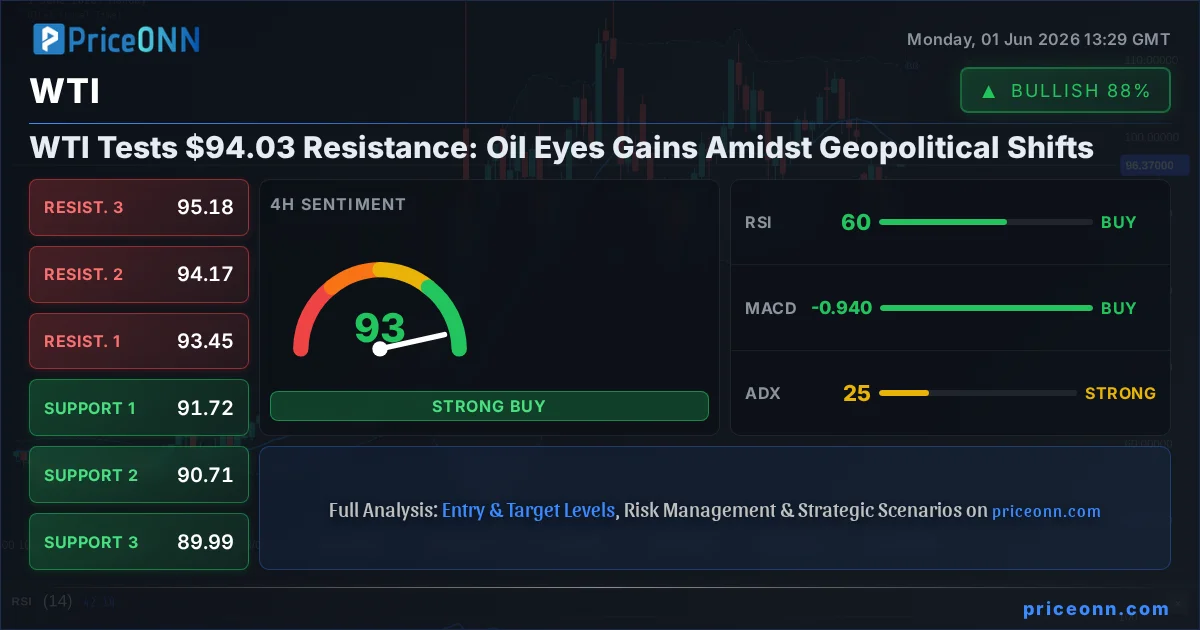
Traders are closely watching the $90.50 level as a critical pivot point. A sustained hold above this area, coupled with positive developments or continued supply tightness, could see WTI test resistance levels around $95 and potentially the $98 mark. However, a decisive break below $90.50 could signal a shift in sentiment, opening the door for a move back towards the low $80s, with further support expected around the $88 to $89 range. Key risk factors include unexpected geopolitical escalations or significant pronouncements from OPEC+ regarding production policy. Conversely, any signs of a prolonged period of calm in the Middle East or a stronger U.S. dollar could accelerate a bearish move.
Outlook
The immediate outlook for WTI crude oil remains one of cautious indecision. The consolidation around $90.50 suggests a market waiting for a clearer signal. Traders should remain vigilant for any shifts in geopolitical rhetoric or official statements from major oil producers. Upcoming economic data releases, particularly those related to global manufacturing and energy demand, will also be crucial in shaping the market's direction in the coming days and weeks. A break above $98 would signal renewed bullish momentum, while a fall below $88 could confirm a bearish trend.
Frequently Asked Questions
What is the current trading range for WTI Crude Oil?
WTI Crude Oil is currently consolidating around the $90.50 level, having remained within a tight range for the past three days. Key resistance is noted near $95 and $98, while support is anticipated around $89.
What are the main factors influencing WTI prices right now?
The primary drivers are geopolitical tensions in the Middle East, which impact supply disruption fears, and the broader global supply-demand balance. Decisions from OPEC+ and the strength of the U.S. dollar also play significant roles in price determination.
What price levels should traders watch for a directional move in WTI?
Traders should monitor the $90.50 level for potential downside breaks or consolidation strength. A move above $98 could signal a bullish continuation, while a drop below $88 might indicate a bearish trend is developing.
Track markets in real-time
Empower your investment decisions with AI-powered analysis, technical indicators and real-time price data.
Join Our Telegram Channel
Get breaking market news, AI analysis and trading signals delivered instantly to your Telegram.
Join Channel PriceONN News
Crude oil prices experienced a significant downturn as market sentiment shifted towards optimism about a potential US-Iran Memorandum of Understanding that could reopen the Strait of Hormuz. WTI futures fell nearly 2% on the news.
PriceONN News
Crude oil prices experienced a significant drop, with WTI futures falling over 1.8% to $87.25, as optimism grew for a U.S.-Iran deal potentially reopening the Strait of Hormuz.
PriceONN News
(RTTNews) - Crude oil prices have tumbled on Friday as expectations of the U.S. and Iran signing a Memorandum of Understanding run high. The MoU would allow for immediate reopening of the Strait of Hormuz and pave the way for the resumption of oil and energy trade.
PriceONN News
Crude oil futures experienced a dramatic intraday reversal on Thursday, soaring overnight on geopolitical fears only to pull back significantly as reports of a potential diplomatic understanding between the U.S. and Iran emerged.
PriceONN News
(RTTNews) - Extending the losses from yesterday's session, crude oil prices have gone into freefall on Wednesday as investor expectations on a potential U.S.-Iran agreement continue to rise despite the U.S. refusing to ease its demands.
PriceONN News
(RTTNews) - Crude oil prices have tumbled on Tuesday as optimism about a U.S.-Iran peace deal that could lead to reopening of the Strait of Hormuz soon grows despite reports of fresh U.S. strikes on Iran yesterday.
PriceONN News
(RTTNews) - After surging early in the day, crude oil prices have tumbled over the course of the trading session on Thursday. With the downturn, crude oil is extending the losses from the two previous sessions, as investors watch the developments in U.S.-Iran peace talks.
PriceONN News
Global oil prices are treading water after a significant 5% slump, as market sentiment grapples with cautious optimism over Middle East de-escalation efforts versus lingering geopolitical uncertainties. Brent crude hovers near $104.72 and WTI near $98.07.
PriceONN News
WTI Crude futures for July delivery plunged 5.66% to $98.26 per barrel as diplomatic efforts to resolve the U.S.-Iran conflict gained significant traction. This sharp decline overshadowed a larger-than-expected drawdown in U.S. crude inventories.
PriceONN News
Crude oil prices experienced a sharp decline, with WTI futures for July delivery falling 5.66% to $98.26. This drop is largely attributed to renewed diplomatic efforts aimed at de-escalating the U.S.-Iran conflict and easing tensions around the Strait of Hormuz.
PriceONN News
The Iran war suddenly turned what had started as a year of oversupply in global oil and LNG markets into the worst oil and gas supply disruption in history. Three months after the U.S.-Israeli strikes on Iran began on February 28, the world has already lost 1 billion barrels of crude oil supply, oil and gas prices have found a new, much higher floor, and whipsaw with violent volatility nearly every day, trade routes have shifted, and tanker rates have spiked. Actual supply shortages are...
PriceONN News
Crude oil futures experienced a dramatic intraday reversal, soaring to $92.52 before pulling back significantly on Thursday. The volatile session was driven by shifting geopolitical narratives and U.S. inventory data.