
Why Did WTI Crude Oil Surge Past $100 Amidst Escalating Geopolitical Tensions?

West Texas Intermediate (WTI) crude oil has seen a notable surge, extending its winning streak for a fourth consecutive trading day and retesting the psychologically important $100 per barrel mark. This upward momentum, observed during early Asian trading on Monday, comes as market participants grapple with escalating geopolitical tensions in the Middle East and diminishing expectations for a rapid de-escalation.
Market Context
The US oil benchmark, WTI, has been on a steady ascent, moving from around $98.90 in recent sessions. While some brief profit-taking might have occurred, the broader trend indicates a bullish sentiment driven by persistent supply-side anxieties. The ongoing conflict in the Middle East, coupled with the lack of clear diplomatic pathways towards peace, is casting a long shadow over global oil supply security. This has been sufficient to override any immediate concerns about global growth, pushing prices higher despite the absence of significant shifts in demand indicators.
Analysis & Drivers
The primary driver behind WTI's recent climb is the persistent and broadening geopolitical instability in the Middle East. As conflicts intensify and diplomatic efforts appear to stall, the market is pricing in a higher probability of supply disruptions. This risk premium is a significant factor in crude oil pricing, especially for benchmarks like WTI which, while sourced domestically in the US, are intrinsically linked to global supply and demand dynamics. The fading optimism for a swift resolution to the Iran conflict, for instance, directly impacts the perceived risk to oil-producing regions and transit routes. Furthermore, the US dollar's valuation can play a role; a weaker dollar typically makes dollar-denominated commodities like oil more attractive to holders of other currencies, potentially adding another layer of support, though this has not been the dominant factor in the current rally.
Trader Implications
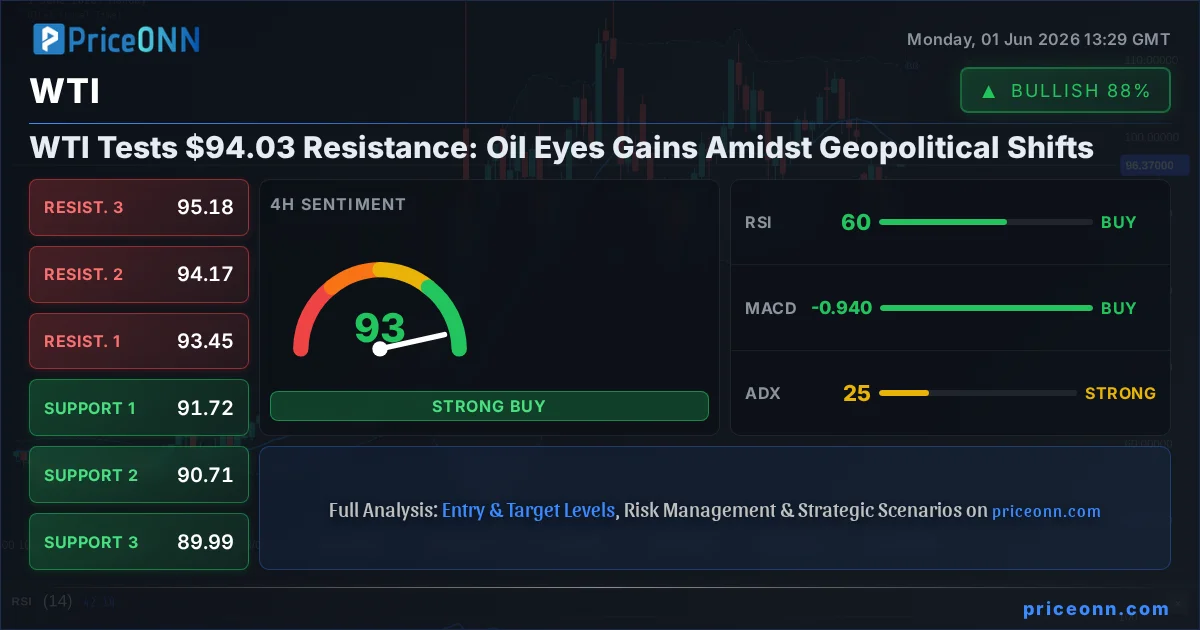
Traders should closely monitor the geopolitical developments in the Middle East, as any further escalation or de-escalation will have a direct impact on WTI prices. Key levels to watch include the $100 per barrel resistance. A sustained break above this level could signal further upside potential, with the next significant psychological barrier being $105. Conversely, a decisive move back below $98 could indicate a temporary pullback, but the underlying supply concerns suggest that significant downside may be limited unless geopolitical tensions ease considerably or major inventory builds are reported. Traders should also keep an eye on weekly US crude oil inventory reports from the API and EIA, scheduled for release mid-week, as these can provide insights into domestic supply and demand balances.
Outlook
The outlook for WTI crude oil remains cautiously optimistic, leaning towards further strength as long as Middle East tensions persist and supply disruption fears remain elevated. Market participants are likely to remain sensitive to headlines from the region. Without a significant diplomatic breakthrough, the path of least resistance for WTI appears to be upwards, with the $100 mark now serving as a critical pivot point. Upcoming OPEC+ meetings will also be crucial for gauging production policy adjustments, which could either reinforce or counteract the current price momentum.
Frequently Asked Questions
What is driving the current surge in WTI crude oil prices?
The primary driver is the escalating geopolitical conflict in the Middle East, which is raising concerns about potential supply disruptions. This has pushed WTI prices to retest the $100 per barrel level, extending a four-day winning streak.
What are the key price levels for WTI to watch?
Traders should monitor the $100 per barrel level as a key resistance. A sustained move above this could target $105. Conversely, a break below $98 might signal a short-term correction, but the broader bullish sentiment suggests limited downside.
What is the short-term outlook for WTI crude oil?
The outlook remains bullish as long as Middle East tensions persist and supply concerns are not alleviated. The $100 per barrel mark is a critical pivot, and any significant de-escalation in the region could lead to a price correction, while further escalation could drive prices higher.
Track markets in real-time
Empower your investment decisions with AI-powered analysis, technical indicators and real-time price data.
Join Our Telegram Channel
Get breaking market news, AI analysis and trading signals delivered instantly to your Telegram.
Join Channel PriceONN News
The possibility of Iran developing a nuclear weapon is now higher than it was before the United States and Israel first attacked the country in February, the International Atomic Energy Agency has concluded in a report. The conclusion suggests the war has so far resulted in the opposite of what President Trump set out to do, namely, prevent Iran from developing a nuclear weapon. Bloomberg cited the report, which has restricted access, saying that in it, the IAEA had warned its member states...
PriceONN News
The Iran war suddenly turned what had started as a year of oversupply in global oil and LNG markets into the worst oil and gas supply disruption in history. Three months after the U.S.-Israeli strikes on Iran began on February 28, the world has already lost 1 billion barrels of crude oil supply, oil and gas prices have found a new, much higher floor, and whipsaw with violent volatility nearly every day, trade routes have shifted, and tanker rates have spiked. Actual supply shortages are...
PriceONN News
China has been cited as an example of a country that has managed to insulate itself relatively well against oil crises. With over a billion barrels in estimated inventories before the war in the Middle East started, China was the poster child of forward planning in energy security. But this could change, and if it does, it would make an already severe crisis even worse. Kpler sounded the alarm about that prospect earlier this month, reporting that Chinese refiners have reduced their purchases...
PriceONN News
Crude oil prices experienced a significant drop, with WTI futures falling over 1.8% to $87.25, as optimism grew for a U.S.-Iran deal potentially reopening the Strait of Hormuz.
PriceONN News
Crude oil prices experienced a significant downturn as market sentiment shifted towards optimism about a potential US-Iran Memorandum of Understanding that could reopen the Strait of Hormuz. WTI futures fell nearly 2% on the news.
PriceONN News
(RTTNews) - Crude oil prices have tumbled on Friday as expectations of the U.S. and Iran signing a Memorandum of Understanding run high. The MoU would allow for immediate reopening of the Strait of Hormuz and pave the way for the resumption of oil and energy trade.
PriceONN News
Crude oil futures experienced a dramatic intraday reversal on Thursday, soaring overnight on geopolitical fears only to pull back significantly as reports of a potential diplomatic understanding between the U.S. and Iran emerged.
PriceONN News
Crude oil futures experienced a dramatic intraday reversal, soaring to $92.52 before pulling back significantly on Thursday. The volatile session was driven by shifting geopolitical narratives and U.S. inventory data.
PriceONN News
Crude oil futures experienced a dramatic reversal, soaring overnight to $92.52 before plummeting nearly 6% to $89 a barrel. This volatility was driven by escalating US-Iran tensions followed by reports of a potential preliminary diplomatic understanding.
PriceONN News
(RTTNews) - Crude oil futures skyrocketed overnight but have shown a significant pullback over the course of the trading day on Thursday.
PriceONN News
The market’s faith in an imminent US-Iran peace breakthrough has clearly weakened today - but it has not disappeared yet. Oil prices jumped again in after fresh military escalation around the Strait of Hormuz reignited fears of prolonged supply disruptions across the Gulf. Brent crude pushed back toward the mid-$90s after new U.S. strikes inside […] The post Brent Oil Holding Below $100 Suggests Markets Still See Room for a US-Iran Deal appeared first on ActionForex.
PriceONN News
(RTTNews) - Extending the losses from yesterday's session, crude oil prices have gone into freefall on Wednesday as investor expectations on a potential U.S.-Iran agreement continue to rise despite the U.S. refusing to ease its demands.