
Why Did WTI Crude Plunge 9% After Goldman Sachs Raised Oil Price Forecasts?

West Texas Intermediate (WTI) crude oil experienced a significant sell-off, plunging approximately 9% on Monday to trade back below the $100 per barrel level and testing critical support around $90.00. This dramatic intraday reversal occurred just hours after Goldman Sachs had revised its oil price forecasts upwards, highlighting the market's volatility and sensitivity to geopolitical developments.
Market Context
The dramatic price action saw WTI trace one of the widest intraday ranges in recent memory. Earlier in the day, sentiment had been driven by a report from Goldman Sachs commodity analysts who boosted their average price forecasts for the year. The investment bank now expects Brent crude to average $85 per barrel and West Texas Intermediate (WTI) to average $79 per barrel, up from previous estimates of $77 and $72 respectively. This revision was predicated on anticipated supply disruptions, with projections suggesting a peak loss of up to 17 million barrels daily due to escalating geopolitical tensions.
Analysis & Drivers
The immediate catalyst for the sharp decline appears to be the news that the United States has postponed planned energy infrastructure strikes on Iran. This de-escalation, however temporary, significantly eased immediate supply fears that had been driving prices higher. While Goldman Sachs factored in a potential six-week disruption to tanker traffic in the Strait of Hormuz, followed by a gradual recovery, the market reacted swiftly to the perceived avoidance of direct conflict. The original upward revision by Goldman Sachs was based on an ultimatum concerning passage through the Strait of Hormuz, a vital chokepoint for global oil supply. The threat of military responses and counter-threats had created a palpable sense of urgency and risk premium in the market.
Factors influencing WTI prices remain multifaceted. Fundamentally, supply and demand dynamics are paramount. Global growth trends dictate demand, while geopolitical events, OPEC+ decisions, and inventory levels significantly impact supply. The US Dollar's strength also plays a crucial role, as oil is predominantly priced in dollars; a weaker dollar typically makes oil more affordable and can support prices. Weekly inventory reports from the American Petroleum Institute (API) and the Energy Information Administration (EIA) provide crucial data on supply-demand balances, with lower inventories often signaling increased demand and potentially higher prices.
Trader Implications
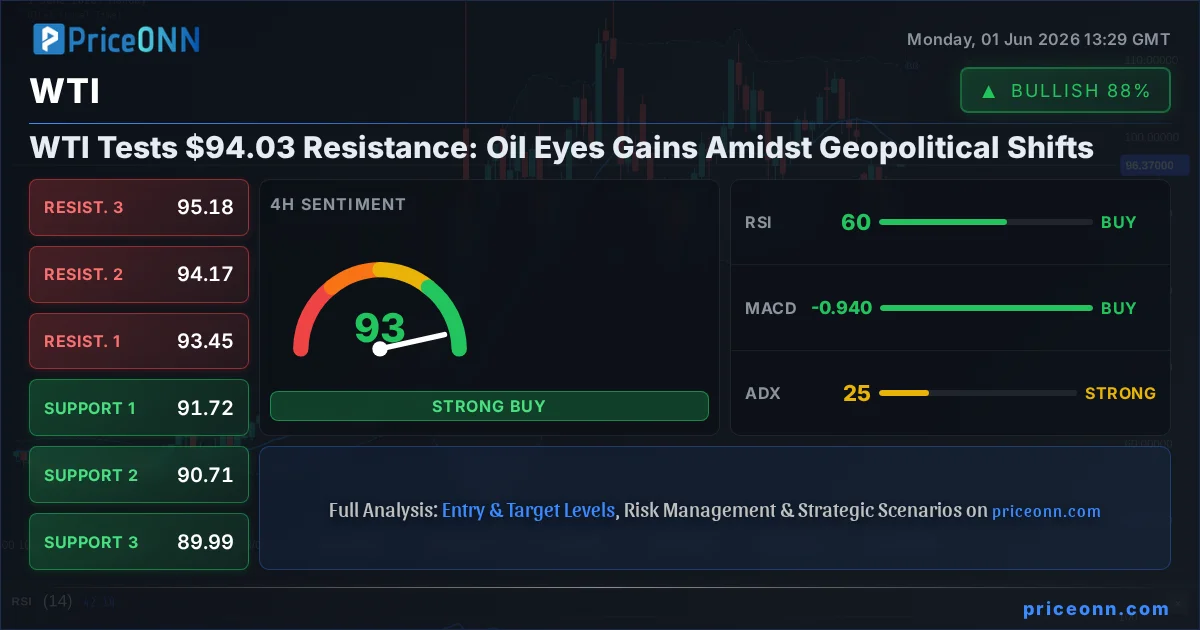
The rapid reversal from intraday highs underscores the extreme sensitivity of oil markets to geopolitical headlines. Traders should remain highly vigilant regarding any further developments concerning Iran and its strategic waterways. Key technical levels to watch for WTI include the psychological $90.00 support level, which was tested today. A decisive break below this could open the door for further downside, potentially targeting previous lows. Conversely, any renewed escalation in tensions could quickly reignite bullish sentiment and push prices back towards the $100 mark and beyond. The market is currently grappling with conflicting narratives: the potential for significant supply disruption versus the avoidance of immediate military conflict. This dichotomy suggests continued choppy price action.
Outlook
Looking ahead, the oil market will likely remain highly reactive to geopolitical news flow. While the immediate threat of strikes has receded, the underlying tensions persist. Traders will be closely monitoring statements from global powers, OPEC+ production decisions, and US inventory reports. The potential for supply disruptions remains a significant factor, and any indication of renewed friction could see prices rebound sharply. However, the market's immediate reaction to de-escalation suggests that a sustained rally may require more concrete supply constraints than perceived threats alone.
Frequently Asked Questions
What caused WTI crude oil to drop nearly 9%?
WTI crude oil prices fell approximately 9% after reports indicated that the United States had postponed planned energy infrastructure strikes on Iran. This news eased immediate supply disruption fears that had previously driven prices higher, causing a rapid reversal from earlier gains.
How does Goldman Sachs' revised oil price forecast compare to the current market?
Goldman Sachs raised its forecast for Brent crude to an average of $85 per barrel and WTI to $79 per barrel for the year. At the time of the report, WTI was trading significantly higher, nearing the $100 mark before its sharp decline, indicating that the market had priced in more immediate supply risks than the revised forecast suggested.
What is the outlook for WTI crude oil prices following this volatility?
The outlook for WTI remains highly uncertain, with prices likely to be driven by ongoing geopolitical developments. While immediate conflict fears have subsided, the underlying tensions persist. Key support is seen around $90.00, with resistance near $100.00.
Track markets in real-time
Empower your investment decisions with AI-powered analysis, technical indicators and real-time price data.
Join Our Telegram Channel
Get breaking market news, AI analysis and trading signals delivered instantly to your Telegram.
Join Channel PriceONN News
BP will sell 5% in the $35-billion Browse LNG project in Australia, which Australian energy giant Woodside is looking to progress, the UK-based supermajor told Reuters on Monday. BP is selling the 5% stake, out of its total of its 44% interest, to South Korea's GS Energy. “The dilution reflects BP’s disciplined approach to portfolio management by bringing in a committed partner,” BP said in a statement emailed to Reuters. The Browse LNG project in Australia, proposed by Woodside Energy, entails...
PriceONN News
The Iran war suddenly turned what had started as a year of oversupply in global oil and LNG markets into the worst oil and gas supply disruption in history. Three months after the U.S.-Israeli strikes on Iran began on February 28, the world has already lost 1 billion barrels of crude oil supply, oil and gas prices have found a new, much higher floor, and whipsaw with violent volatility nearly every day, trade routes have shifted, and tanker rates have spiked. Actual supply shortages are...
PriceONN News
Nuclear fuel is becoming a geopolitical battleground as the world increasingly turns to nuclear energy to contend with skyrocketing energy demand projections. The combination of an oil-based energy crisis emanating out of the Strait of Hormuz, the enormous and ballooning energy needs of artificial intelligence, and the urgent imperative of decarbonization is garnering a renewed interest in nuclear energy as a carbon-free, efficient, and round-the-clock power source. Moreover, nuclear energy can...
PriceONN News
Over the last two decades, solar panels have fallen in price while efficiency has increased. Greater uptake and high levels of investment in research and development have led to vast improvements in solar power technology. As panel prices fall and governments worldwide look to diversify their energy mix and cut emissions, several developers are now launching mega-projects to meet the growing demand. Most major solar projects developed in recent years provide hundreds of megawatts of clean...
PriceONN News
China has been cited as an example of a country that has managed to insulate itself relatively well against oil crises. With over a billion barrels in estimated inventories before the war in the Middle East started, China was the poster child of forward planning in energy security. But this could change, and if it does, it would make an already severe crisis even worse. Kpler sounded the alarm about that prospect earlier this month, reporting that Chinese refiners have reduced their purchases...
PriceONN News
The Iran war has handed the United States a rare opportunity: a new dawn of energy dominance in an increasingly fractured world. With coordinated US-Israeli strikes disrupting the Strait of Hormuz from late February, roughly 20% of global LNG supply has been stripped from the market since early March. Prices have surged across Asia and Europe. And into that vacuum, American gas has flowed. The numbers speak for themselves. US LNG exports to Asia jumped sharply in April, with nearly a quarter of...
PriceONN News
Cuba has been experiencing a worsening energy crisis for several years, which previously led it to rely heavily on Venezuela for its fuel. Following the United States’ intervention in Venezuela in February, the energy crisis has grown even worse, as Cubans face regular blackouts and the economy suffers. Cuba requires about 100,000 barrels a day to power its grid and meet the regular transportation demands. It fulfils just 40 percent of this demand domestically. In January, the Trump...
PriceONN News
Crude oil prices experienced a significant drop, with WTI futures falling over 1.8% to $87.25, as optimism grew for a U.S.-Iran deal potentially reopening the Strait of Hormuz.
PriceONN News
Crude oil prices experienced a significant downturn as market sentiment shifted towards optimism about a potential US-Iran Memorandum of Understanding that could reopen the Strait of Hormuz. WTI futures fell nearly 2% on the news.
PriceONN News
(RTTNews) - Crude oil prices have tumbled on Friday as expectations of the U.S. and Iran signing a Memorandum of Understanding run high. The MoU would allow for immediate reopening of the Strait of Hormuz and pave the way for the resumption of oil and energy trade.
PriceONN News
Crude oil futures experienced a dramatic intraday reversal on Thursday, soaring overnight on geopolitical fears only to pull back significantly as reports of a potential diplomatic understanding between the U.S. and Iran emerged.
PriceONN News
Crude oil futures experienced a dramatic intraday reversal, soaring to $92.52 before pulling back significantly on Thursday. The volatile session was driven by shifting geopolitical narratives and U.S. inventory data.