
Why Did WTI Crude Plunge 9% After Hitting $99 Amid Mideast Tensions?


West Texas Intermediate (WTI) crude oil witnessed a significant intraday reversal, plummeting approximately 9% to trade back below the $100 per barrel level and testing $90.00. This sharp decline on Monday occurred after earlier gains that saw WTI climb above $99.00, driven by escalating geopolitical tensions in the Middle East and threats to critical shipping lanes.
Market Context: A Volatile Reversal
The oil market experienced one of its most volatile trading sessions recently, with WTI tracing one of the widest intraday ranges in modern history. Early Monday, WTI was trading around $99.10 as Middle East tensions reached a fever pitch, amplified by concerns over potential disruptions to the Strait of Hormuz. This situation led prominent financial analysts to revise their price forecasts upwards, with one major institution boosting its 2026 outlook for Brent crude to $85 and WTI to $79 per barrel, citing potential daily supply losses peaking at 17 million barrels.
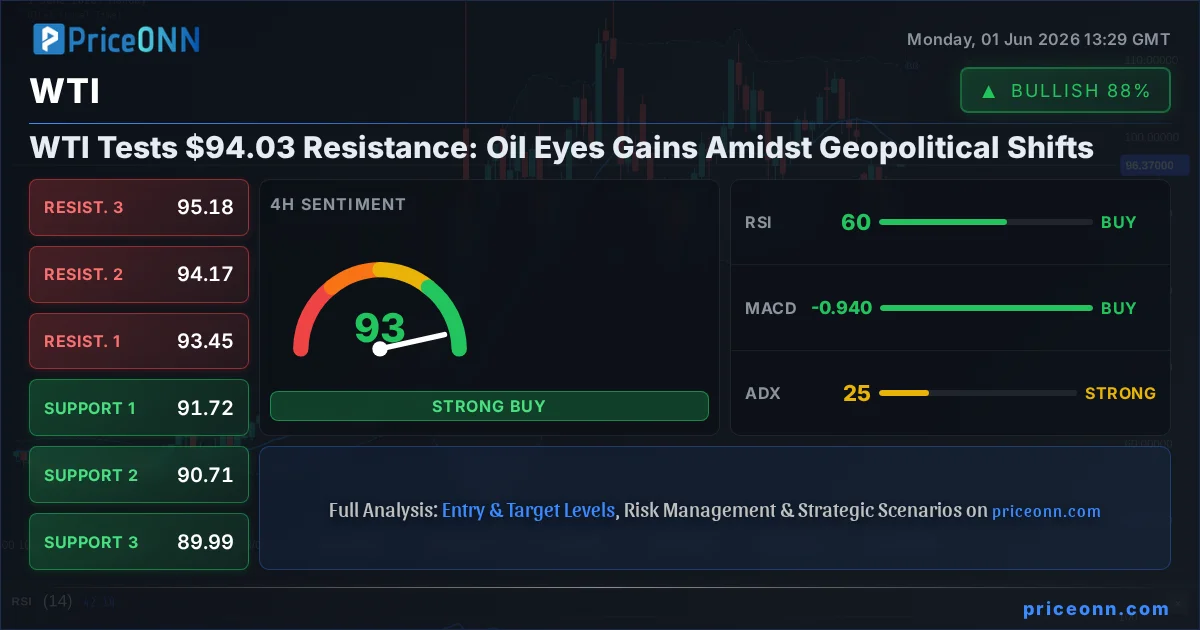
However, market sentiment shifted dramatically. Reports emerged suggesting that a planned energy infrastructure strike on Iran was postponed. This de-escalation, however temporary, allowed prices to shed their risk premium rapidly. The price action underscores the market's hypersensitivity to geopolitical developments in the oil-rich Middle East, where even the threat of disruption can send prices soaring, only to fall back just as quickly on news of averted conflict.
Analysis & Drivers: Geopolitics and Forecasts
The primary catalyst for the initial price surge was the escalating conflict in the Middle East and specific threats directed at the Strait of Hormuz, a vital chokepoint for global oil transit. Reports indicated increased military posturing and a potential ultimatum concerning passage through this critical waterway, injecting significant anxiety into the market. This fear of supply disruption led to a substantial risk premium being added to oil prices.
Compounding these concerns, a major financial institution had recently raised its oil price forecasts. Analysts revised their 2026 outlook for Brent crude to an average of $85 per barrel (up from $77) and for WTI to an average of $79 per barrel (up from $72). These projections were based on anticipated supply losses potentially reaching as high as 17 million barrels daily due to the unfolding crisis. The firm factored in an estimated six-week disruption to tanker traffic in the Strait of Hormuz, followed by a gradual recovery.
The subsequent sharp decline, however, was triggered by news of a postponement of planned energy infrastructure strikes on Iran. This development eased immediate fears of a direct military confrontation and its potential impact on oil supplies, leading to a swift unwinding of the risk premium. The market's rapid about-face highlights how quickly sentiment can pivot based on geopolitical headlines.
Interestingly, India's domestic fuel prices remained stable despite its oil basket soaring to $156.29 per barrel on March 19, a rare instance of it surpassing Brent crude. This stability was attributed to refiners absorbing costs and ample inventory levels, even as international benchmarks like WTI experienced extreme volatility.
Trader Implications: Navigating Extreme Volatility
Traders are advised to remain highly vigilant and prepared for continued price swings in WTI and other crude benchmarks. The market's reaction to geopolitical news underscores the significant risk of sudden, sharp movements. Key factors to monitor include:
- Geopolitical Developments: Any further escalation or de-escalation in the Middle East, particularly concerning the Strait of Hormuz and Iran, will be paramount.
- Supply Data: Weekly oil inventory reports from the API and EIA will provide insights into actual supply and demand dynamics, potentially overriding geopolitical sentiment if they indicate significant shifts.
- Forecast Revisions: Further adjustments to price forecasts by major financial institutions could signal shifts in underlying market expectations.
For traders, the current environment demands a cautious approach. While the immediate threat of widespread supply disruption may have receded, the underlying tensions remain. Key support for WTI can be observed around the $90.00 mark, while the $100.00 level now acts as a significant psychological and technical resistance. A decisive break below $90 could signal further downside, whereas a sustained push back above $100 would indicate a renewed risk-on sentiment.
Outlook
The outlook for WTI crude remains highly uncertain, heavily dependent on the volatile geopolitical landscape in the Middle East. While the immediate crisis appears to have been averted, the underlying friction persists, suggesting that oil prices could remain susceptible to sharp fluctuations. Traders should anticipate continued choppiness, with support at $90 and resistance at $100 being critical levels to watch. Any renewed escalation could quickly push prices back towards the revised forecasts of $79 and above, while sustained de-escalation might lead to a retest of lower levels as the market digests fundamental supply-demand metrics.
Frequently Asked Questions
What caused WTI crude oil prices to fall sharply on Monday?
WTI crude oil prices fell approximately 9% on Monday, dropping below $100 per barrel to test $90.00, primarily due to news that planned energy infrastructure strikes on Iran were postponed. This development eased immediate fears of supply disruptions in the Middle East.
What are the revised price forecasts for WTI and Brent crude for 2026?
Following recent geopolitical tensions, one major financial institution has revised its 2026 price forecasts. WTI is now expected to average $79 per barrel, up from a previous estimate of $72, and Brent crude is forecast to average $85 per barrel, an increase from $77.
What key levels should traders watch for WTI crude oil in the near term?
Traders should closely monitor the $90.00 support level for WTI crude oil. A break below this could signal further declines. Conversely, the $100.00 mark represents significant psychological and technical resistance; a sustained move above this level would indicate a shift towards higher prices.
Track markets in real-time
Empower your investment decisions with AI-powered analysis, technical indicators and real-time price data.
Join Our Telegram Channel
Get breaking market news, AI analysis and trading signals delivered instantly to your Telegram.
Join Channel PriceONN News
Crude oil prices experienced a significant drop, with WTI futures falling over 1.8% to $87.25, as optimism grew for a U.S.-Iran deal potentially reopening the Strait of Hormuz.
PriceONN News
(RTTNews) - Crude oil prices have tumbled on Friday as expectations of the U.S. and Iran signing a Memorandum of Understanding run high. The MoU would allow for immediate reopening of the Strait of Hormuz and pave the way for the resumption of oil and energy trade.
PriceONN News
Crude oil futures experienced a dramatic intraday reversal on Thursday, soaring overnight on geopolitical fears only to pull back significantly as reports of a potential diplomatic understanding between the U.S. and Iran emerged.
PriceONN News
Crude oil futures experienced a dramatic intraday reversal, soaring to $92.52 before pulling back significantly on Thursday. The volatile session was driven by shifting geopolitical narratives and U.S. inventory data.
PriceONN News
Brent crude prices surged towards the mid-$90s amid fears of supply disruptions from Middle East tensions, only to pare gains later as whispers of a potential US-Iran diplomatic understanding emerged.
PriceONN News
(RTTNews) - Crude oil futures skyrocketed overnight but have shown a significant pullback over the course of the trading day on Thursday.
PriceONN News
Global oil prices are treading water after a significant 5% slump, as market sentiment grapples with cautious optimism over Middle East de-escalation efforts versus lingering geopolitical uncertainties. Brent crude hovers near $104.72 and WTI near $98.07.
PriceONN News
WTI Crude Oil futures experienced a sharp decline of over 5.6%, falling to $98.26 per barrel as diplomatic efforts between the U.S. and Iran gained significant momentum, easing supply disruption fears.
PriceONN News
(RTTNews) - Oil prices were little changed on Thursday, after having fallen over 5 percent in the previous session amid optimism over a possible easing of Middle East tensions. Brent crude futures for July delivery were down 0.3 percent at $104.72 a barrel while WTI crude futures
PriceONN News
Crude oil prices experienced a sharp decline, with WTI futures for July delivery falling 5.66% to $98.26. This drop is largely attributed to renewed diplomatic efforts aimed at de-escalating the U.S.-Iran conflict and easing tensions around the Strait of Hormuz.
PriceONN News
The Iran war suddenly turned what had started as a year of oversupply in global oil and LNG markets into the worst oil and gas supply disruption in history. Three months after the U.S.-Israeli strikes on Iran began on February 28, the world has already lost 1 billion barrels of crude oil supply, oil and gas prices have found a new, much higher floor, and whipsaw with violent volatility nearly every day, trade routes have shifted, and tanker rates have spiked. Actual supply shortages are...
PriceONN News
The Iran war has handed the United States a rare opportunity: a new dawn of energy dominance in an increasingly fractured world. With coordinated US-Israeli strikes disrupting the Strait of Hormuz from late February, roughly 20% of global LNG supply has been stripped from the market since early March. Prices have surged across Asia and Europe. And into that vacuum, American gas has flowed. The numbers speak for themselves. US LNG exports to Asia jumped sharply in April, with nearly a quarter of...