
Why Did WTI Oil Slip Below $94 Amid Middle East De-escalation Efforts?
West Texas Intermediate (WTI), the primary U.S. crude oil benchmark, experienced a downward drift, trading around the $93.50 per barrel mark during early Friday Asian trading hours. This price adjustment follows a period of heightened geopolitical tension, now seemingly tempered by diplomatic overtures from U.S. and Israeli leadership aimed at calming market anxieties regarding damage to critical energy infrastructure in the Persian Gulf.
Market Context
The benchmark U.S. crude, WTI, known for its light gravity and low sulfur content, is a pivotal global pricing standard. Its price is heavily influenced by the supply and demand balance, global economic health, and significant geopolitical events. Historically, WTI's value is closely tied to its primary distribution hub in Cushing, Oklahoma, often referred to as the 'Pipeline Crossroads of the World'. Recent market sentiment had been sensitive to news of potential disruptions in the Middle East, a key oil-producing region. However, the latest statements from international leaders appear to be reducing immediate supply disruption fears, leading to a recalibration of prices.
Analysis & Drivers
The recent price decline in WTI can be attributed to a confluence of factors. Primarily, the perceived de-escalation of geopolitical risks in the Middle East has removed some of the immediate upward pressure on oil prices that was driven by fear of supply disruptions. Analysts note that while significant damage to energy facilities can have lingering effects, the swift diplomatic responses have provided a measure of reassurance to the market. Furthermore, broader economic indicators, though not explicitly detailed in recent reports, continue to play a background role. A strong U.S. dollar can also exert downward pressure on dollar-denominated commodities like oil, making them more expensive for holders of other currencies. Market participants are also keenly awaiting upcoming inventory data from the American Petroleum Institute (API) and the Energy Information Administration (EIA), which will provide a clearer picture of U.S. crude stockpiles and inform short-term price direction.
Trader Implications
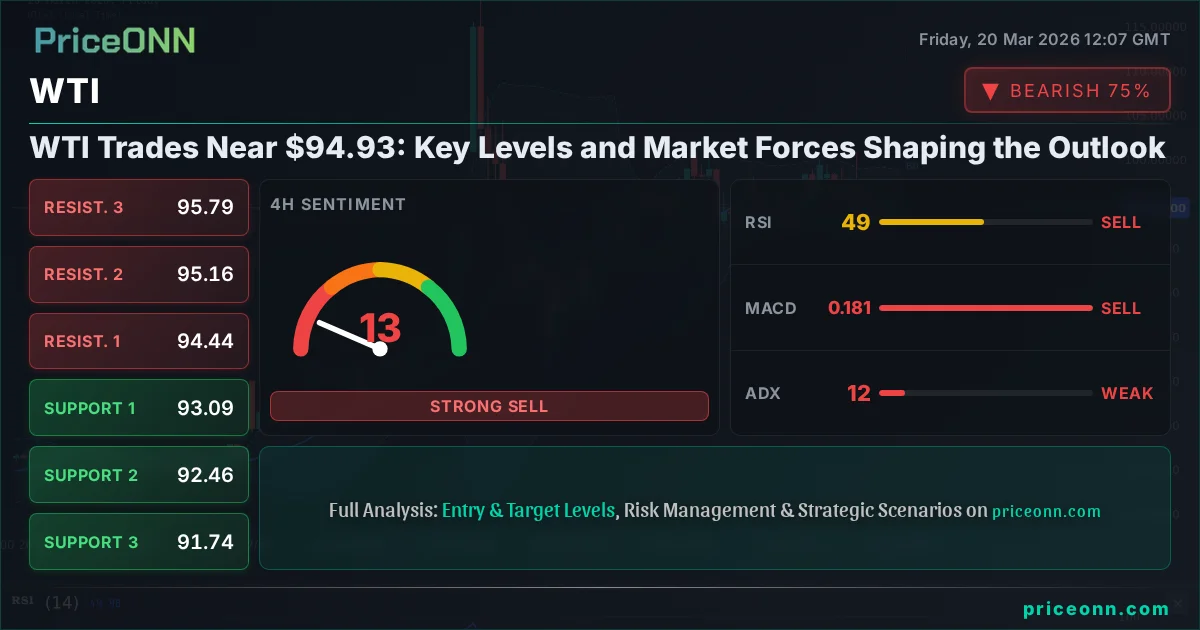
For traders, the current price action suggests a potential short-term bearish bias as immediate supply fears recede. Key levels to watch for WTI include the $93.00 support level, which if breached decisively, could signal further downside towards the $91.50 mark. On the upside, resistance is likely to be encountered around the $94.50 to $95.00 range. Traders should remain vigilant for any new geopolitical developments or shifts in economic data that could rapidly alter market sentiment. The influence of OPEC+ production decisions also remains a significant factor that could reintroduce volatility. Monitoring the U.S. dollar index (DXY) will be crucial, as a strengthening dollar could add further headwinds for oil prices.
Outlook
Looking ahead, WTI is likely to remain sensitive to geopolitical developments in the Middle East and broader macroeconomic trends. While immediate tensions may be easing, the underlying instability in the region presents a persistent risk premium that could resurface. Traders will be closely watching for any signs of renewed conflict or further diplomatic breakthroughs. Economic data releases, particularly those related to inflation and growth from major economies, will also be critical in shaping demand expectations. The market's reaction to upcoming EIA inventory reports will provide further insight into the domestic supply picture.
Frequently Asked Questions
What is the current price of WTI crude oil?
As of early Friday trading, West Texas Intermediate (WTI) crude oil was trading around $93.50 per barrel. This level represents a slight decrease as geopolitical concerns in the Middle East showed signs of easing.
What factors are currently influencing WTI prices?
The primary drivers are geopolitical developments in the Middle East, specifically efforts to calm concerns over energy infrastructure damage, and the broader supply-demand balance. Diplomatic efforts have reduced immediate supply disruption fears, leading to price adjustments.
What are the key price levels for WTI traders to watch?
Traders should monitor the $93.00 support level for potential further declines and the $94.50 to $95.00 range as key resistance. A break below $93.00 could target $91.50.
Track markets in real-time
Empower your investment decisions with AI-powered analysis, technical indicators and real-time price data.
Join Our Telegram Channel
Get breaking market news, AI analysis and trading signals delivered instantly to your Telegram.
Join Channel


PriceONN