
Why Is WTI Crude Oil Holding Near $92 Amid Middle East Tensions and Dollar Strength?

West Texas Intermediate (WTI) crude oil is navigating a complex market landscape, currently trading around $92.05 per barrel. This level represents a 1.73% increase on the day, indicating a positive bias, yet the advance lacks significant bullish momentum. This cautious trading environment is shaped by a delicate interplay between escalating geopolitical tensions in the Middle East and the persistent strength of the US Dollar, both acting as formidable forces influencing upside potential.
Market Context
WTI crude oil has maintained a firm stance for the second consecutive day, hovering near the $91-$92 range. While the price is extending its positive trend, market data shows a distinct absence of strong conviction from buyers. This suggests that while underlying supply concerns provide a floor, significant upward movement is being hampered by competing macroeconomic factors. The benchmark's resilience is largely a function of two primary drivers: heightened geopolitical instability in the Middle East, which introduces a persistent risk premium for supply disruptions, and a notably strong US Dollar. The latter makes dollar-denominated commodities like oil more expensive for holders of other currencies, thereby acting as a natural ceiling on price appreciation.
Analysis & Drivers
The current price action in WTI is a clear reflection of competing forces. Geopolitical events in the Middle East are a primary catalyst for underlying support. Reports indicate that Saudi crude oil exports to key Asian markets, specifically China and India, are projected to fall in April due to production disruptions. Saudi Aramco has reportedly notified term customers in Asia that April shipments will be reduced, with exports to China seen at approximately 40 million barrels, down from 48 million in February, and to India at around 23 million barrels. This reduction, stemming from disruptions possibly linked to the Strait of Hormuz, tightens immediate supply, providing a bullish underpinning for prices.
Conversely, the strength of the US Dollar is a significant headwind. As oil is priced globally in US dollars, a stronger dollar inherently increases the cost for international buyers. This currency dynamic acts as a powerful counter-balance to supply-side anxieties, capping the extent to which WTI can rally. Furthermore, while not explicitly detailed in recent data, broader global economic sentiment and demand forecasts also play a crucial role. Analysts note that any signs of weakening global growth could dampen demand expectations, further limiting upside potential even amidst supply constraints.
Trader Implications
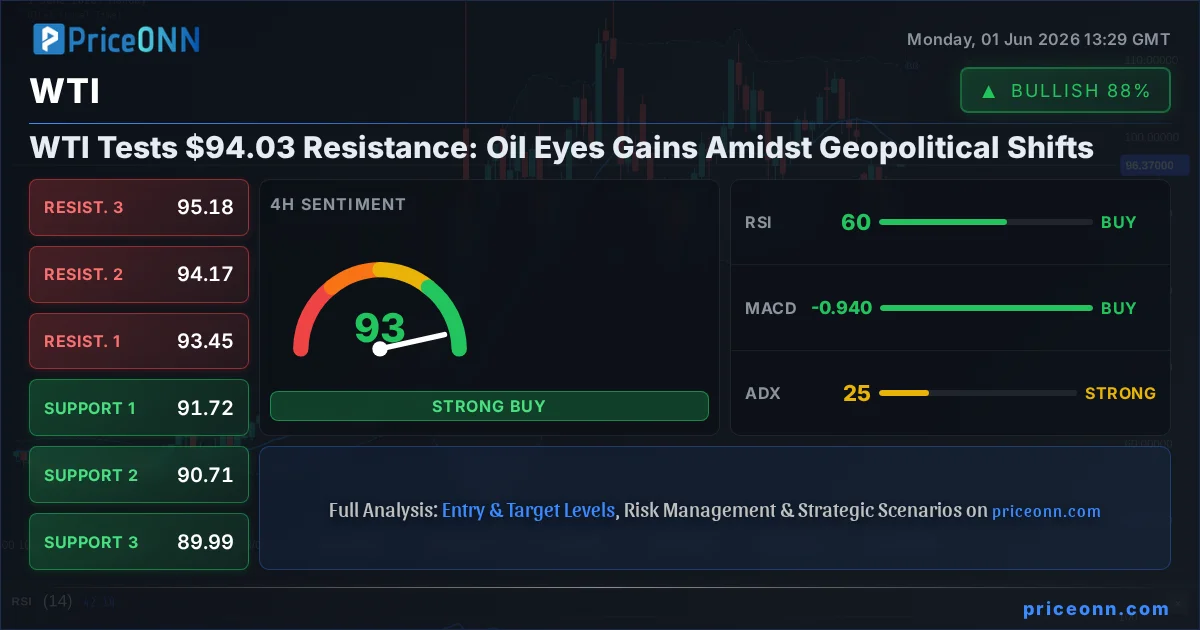
Traders are currently caught between the bullish narrative of potential supply disruptions and the bearish pressure of a strong dollar and cautious demand outlook. Key levels to watch include the 200-hour Exponential Moving Average (EMA), which has been a point of resistance and is currently around the $91.00 mark. A decisive break and sustained hold above this level could signal increased bullish conviction and potentially open the door for further gains towards the $93-$94 range. Conversely, failure to overcome this immediate resistance could lead to a retest of support levels, potentially near the $90.00 psychological mark.
The market appears to be waiting for a clearer signal. Traders should monitor geopolitical developments in the Middle East closely, as any escalation could rapidly shift sentiment and price action. Simultaneously, the trajectory of the US Dollar index (DXY) will be critical. A sustained weakening of the dollar could provide the catalyst needed for WTI to break higher. Conversely, further dollar strength would likely keep prices range-bound or push them lower. Weekly inventory reports from the API and EIA will also provide crucial insights into the immediate supply-demand balance. A larger-than-expected draw in US crude inventories could offer temporary support, while builds might exacerbate downward pressure.
Outlook
The near-term outlook for WTI crude oil remains one of cautious optimism, balanced by significant headwinds. While Middle East tensions provide a baseline support and reduce immediate downside risk, the strong US Dollar is expected to continue capping significant rallies. Traders should anticipate continued volatility as these opposing forces battle for dominance. The market's ability to sustain prices above the $91.00-$92.00 area will be a key determinant of short-term direction, with a decisive breakout likely requiring either a significant escalation of geopolitical risk or a noticeable softening of the US Dollar.
Frequently Asked Questions
What is the current price of WTI crude oil?
As of the latest data, West Texas Intermediate (WTI) crude oil is trading around $92.05 per barrel, showing a modest gain for the day.
Why are Saudi oil exports to China and India decreasing?
Saudi crude oil exports to China and India are set to decline in April due to production disruptions in the Middle East. Shipments to China are expected to be around 40 million barrels, down from 48 million in February.
What are the key levels traders should watch for WTI crude oil?
Traders should monitor the 200-hour EMA around $91.00 for immediate resistance. A sustained move above this level could signal further upside, while failure to do so might lead to a retest of the $90.00 support.
Track markets in real-time
Empower your investment decisions with AI-powered analysis, technical indicators and real-time price data.
Join Our Telegram Channel
Get breaking market news, AI analysis and trading signals delivered instantly to your Telegram.
Join Channel PriceONN News
Crude oil prices experienced a significant drop, with WTI futures falling over 1.8% to $87.25, as optimism grew for a U.S.-Iran deal potentially reopening the Strait of Hormuz.
PriceONN News
Crude oil prices experienced a significant downturn as market sentiment shifted towards optimism about a potential US-Iran Memorandum of Understanding that could reopen the Strait of Hormuz. WTI futures fell nearly 2% on the news.
PriceONN News
(RTTNews) - Crude oil prices have tumbled on Friday as expectations of the U.S. and Iran signing a Memorandum of Understanding run high. The MoU would allow for immediate reopening of the Strait of Hormuz and pave the way for the resumption of oil and energy trade.
PriceONN News
Crude oil futures experienced a dramatic intraday reversal on Thursday, soaring overnight on geopolitical fears only to pull back significantly as reports of a potential diplomatic understanding between the U.S. and Iran emerged.
PriceONN News
(RTTNews) - Extending the losses from yesterday's session, crude oil prices have gone into freefall on Wednesday as investor expectations on a potential U.S.-Iran agreement continue to rise despite the U.S. refusing to ease its demands.
PriceONN News
(RTTNews) - Crude oil prices have tumbled on Tuesday as optimism about a U.S.-Iran peace deal that could lead to reopening of the Strait of Hormuz soon grows despite reports of fresh U.S. strikes on Iran yesterday.
PriceONN News
Iran's oil exports fell to their lowest level in at least six years in May as the U.S. naval blockade continued to choke off crude shipments and leave tens of millions of barrels stranded at sea. According to shipping data from Vortexa, Iran exported just 209,000 barrels per day (bpd) of crude oil and condensate in May, down from 1.34 million bpd in April and nearly 1.9 million bpd in March. Kpler had estimated May exports slightly higher at 260,000 bpd, but still the lowest level since the...
PriceONN News
The Iran war suddenly turned what had started as a year of oversupply in global oil and LNG markets into the worst oil and gas supply disruption in history. Three months after the U.S.-Israeli strikes on Iran began on February 28, the world has already lost 1 billion barrels of crude oil supply, oil and gas prices have found a new, much higher floor, and whipsaw with violent volatility nearly every day, trade routes have shifted, and tanker rates have spiked. Actual supply shortages are...
PriceONN News
Crude oil futures experienced a dramatic intraday reversal, soaring to $92.52 before pulling back significantly on Thursday. The volatile session was driven by shifting geopolitical narratives and U.S. inventory data.
PriceONN News
(RTTNews) - Crude oil futures skyrocketed overnight but have shown a significant pullback over the course of the trading day on Thursday.
PriceONN News
The market’s faith in an imminent US-Iran peace breakthrough has clearly weakened today - but it has not disappeared yet. Oil prices jumped again in after fresh military escalation around the Strait of Hormuz reignited fears of prolonged supply disruptions across the Gulf. Brent crude pushed back toward the mid-$90s after new U.S. strikes inside […] The post Brent Oil Holding Below $100 Suggests Markets Still See Room for a US-Iran Deal appeared first on ActionForex.
PriceONN News
South America has raised its oil exports more than the U.S. has done so far this year as key producers in the region boosted production and shipments to a world scrambling for crude that’s not dependent on the Strait of Hormuz. Over the past five years, South America’s biggest producer and exporter, Brazil, has started production at several new offshore platforms in the Santos pre-salt fields. Guyana has continuously increased overseas shipments as the Exxon-led consortium starts up...