
Will AUD/USD Fall to 0.7000 Amid Rising Unemployment and Dollar Strength?

The AUD/USD pair has dipped into negative territory, trading around the 0.7080 level during early Asian trading on Friday. This softening of the Australian Dollar against its US counterpart follows the release of February employment data, which showed a surprise increase in Australia's jobless rate to 4.0%. Concurrently, the US Dollar Index (DXY), a gauge of the dollar's strength against a basket of major currencies, is holding firm near 99.40, bolstered by a recent 'hawkish hold' policy from the US Federal Reserve.
Market Context
The AUD/USD experienced a notable decline on Thursday, moving away from recent highs. Market data shows the pair trading around 0.7050, representing a roughly 0.47% drop, as the US Dollar weakened across the board. However, this trend reversed as Friday's Asian session commenced. Traders are digesting the Federal Reserve's latest stance, which, while holding interest rates steady, signaled a prolonged period of higher rates, effectively a 'hawkish hold'. This has injected renewed strength into the greenback. Adding to global economic uncertainty, crude oil prices are experiencing volatility, with Brent crude trading near $114 per barrel and WTI past $105, driven by escalating geopolitical tensions in the Middle East. This backdrop of a strengthening dollar and rising oil prices presents a complex environment for the AUD/USD pair.
Analysis & Drivers
Several key factors are influencing the current price action for AUD/USD. Firstly, the unexpected rise in Australia's unemployment rate to 4.0% in February signals a potential cooling in the domestic labor market, which is typically a headwind for the Australian Dollar. This data point contrasts with previous market expectations and weighs on the AUD. Secondly, the US Federal Reserve's commitment to maintaining restrictive monetary policy, as indicated by its 'hawkish hold', continues to support the US Dollar. Analysts note that the Fed's focus on price stability, even at the risk of slowing economic growth, is a significant driver for USD strength. The dollar's historical role as a global reserve currency, with over 88% of global foreign exchange turnover in 2022, amplifies the impact of Fed policy decisions. Furthermore, geopolitical developments in the Middle East are creating a 'risk-off' sentiment globally. Threats to oil production facilities in Saudi Arabia, the UAE, and Qatar, coupled with supply disruptions, are driving up oil prices. While higher commodity prices can sometimes benefit commodity-linked currencies like the AUD, the prevailing geopolitical uncertainty and the subsequent flight to safe-haven assets like the US Dollar are currently overshadowing this effect.
Trader Implications
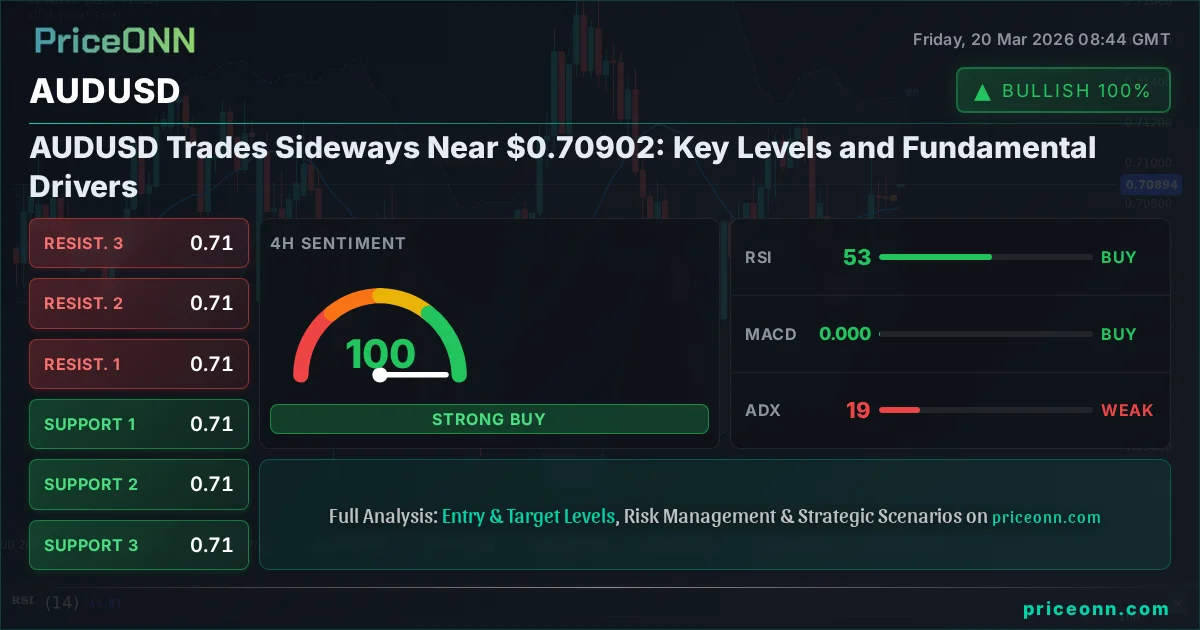
For traders, the AUD/USD pair presents a dual challenge. The immediate downside pressure stems from the weaker-than-expected Australian employment data and the robust US Dollar. Key support levels to watch are the recent lows around 0.7050, followed by the psychological 0.7000 mark. A break below 0.7000 could signal further downside. On the upside, resistance might be found at the 50-day moving average, which was previously a bullish indicator for the pair, currently situated around 0.7090-0.7100. Traders should closely monitor upcoming RBA statements for any shift in monetary policy outlook, as well as further developments in US inflation data and Fed commentary. The ongoing geopolitical risks in the Middle East remain a significant wildcard, potentially driving further demand for the safe-haven dollar and pressuring AUD/USD. A sustained move above 0.7100 would require a significant shift in market sentiment or a dovish pivot from the Fed.
Outlook
The outlook for AUD/USD remains cautious in the short term. The combination of rising unemployment in Australia and a hawkish Federal Reserve points towards continued pressure on the pair. However, the volatility in crude oil prices due to Middle Eastern tensions could introduce significant swings. If geopolitical risks escalate further, the safe-haven appeal of the US Dollar is likely to strengthen, potentially pushing AUD/USD towards the 0.7000 level. Conversely, any signs of de-escalation in the Middle East or a more dovish tone from the Fed could offer relief to the Australian Dollar.
Frequently Asked Questions
What is the current support level for AUD/USD?
The immediate support level for AUD/USD is around 0.7050, with a more significant psychological barrier at 0.7000. A sustained break below 0.7000 could lead to further declines.
How is the US Dollar Index (DXY) impacting AUD/USD?
The DXY is currently trading near 99.40, supported by the Federal Reserve's hawkish hold. A stronger DXY generally puts downward pressure on AUD/USD, as seen in the recent trading session.
What is the outlook for AUD/USD given the current economic factors?
The outlook is cautious, with potential for further downside towards 0.7000 due to rising Australian unemployment and a strong USD. However, escalating Middle East tensions could further boost the safe-haven dollar.
Track markets in real-time
Empower your investment decisions with AI-powered analysis, technical indicators and real-time price data.
Join Our Telegram Channel
Get breaking market news, AI analysis and trading signals delivered instantly to your Telegram.
Join Channel



PriceONN