
Will Crude Oil Prices Surge to $200 Amid Escalating Middle East Conflict?

Crude oil prices are facing a critical juncture, with the U.S. federal government actively modeling a scenario where prices could reach $200 per barrel. This alarming assessment comes amid escalating geopolitical risks in the Middle East, which threaten to disrupt global energy supplies. While some pronouncements have suggested a potential de-escalation, the underlying market dynamics and physical supply constraints point to significant upside risk for oil benchmarks.
Market Context: A Tale of Two Signals
This past week saw a notable divergence in market sentiment. Initially, prices were poised for a decline, with Brent crude trading at $107.98 and West Texas Intermediate (WTI) at $94.12, down from earlier highs of over $111 and $98 respectively. This pullback was largely driven by optimistic statements suggesting an imminent end to regional hostilities. However, this narrative is increasingly being challenged by the stark realities of physical supply disruptions.
Despite the recent price retreat, both Brent and WTI remain substantially elevated compared to the beginning of the year. The critical Strait of Hormuz, a vital chokepoint for Middle Eastern oil exports, remains under threat. This closure has already forced Asian nations, heavily reliant on Gulf oil, into rationing fuel and paying hefty premiums for alternative crude grades. Millions of barrels of crude are effectively landlocked, compelling producers to curtail output not by choice, but by necessity.
Analysis & Drivers: Geopolitics vs. Diplomacy
The primary driver for the current volatility is the escalating conflict in the Middle East. The potential for a protracted war raises the specter of severe supply shocks. Analysts have outlined various scenarios, with the base case predicting a swift de-escalation. However, alternative scenarios warn of fundamental damage to global energy supply chains, which would inevitably trigger widespread economic headwinds.
The U.S. government's modeling of a $200 per barrel scenario underscores the severity of the perceived risk. Such a price surge would have devastating consequences, particularly for developing nations, but developed economies would also face significant pain. In the United States, average gasoline prices have already climbed approximately 30% since heightened geopolitical instability began, reaching a national average of $3.982 per gallon by March 25th. This rise in fuel costs acts as a foundational driver for broader inflation across goods and services.
Furthermore, the value of the US Dollar plays a crucial role in oil pricing. A weaker dollar typically makes oil cheaper for holders of other currencies, potentially boosting demand, while a stronger dollar can have the opposite effect. The interplay between geopolitical tensions, physical supply constraints, and macroeconomic factors like currency valuations creates a complex and volatile market environment.
Trader Implications: Navigating Uncertainty
Traders are currently caught between conflicting signals: hopes for a diplomatic resolution and the tangible threat of severe supply disruptions. The physical market realities, particularly the strain on supply from the Middle East, suggest that the recent price dip may be temporary. The paper market appears somewhat detached from the unfolding crisis, creating a divergence that could lead to sharp reversals.
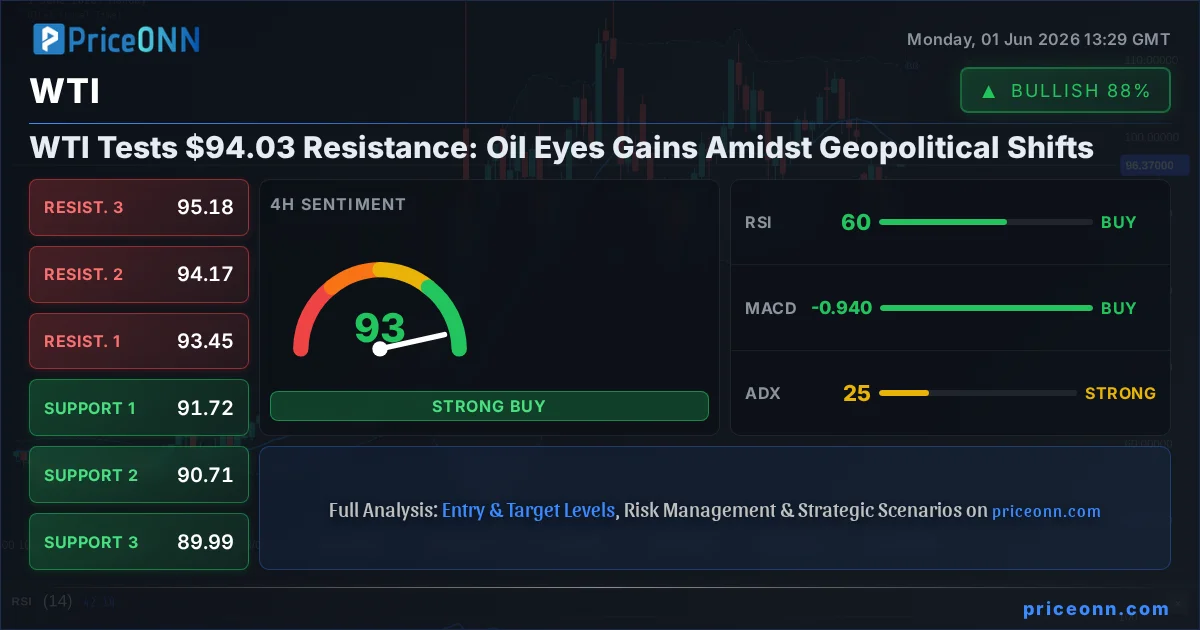
Key levels to watch include the $93.50 mark for WTI, which has served as a recent pivot point. A sustained break above this level, supported by escalating supply concerns, could signal a move higher. Conversely, any concrete news of a successful ceasefire could trigger a sharp sell-off, testing lower support levels. Given the potential for extreme volatility, risk management is paramount. Traders should consider tighter stop-losses and position sizing carefully.
The market is essentially bracing for a significant upward move if the Strait of Hormuz remains blocked. The impact will likely be felt most acutely in Asia and Europe before potentially spreading further. Investors and traders must remain vigilant to geopolitical pronouncements while closely monitoring physical supply indicators and the price action around key technical levels.
The outlook for crude oil remains highly uncertain, with significant risks skewed to the upside. While diplomatic efforts may offer temporary relief, the fundamental supply constraints and geopolitical tensions are potent forces. Traders should be prepared for continued volatility and potential sharp price movements. The coming days and weeks will be critical in determining whether the market prices in peace or prepares for a protracted conflict, potentially pushing oil towards unprecedented levels.
Frequently Asked Questions
What is the current price of Brent crude and WTI?
As of the latest reports, Brent crude was trading around $107.98 per barrel, while West Texas Intermediate (WTI) was priced at approximately $94.12 per barrel. These figures represent a retreat from earlier highs earlier in the week.
What is the U.S. government's worst-case oil price scenario?
The U.S. federal government is modeling a potential scenario where crude oil prices could surge to as high as $200 per barrel. This assessment is being conducted to understand the potential economic fallout of such a dramatic price increase.
What are the key factors driving current oil price volatility?
The primary drivers are escalating geopolitical tensions in the Middle East, particularly concerning the Strait of Hormuz, and the resulting physical supply disruptions. This is contrasted by signals of potential diplomatic de-escalation, creating significant market uncertainty and volatility.
Track markets in real-time
Empower your investment decisions with AI-powered analysis, technical indicators and real-time price data.
Join Our Telegram Channel
Get breaking market news, AI analysis and trading signals delivered instantly to your Telegram.
Join Channel PriceONN News
Global oil prices are treading water after a significant 5% slump, as market sentiment grapples with cautious optimism over Middle East de-escalation efforts versus lingering geopolitical uncertainties. Brent crude hovers near $104.72 and WTI near $98.07.
PriceONN News
Crude oil prices experienced a significant drop, with WTI futures falling over 1.8% to $87.25, as optimism grew for a U.S.-Iran deal potentially reopening the Strait of Hormuz.
PriceONN News
Crude oil prices experienced a significant downturn as market sentiment shifted towards optimism about a potential US-Iran Memorandum of Understanding that could reopen the Strait of Hormuz. WTI futures fell nearly 2% on the news.
PriceONN News
(RTTNews) - Crude oil prices have tumbled on Friday as expectations of the U.S. and Iran signing a Memorandum of Understanding run high. The MoU would allow for immediate reopening of the Strait of Hormuz and pave the way for the resumption of oil and energy trade.
PriceONN News
Crude oil futures experienced a dramatic intraday reversal on Thursday, soaring overnight on geopolitical fears only to pull back significantly as reports of a potential diplomatic understanding between the U.S. and Iran emerged.
PriceONN News
(RTTNews) - Extending the losses from yesterday's session, crude oil prices have gone into freefall on Wednesday as investor expectations on a potential U.S.-Iran agreement continue to rise despite the U.S. refusing to ease its demands.
PriceONN News
(RTTNews) - Crude oil prices have tumbled on Tuesday as optimism about a U.S.-Iran peace deal that could lead to reopening of the Strait of Hormuz soon grows despite reports of fresh U.S. strikes on Iran yesterday.
PriceONN News
(RTTNews) - After surging early in the day, crude oil prices have tumbled over the course of the trading session on Thursday. With the downturn, crude oil is extending the losses from the two previous sessions, as investors watch the developments in U.S.-Iran peace talks.
PriceONN News
WTI Crude futures for July delivery plunged 5.66% to $98.26 per barrel as diplomatic efforts to resolve the U.S.-Iran conflict gained significant traction. This sharp decline overshadowed a larger-than-expected drawdown in U.S. crude inventories.
PriceONN News
Crude oil prices experienced a sharp decline, with WTI futures for July delivery falling 5.66% to $98.26. This drop is largely attributed to renewed diplomatic efforts aimed at de-escalating the U.S.-Iran conflict and easing tensions around the Strait of Hormuz.
PriceONN News
The Iran war suddenly turned what had started as a year of oversupply in global oil and LNG markets into the worst oil and gas supply disruption in history. Three months after the U.S.-Israeli strikes on Iran began on February 28, the world has already lost 1 billion barrels of crude oil supply, oil and gas prices have found a new, much higher floor, and whipsaw with violent volatility nearly every day, trade routes have shifted, and tanker rates have spiked. Actual supply shortages are...
PriceONN News
Crude oil futures experienced a dramatic intraday reversal, soaring to $92.52 before pulling back significantly on Thursday. The volatile session was driven by shifting geopolitical narratives and U.S. inventory data.