
Will Gold Breach $4,500 as Middle East Tensions Escalate?
The precious metal, gold (XAU/USD), experienced a notable downturn at the start of the trading week, opening over 1% lower and testing levels near $4,445.00. This decline comes amid escalating fears of a wider conflict in the Middle East, which has propelled oil prices higher. West Texas Intermediate (WTI) crude oil surged nearly 3% in early trading, surpassing $102.50 per barrel, intensifying global inflation concerns.
Market Context
Last week was characterized by significant volatility across both oil and equity markets, largely driven by developments surrounding Iran. Early in the week, attempts by the U.S. President to de-escalate tensions provided a temporary boost to market sentiment, leading to a dip in oil prices and a rise in stock markets. However, by the week's end, a lack of substantial progress in negotiations and Iran's apparent unwillingness to cease conflict shifted sentiment back towards risk-off. This reversal saw oil prices ascend towards the $100 mark once again, while U.S. equity markets reversed course, closing near their weekly lows and marking a fifth consecutive week of declines. Economic data releases were sparse but added to prevailing concerns, with the U.S. S&P Global Services PMI undershooting expectations and consumer sentiment showing a decline. Consumers are increasingly anticipating higher inflation and expressing greater apprehension about the future, contributing to a cautious market mood.
Analysis & Drivers
The current market environment is heavily influenced by geopolitical instability in the Middle East. Fears of a potential U.S. invasion of Iran, following remarks from President Donald Trump, have injected significant uncertainty, pushing crude oil prices above $98.50 and even touching $101.40 earlier in the week. This surge in oil prices is a direct catalyst for rising inflation expectations globally. Gold, historically a safe-haven asset and an inflation hedge, typically benefits from such uncertainty. However, its inverse correlation with the U.S. Dollar and risk assets is also at play. A stronger dollar can suppress gold prices, while a sell-off in equities, as seen in the past five weeks, usually favors the precious metal. Central banks, major gold holders, continue to diversify reserves, with emerging economies like China, India, and Turkey significantly increasing their gold holdings, a trend that saw record purchases in 2022. This underlying demand from official institutions provides a supportive backdrop for gold.
Trader Implications
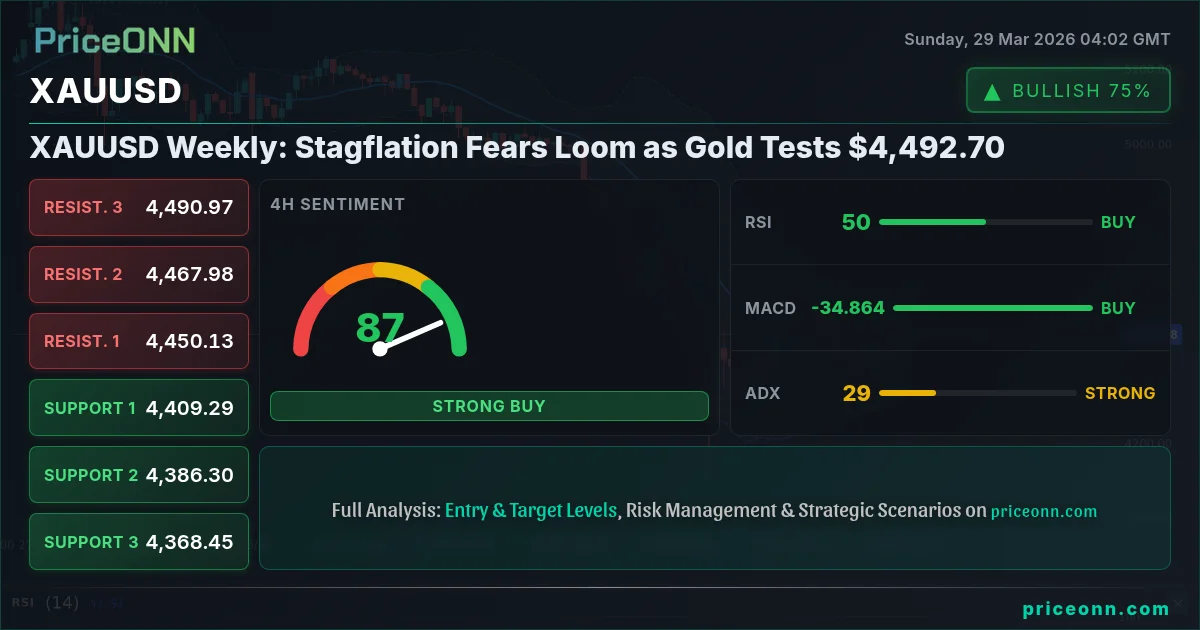
Traders are closely monitoring the geopolitical situation for any shifts in the Iran conflict, as this will be the primary driver for oil prices and, consequently, inflation expectations. Key levels to watch for WTI crude oil include resistance around $105.00 and $110.00, with support identified near $95.00 and $90.00. For gold (XAU/USD), the immediate focus is on whether it can reclaim previous highs. Key support levels are seen around $4,400 and $4,350, while resistance lies near $4,500 and $4,550. The U.S. Dollar's performance will also be critical; a weakening dollar would typically lend support to gold prices. Investors should remain vigilant for any official statements or developments that could alter the current risk-on sentiment driven by oil prices. The inverse relationship between risk assets and gold suggests that continued weakness in U.S. equities could provide a floor for gold, even with a strong dollar.
Outlook
The immediate outlook for gold remains tied to the volatile geopolitical landscape in the Middle East and its impact on energy markets. Should tensions continue to escalate, leading to further gains in crude oil, gold is likely to find support as a safe-haven asset and inflation hedge. Conversely, any diplomatic breakthroughs or de-escalation could trigger profit-taking in oil and potentially weigh on gold. Upcoming economic data, particularly inflation figures and U.S. manufacturing and services PMI reports, will also be crucial in shaping market sentiment and the Federal Reserve's potential policy path. Traders should prepare for continued choppiness, with geopolitical headlines dictating short-term price action.
Frequently Asked Questions
What is the current price of Gold (XAU/USD)?
Gold opened Monday's trading session near $4,445.00, experiencing a decline of over 1% amidst rising geopolitical tensions and a surge in oil prices.
Why are oil prices increasing and how does it affect Gold?
Fears of widening conflicts in the Middle East, particularly concerning Iran, have driven WTI crude oil prices above $102.50. This rally in oil fuels global inflation expectations, which typically supports gold's role as an inflation hedge and safe-haven asset.
What are the key support and resistance levels for Gold in the near term?
Traders should watch for support levels around $4,400 and $4,350. Key resistance is anticipated near $4,500 and potentially $4,550, with the geopolitical situation being the primary catalyst for any significant moves.
Track markets in real-time
Empower your investment decisions with AI-powered analysis, technical indicators and real-time price data.
Join Our Telegram Channel
Get breaking market news, AI analysis and trading signals delivered instantly to your Telegram.
Join Channel
PriceONN