
Will USD/JPY Break 160 as Fed and BoJ Decisions Loom?


The USD/JPY cross is currently trading around the 158.90 mark, a level fraught with tension as it inches closer to the 160.00 handle. This proximity to a key psychological barrier has amplified concerns regarding potential foreign exchange intervention by the Japanese Ministry of Finance, aimed at bolstering the Yen. The currency pair finds itself at a critical juncture, overshadowed by a significant "central bank double-header" this week, featuring the U.S. Federal Reserve on Wednesday and the Bank of Japan on Thursday. These pivotal monetary policy meetings are poised to be major catalysts for the pair's future direction.
Market Context
USD/JPY has been on a downward trajectory for the past two days, settling near 158.90 in a subdued trading session. While the long-term bullish trend remains intact, it has been primarily underpinned by the substantial yield differential between U.S. and Japanese bonds. However, market data indicates that the U.S. dollar is currently in overbought territory. Its continued strength hinges on a hawkish stance from the Federal Reserve and a relatively loose policy from the Bank of Japan. The widening gap in yields has historically favored the U.S. dollar against the Japanese Yen, a dynamic that has been a primary driver of the pair's ascent. The Bank of Japan's gradual unwinding of its ultra-loose monetary policy, initiated in 2024, has provided some support to the Yen, contributing to a narrowing of this yield differential.
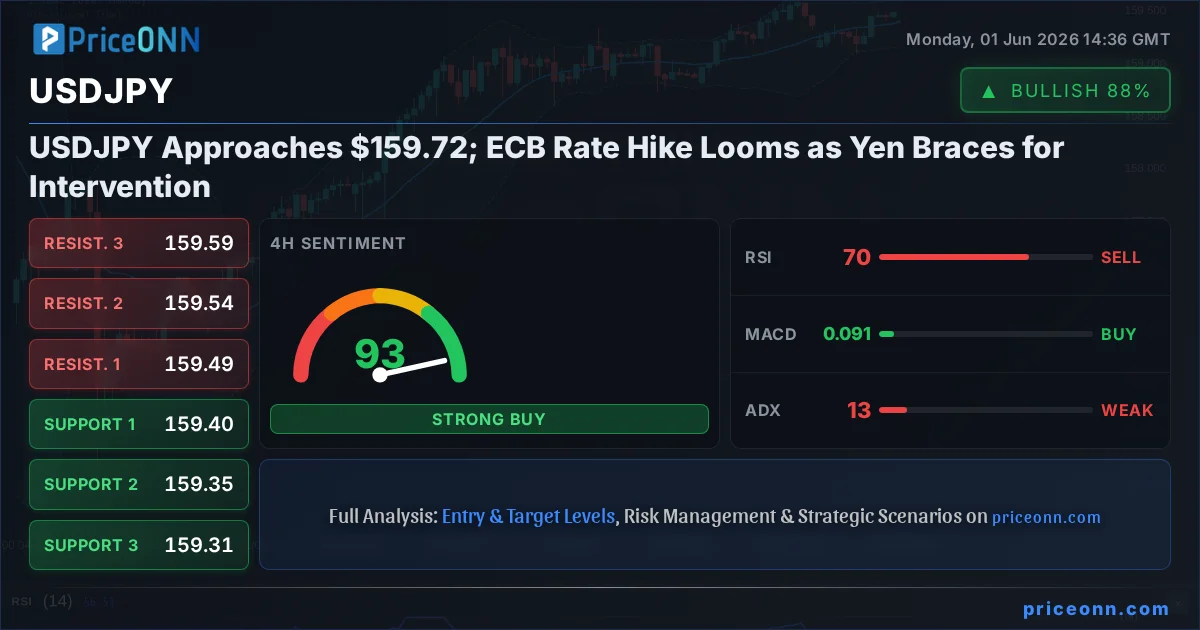
Analysis & Drivers
The impending central bank meetings are the dominant drivers for USD/JPY. The Federal Reserve is widely anticipated to maintain its benchmark interest rate at 3.75%. However, the market's focus will squarely be on the "Dot Plot," which offers projections for future rate adjustments. Should the Fed signal fewer rate cuts for 2026, perhaps due to persistent inflation hovering around 3.1%, this could strengthen the U.S. dollar. Conversely, any indication of a more dovish outlook would likely pressure the dollar. On the other side, the Bank of Japan's policy decision is also critical. While the BoJ has begun to move away from its decade-long ultra-loose monetary policy, any hint of a premature pivot or a less aggressive approach to normalization could weaken the Yen. The historical divergence in monetary policy between the Fed and the BoJ has been a significant factor, but as policy paths converge, this differential's influence may wane.
Furthermore, the Japanese Yen's safe-haven status could come into play if global market sentiment deteriorates. In times of heightened uncertainty, investors often flock to the Yen due to its perceived stability. This risk aversion could independently support the Yen, adding another layer of complexity to the USD/JPY dynamic, irrespective of central bank decisions. The potential for direct intervention by Japanese authorities also remains a key risk, particularly if the pair decisively breaks above 160.00.
Trader Implications
Traders should closely monitor the communication from both the Federal Reserve and the Bank of Japan. Key levels to watch for USD/JPY include the immediate resistance around 160.00, a breach of which could trigger intervention fears and potential volatility. Support can be observed near the 158.00 level. A Fed that signals fewer rate cuts than expected could push USD/JPY higher, potentially testing new multi-decade highs. Conversely, a more dovish Fed or signs of a more aggressive BoJ tightening could lead to a significant pullback. The risk of intervention presents a ceiling for upside moves, meaning that even strong U.S. dollar sentiment might be capped around the 160.00-161.00 zone if authorities decide to act. Traders should prepare for increased volatility around the central bank announcements, especially if the "Dot Plot" or forward guidance deviates from market expectations.
Outlook
The outlook for USD/JPY remains highly dependent on the outcomes of the Fed and BoJ meetings. If both central banks maintain hawkish or relatively steady stances, the yield differential could continue to support the dollar, pushing USD/JPY towards 160 and beyond, albeit with the constant threat of intervention. However, if the Fed pivots to a more dovish tone or the BoJ signals faster normalization, we could see a significant correction. The delicate balance between yield differentials, central bank policies, and the ever-present risk of intervention creates a complex trading environment. Market participants will be looking for clarity on the future path of monetary policy in both economies to gauge the sustainability of current price levels.
Frequently Asked Questions
What is the current trading level for USD/JPY and the key resistance?
The USD/JPY pair is currently trading around 158.90. The key psychological resistance level to watch is 160.00, a breach of which could increase the likelihood of Japanese currency intervention.
What is the primary factor supporting the USD/JPY's bullish trend?
The primary factor supporting the bullish trend in USD/JPY has been the significant widening of the interest rate differential between U.S. and Japanese bonds. This gap has historically favored the U.S. dollar.
What are the main risks for USD/JPY traders this week?
The main risks for USD/JPY traders include the outcomes of the Federal Reserve and Bank of Japan meetings, potential deviations from expected monetary policy guidance, and the possibility of direct foreign exchange intervention by Japanese authorities if the pair moves significantly higher towards or above 160.00.
Track markets in real-time
Empower your investment decisions with AI-powered analysis, technical indicators and real-time price data.
Join Our Telegram Channel
Get breaking market news, AI analysis and trading signals delivered instantly to your Telegram.
Join Channel PriceONN News
USDJPY has returned to the area of previous interventions. The ECB is moving towards a rate hike in June. The US dollar retreated on Friday amid new record highs for stock indices and rumours of amendments to the US-Iran agreement. However, tit-for-tat exchanges between the adversaries pushed the dollar index back into the support zone […] The post Yen Braces for a New Storm appeared first on ActionForex.
PriceONN News
The USD/JPY pair is showing signs of upside exhaustion, struggling to overcome the 159.65 resistance level and trading below a key bullish trend line. This technical setup raises concerns about a potential pullback in the near term.
PriceONN News
Markets are pricing in a potential de-escalation in the US-Iran conflict, leading to a significant drop in crude oil prices and a weakening US Dollar as diplomatic efforts appear to be gaining traction.
PriceONN News
USD/CAD faces pressure as Canada's economy shows signs of stalling, with Q1 GDP contracting 0.1% and domestic demand weakening. This comes as trade negotiations and geopolitical shifts add layers of uncertainty.
PriceONN News
AUD/USD’s late break of 0.7183 resistance suggests that pullback from 0.7277 has already completed at 0.7076, after defending 55 D EMA. Initial bias is back on the upside this week for retesting 0.7277 high first. Firm break there will resume larger up trend. For now, risk will stay on the upside as long as 0.7076 […] The post AUD/USD Weekly Report appeared first on ActionForex.
PriceONN News
USD/CAD is showing signs of potential upward movement as Canada's economy grapples with a significant slowdown, marked by weak domestic demand and stalled investment, while trade negotiations loom large.
PriceONN News
USD/JPY is testing the critical 160 level as stalled US-Iran negotiations and hawkish Federal Reserve rhetoric fuel inflation concerns and a potential for further rate hikes. Traders are closely watching upcoming US Non-Farm Payrolls and Eurozone CPI data for direction.
PriceONN News
Canada's economy showed signs of weakness in early 2026, but upcoming May jobs data is expected to reveal a moderate uplift. Analysts anticipate job growth of around 25,000 positions and a potential dip in the unemployment rate to 6.8%.
PriceONN News
The USD/JPY pair is flirting with the 160 level as stalled US-Iran negotiations and hawkish Federal Reserve rhetoric fuel inflation concerns. Traders are closely watching upcoming US Non-Farm Payrolls and Eurozone CPI data.
PriceONN News
EUR/USD stalled below 1.1660 as the US Dollar defied expectations, refusing to weaken despite reports of a US-Iran ceasefire extension. Market participants remain cautious, awaiting concrete confirmation and assessing lingering inflationary pressures.
PriceONN News
The Japanese Yen is showing signs of renewed pressure, with USD/JPY approaching the psychologically significant 160 level. This comes as traders brace for key US jobs data and Eurozone inflation figures, all while lingering US-Iran tensions add a layer of uncertainty to market sentiment.
PriceONN News
EUR/USD closed at 1.1640, showing resilience amid mixed signals. Easing US-Iran tensions initially pressured the dollar, but persistent inflation concerns and political ratification hurdles are keeping the greenback surprisingly steady.