
Will WTI Crude Break $100 as Middle East Tensions Escalate?


WTI crude oil prices are showing renewed strength, trading near $95.00 per barrel as the ongoing conflict in the Strait of Hormuz intensifies. The critical energy chokepoint has been effectively closed for three weeks, severely impacting global oil exports and pushing the market to consider extreme price scenarios, including a potential surge to $200 per barrel.
Market Context
The market sentiment is increasingly shaped by the palpable fear of sustained supply interruptions. The Strait of Hormuz closure has choked off significant export flows, and the limited capacity of alternative routes is now a major vulnerability. While some tankers are reportedly navigating the strait, data suggests a substantial portion are Iranian-origin vessels. Only a handful of non-Iranian tankers have successfully passed through, with limited recorded journeys to destinations like India and Pakistan.
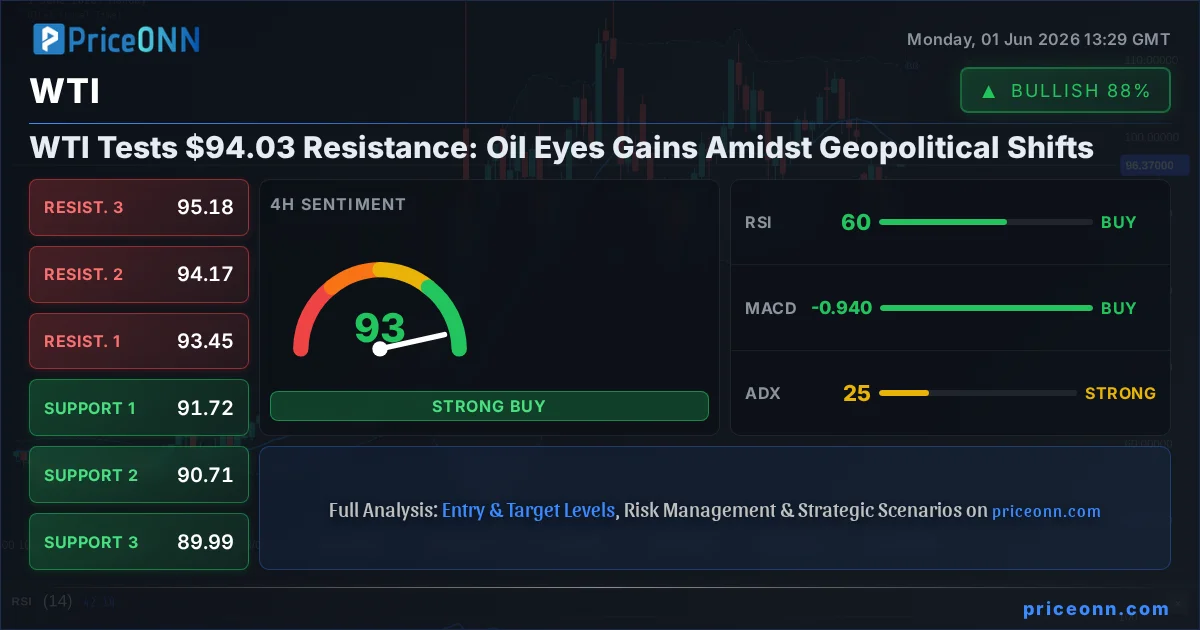
Alternative pipelines, such as Saudi Arabia's East-West pipeline (5 million bpd capacity) and the UAE's Habshan-Fujairah conduit (1.5 million bpd capacity), are being utilized more heavily. Saudi Aramco has ramped up loadings from its Red Sea terminals to 3 million barrels per day, though this is still considerably less than its pre-conflict rate of 7 million bpd. The UAE's primary export route has also faced direct attacks, with Iran striking the Fujairah export terminal twice in two days, forcing ADNOC to suspend loadings.
Analysis & Drivers
The primary driver for the current price action is the escalating geopolitical instability in the Middle East. The repeated attacks and blockades in the Strait of Hormuz are creating a genuine fear of long-term supply disruption. This fear is amplified by the limited capacity and vulnerability of alternative export routes. Reports indicate that China, the world's largest oil demand center, has been building substantial crude oil stockpiles. Despite higher refining rates in January and February, China added an average of 1.24 million barrels per day to storage, a move that may offer some buffer but highlights the global concern over supply availability.
Furthermore, the potential impact on Asian refineries is significant. Analysts warn that up to 6 million bpd of crude runs could be cut across Asia in April due to severe supply disruptions, given a 65% dependency on Middle Eastern crude. This demand-side disruption, coupled with supply fears, creates a potent cocktail for price increases. The technical setup for WTI also appears bullish, with prices retaking the $95.00 level and showing signs of a potential breakout towards the psychologically significant $100.00 mark.
Trader Implications
Traders should closely monitor developments in the Strait of Hormuz and any further escalations or de-escalations in the region. Key price levels to watch for WTI include immediate resistance around $96.00-$97.00, with a decisive break above $100.00 potentially opening the door for a rapid ascent towards the $105.00-$110.00 range. Conversely, any signs of a diplomatic resolution or a sustained opening of the Strait could lead to a sharp pullback, with support found at $92.50 and then $90.00.
The upcoming weekly oil inventory reports from the API and EIA will also be crucial. A significant drawdown in U.S. crude stockpiles would further support bullish sentiment, while a build could provide a temporary reprieve for prices. Given the heightened supply risk premium, a strategy focused on buying on dips or looking for bullish continuation patterns on intraday charts may be prudent, while maintaining strict risk management.
Outlook
The immediate outlook for WTI crude oil remains bullish, heavily influenced by the ongoing Middle East crisis. Unless diplomatic efforts yield immediate results or alternative supply routes prove far more resilient than anticipated, prices are likely to remain elevated and potentially test higher levels. The market's focus will remain fixed on supply security, with the specter of $200 oil, however extreme, now a tangible point of discussion among analysts and traders.
Frequently Asked Questions
What is the current price of WTI crude oil?
As of Tuesday's Asian trading session, West Texas Intermediate (WTI) crude oil is trading around $95.00 per barrel, recovering some ground amid escalating Middle East supply concerns.
How are Middle East tensions affecting oil prices?
The closure of the Strait of Hormuz for three weeks has severely disrupted oil exports. This has led to a significant risk premium being priced into crude, driving WTI prices higher and prompting discussions of extreme price targets like $200 per barrel.
What are the key price levels to watch for WTI?
Traders should watch for resistance near $96.00-$97.00 and a potential breakout above $100.00. Support levels are seen at $92.50 and $90.00, with a sustained breach of these levels potentially signaling a trend reversal.
Track markets in real-time
Empower your investment decisions with AI-powered analysis, technical indicators and real-time price data.
Join Our Telegram Channel
Get breaking market news, AI analysis and trading signals delivered instantly to your Telegram.
Join Channel PriceONN News
Crude oil prices experienced a significant drop, with WTI futures falling over 1.8% to $87.25, as optimism grew for a U.S.-Iran deal potentially reopening the Strait of Hormuz.
PriceONN News
(RTTNews) - Crude oil prices have tumbled on Friday as expectations of the U.S. and Iran signing a Memorandum of Understanding run high. The MoU would allow for immediate reopening of the Strait of Hormuz and pave the way for the resumption of oil and energy trade.
PriceONN News
Crude oil futures experienced a dramatic intraday reversal on Thursday, soaring overnight on geopolitical fears only to pull back significantly as reports of a potential diplomatic understanding between the U.S. and Iran emerged.
PriceONN News
Global oil prices are treading water after a significant 5% slump, as market sentiment grapples with cautious optimism over Middle East de-escalation efforts versus lingering geopolitical uncertainties. Brent crude hovers near $104.72 and WTI near $98.07.
PriceONN News
Crude oil prices experienced a significant downturn as market sentiment shifted towards optimism about a potential US-Iran Memorandum of Understanding that could reopen the Strait of Hormuz. WTI futures fell nearly 2% on the news.
PriceONN News
Crude oil futures experienced a dramatic intraday reversal, soaring to $92.52 before pulling back significantly on Thursday. The volatile session was driven by shifting geopolitical narratives and U.S. inventory data.
PriceONN News
(RTTNews) - Crude oil futures skyrocketed overnight but have shown a significant pullback over the course of the trading day on Thursday.
PriceONN News
(RTTNews) - Extending the losses from yesterday's session, crude oil prices have gone into freefall on Wednesday as investor expectations on a potential U.S.-Iran agreement continue to rise despite the U.S. refusing to ease its demands.
PriceONN News
(RTTNews) - Crude oil prices have tumbled on Tuesday as optimism about a U.S.-Iran peace deal that could lead to reopening of the Strait of Hormuz soon grows despite reports of fresh U.S. strikes on Iran yesterday.
PriceONN News
(RTTNews) - After surging early in the day, crude oil prices have tumbled over the course of the trading session on Thursday. With the downturn, crude oil is extending the losses from the two previous sessions, as investors watch the developments in U.S.-Iran peace talks.
PriceONN News
Iran's oil exports fell to their lowest level in at least six years in May as the U.S. naval blockade continued to choke off crude shipments and leave tens of millions of barrels stranded at sea. According to shipping data from Vortexa, Iran exported just 209,000 barrels per day (bpd) of crude oil and condensate in May, down from 1.34 million bpd in April and nearly 1.9 million bpd in March. Kpler had estimated May exports slightly higher at 260,000 bpd, but still the lowest level since the...
PriceONN News
The Iran war suddenly turned what had started as a year of oversupply in global oil and LNG markets into the worst oil and gas supply disruption in history. Three months after the U.S.-Israeli strikes on Iran began on February 28, the world has already lost 1 billion barrels of crude oil supply, oil and gas prices have found a new, much higher floor, and whipsaw with violent volatility nearly every day, trade routes have shifted, and tanker rates have spiked. Actual supply shortages are...